


A very popular dish at Taiwanese night markets for generations has been the oyster omelet, with its soft sticky texture and slightly crispy edge. In Taiwan, this dish is often pronounced in Taiwanese Hokkien as o-a-tsian, which literally means “oyster fried.” One unique feature of the language is that a dish is often named by saying its major ingredients first, followed by the method used to cook it.
蚵仔煎是台灣流傳好幾代的夜市美食,口感軟黏,邊緣微脆,在台灣多半以台語念做o-a-tsian,意思為「牡蠣煎」。這是台語獨特的語法,命名時會將食材的名字加上烹飪的動詞,就成了菜餚的名字。
omelet (n.) 煎蛋餅(英式拼法為 omelette)
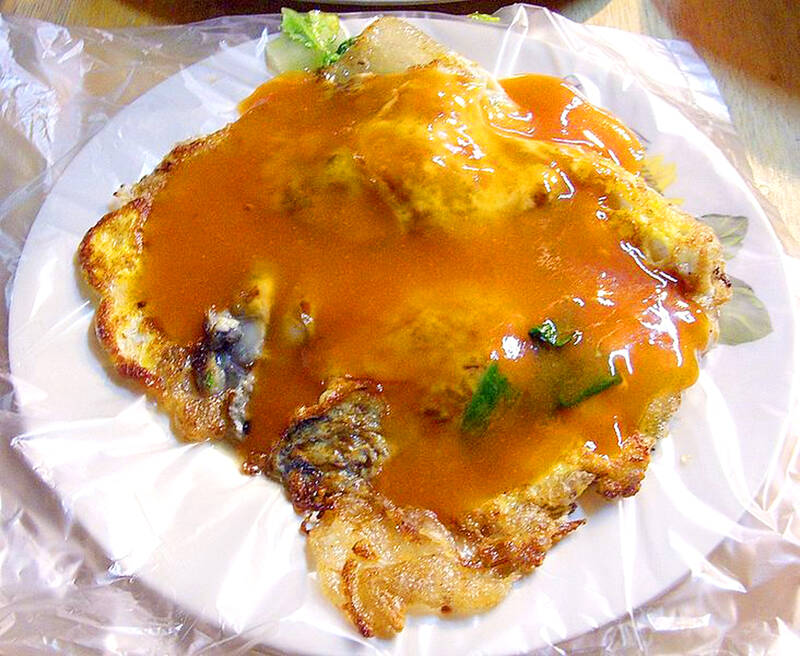
Photo: Wikimedia Commons / 照片:Wikimedia Commons
sticky (adj.) 黏黏的
texture (n.) 口感,質地
ingredient (n.) 食材
An oyster omelet is made by frying oysters, eggs and vegetables, then pouring a sweet potato starch batter over them. In addition to the traditional oyster omelet, those who hesitate to eat oysters can also order an alternative version of the dish that uses shrimp as a substitute. Customers allergic to seafood can also order a version without them.
蚵仔煎食材有蚵仔、蛋、蔬菜,淋上番薯粉漿一起煎,除了傳統的蚵仔煎,不吃蚵仔的人也可以選擇改放蝦仁的蝦仁煎,對海鮮過敏的顧客也可點不含海鮮的品項。
sweet potato starch (n. phr.) 番薯粉
batter (n.) 漿,麵糊
Although the oyster omelet has various origin stories, one of the well-known legends attributes its creation to General Cheng Cheng-kung. Cheng, also known as Koxinga, played an important role in the development of Taiwan. His father, Cheng Chih-lung, was a powerful merchant and pirate who controlled most of the maritime trade of China during the Ming Dynasty. In the 17th century, the Qing Dynasty replaced the Ming Dynasty and established its own rule over China. Cheng Cheng-kung refused to surrender to the Qing rule and cooperated with the remaining Ming loyalists in fighting them. After many battles against the Qing, Cheng’s troops were severely weakened and ran out of supplies. To sustain his troops, Cheng decided to retreat to Taiwan, which at the time was under the colonial rule of the Dutch East India Company.
關於蚵仔煎的由來眾說紛紜,其中最廣為人知的是由鄭成功將軍所發明。鄭成功尊稱為國姓爺,於台灣開拓扮演重要角色。他的父親鄭芝龍是位勢力龐大的商人及海盜,控制中國明朝絕大多數的海上貿易。在17世紀時,清朝取代明朝統治中原,鄭成功拒絕屈服於滿清政權,於是與其他效忠明朝的臣民聯手對抗清朝,歷經多場戰役後,鄭成功的部隊遭受重創,軍需物資短缺,為了維持兵力,他決定帶兵轉往當時由荷蘭東印度公司殖民統治的台灣。
loyalist (n.) 忠誠者
run out of (v. phr.) 用完、耗盡(某物)
supplies (n. 複數) 生活必需品
In 1661, Cheng Cheng-kung’s army landed in Tainan and fought the Dutch. In anticipation of an attack, the Dutch had already hidden much of the available food, leaving Cheng’s army in danger of running out of food. To feed his hungry soldiers, he improvised a dish using the available local ingredients: oysters and sweet potatoes. The oysters were fried in a pan and then covered with sweet potato starch batter. This dish is the prototype of today’s beloved oyster omelet.
1661年,鄭成功率軍登陸台南與荷軍作戰。荷軍早有預料,在戰前就將食物藏了起來,任由鄭成功的軍隊面臨糧食耗盡的危機。為了填飽士兵的肚子,他以當地容易取得的蚵仔和番薯來料理,先在平底鍋上煎蚵,再淋上番薯粉漿,就成了現在大家喜愛的「蚵仔煎」的原型。
anticipation (n.) 預期,期望;預料
prototype (n.) 原型
Today, an oyster omelet has evolved to have more flavors. The omelet is typically served with a sweet and spicy sauce made with ketchup, miso and chili bean sauce, and it can also be garnished with basil or coriander. The choices of vegetables vary regionally. Baby bok choy and crown daisy are often seen in the north, while people in southern Taiwan use mung bean sprouts more. The use of mung bean sprouts may be traced back to the Ming Dynasty, when they were commonly used as a cushion for the porcelain cargo to prevent breakage in merchant ships from the Guangdong and Fujian regions in the Ming Dynasty. Sailors also found on their long voyages that they were a welcome addition to their meals. This is how the sprouts became an indispensable ingredient for oyster omelets.
如今蚵仔煎滋味更豐富,淋上以番茄醬、味噌、辣豆瓣醬製成的甜辣醬汁,並用九層塔、芫荽(香菜)增添風味,各地所使用的蔬菜也不太一樣。北部常用小白菜或茼蒿,台南則會放綠豆芽。這據說是因為明代廣東福建地區的商船常用豆芽菜裹住瓷器防止碰撞破損,還可當作配菜,於是演變成蚵仔煎不可或缺的食材。
miso (n.) 味噌
basil (n.) 九層塔
coriander (n.) 芫荽(香菜)
baby bok choy (n. phr.) 小白菜
crown daisy (n.) 茼蒿
mung bean (n. phr.) 綠豆
porcelain (n.) 瓷器
indispensable (adj.) 不可或缺的
文章由書林出版公司提供:
www.bookman.com.tw
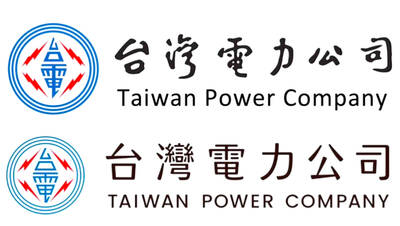
The debate surrounding Taipower’s recent corporate identity reboot has gone well beyond the design community. The controversy began after Taipower replaced the familiar “Taiwan Power Company” wording — widely regarded as the calligraphy of Yu You-ren (1879-1964), former Control Yuan president and master calligrapher — with a modern logotype by designer Aaron Nieh’s team, Aaron Nieh Workshop. Taipower said the change was not a wholesale replacement of old signage, but an “optimization of its identity system,” aimed at meeting the needs of digital media, electronic bills, apps, social media graphics and various small-format applications. Existing physical markings, such as building

Since 2005, the third Monday in January has come to be known as “Blue Monday.” In other words, that day is believed to be the most depressing day of the year. This concept seems logical at first. After all, Monday marks the start of the school or workweek after two days of rest and fun. Also, blue is a color that is often associated with sadness. Furthermore, in many parts of the world, January is a time when the weather is cold, rainy, and gloomy. But is there any scientific proof that this January day is truly sadder than any of

Continued from yesterday(延續自昨日) https://www.taipeitimes.com/News/lang For the most part, the idea of “Blue Monday” has been rejected as a myth. Some mental health experts also say there is a danger in labeling a certain day as the most depressing time of the entire year. Some argue that if people expect to feel sadder on the third Monday in January, this belief alone may increase their anxiety. One group that is worried about the negative effect of believing in Blue Monday is Samaritans. A mental health charity based in the UK, Samaritans is working to turn Blue Monday into “Brew Monday.” In this

A: In early May, there were concerts by Icyball, Chyi Yu, Korea’s EXO and Japan’s Anisama, but I missed them all. What a shame. B: That’s OK. There are shows coming up by various artists, including Power Station, Accusefive, Japanese singer Mika Nakashima, Chinese-Icelandic jazzer Laufey, and even Singaporean diva Stefanie Sun. A: After a 12-year hiatus, Stefanie is finally returning to Taipei again. B: In late May, there will be more shows by Crowd Lu, WeiBird, Korea’s Donghae, 2AM, EXID, and Thailand’s BUS. A: The Thai boyband is so popular. It looks like “T-pop” is catching up with J-pop


 RSS
RSS