


Astronomers believe they may have found the first direct evidence of a new planet being born. A dense disc of dust and gas has been spotted surrounding a young star called AB Aurigae, about 520 light years away from Earth.
Using the European Southern Observatory’s (ESO) Very Large Telescope (VLT), located in Chile, the researchers observed a spiral structure with a “twist” near the center, which suggests a new world may be in the process of forming. The swirling disc was one of the telltale signs of the star system being born in the constellation of Auriga, the scientists said.
Anthony Boccaletti, who led the study from the Observatoire de Paris at the PSL University, in France, said: “Thousands of exoplanets have been identified so far, but little is known about how they form.”
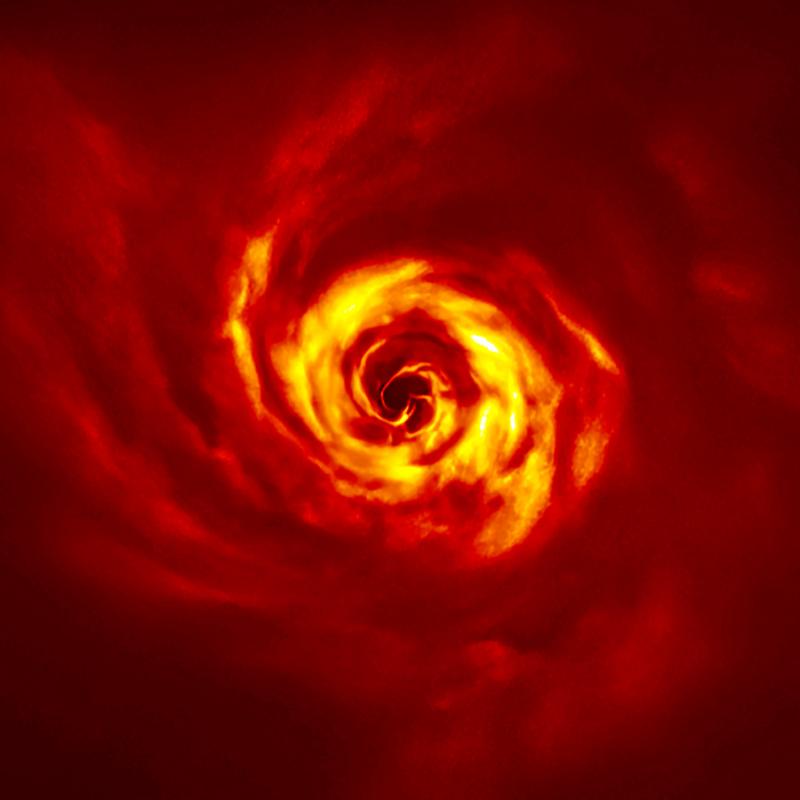
Photo: Reuters照片:路透
Boccaletti and his team of astronomers used VLT’s SPHERE instrument — short for Spectro-Polarimetric High-contrast Exoplanet Research — to take photos of AB Aurigae, which show “a stunning spiral of dust” caused by the baby planet trying to “kick” the gas. The same instrument was used in 2018 to take photos of another infant planet, thought to be just 5.4 million years old.
According to Emmanuel Di Folco, of the Astrophysics Laboratory of Bordeaux in France, and one of the study’s authors, this so-called kicking phenomenon causes “disturbances in the disc in the form of a wave, somewhat like the wake of a boat on a lake.”
As the new planet rotates around AB Aurigae, it causes the surrounding gas and dust to be shaped into a spiral arm. The very bright yellow region near the center of the spiral is the twist, which lies at about the same distance from the star as Neptune from the sun.
The Institute of Astronomy and Astrophysics of Academia Sinica (ASIAA) in Taiwan on Wednesday revealed further detail behind the sequence of events that led to this milestone in astronomy. Back in 2017, researchers led by ASIAA Assistant Research Fellow Tang Ya-wen first spotted prominent spiral structures in a dense disk of dust and gas around the young star. They suggested that the site might be the location of a forming planet. In 2019 and early 2020, Boccaletti led a multi-national research team, in which Tang also participated, to conduct the most thorough and comprehensive observation of AB Aurigae to date, using the SPHERE instrument on the ESO’s VLT.
The observation confirmed the presence of the spiral arms, first detected by Tang in 2017, and spotted a very bright yellow “twist” region close to the center of the disk, which suggested that the light came from the accretion of dust and gas at a lower temperature, which conforms with theoretical models of planetary formation. Astronomers believe that planets are born from this kind of accretion of dust and gas surrounding a young star — AB Aurigae in this case — and that this discovery serves as the first direct evidence of baby planets coming into to existence.
“We need to observe very young ‘star-planet’ systems to really capture the moment when planets form. But until now astronomers had rarely been able to take sharp enough images of these young disks to directly discern regions of planetary formation,” Tang says. The observations are reported in the journal Astronomy & Astrophysics.
(Guardian, with additional reporting by staff writer)
天文學家表示,他們可能首次發現新行星正在誕生的直接證據。在距離地球約五百二十光年的年輕恆星「御夫座AB」周圍,天文學家發現一塊由密集的塵埃和氣體形成的圓盤。
研究人員運用歐洲南天天文台(ESO)位於智利的「甚大望遠鏡」,對一個螺旋形天體結構進行觀測,在接近其中心處發現一個「扭結點」,暗示一顆行星可能正處於誕生過程中。科學家表示,這個旋轉的圓盤可說是恆星系統正在御夫星座內形成的典型徵兆。
這項研究來自於法國巴黎文理研究大學的巴黎天文台,研究主持人安東尼‧博卡萊蒂指出:「迄今,人類已經辨識出成千上萬顆系外行星,但是我們對於它們形成的方式卻所知甚少」。
博卡萊蒂和他的天文學家研究團隊利用「甚大望遠鏡」的「SPHERE」行星搜尋器(全名為「光譜偏振高對比系外行星研究儀」),對御夫座AB進行拍攝,影像呈現出一片「驚人的塵埃漩渦」,這是行星寶寶試圖想要「踢」氣體的結果。該儀器在二○一八年也曾被用來拍攝另一顆嬰兒行星,科學家當時推測該行星年齡僅有五百四十萬年。
這篇研究的作者之一、法國波爾多天體物理學實驗室的艾曼紐爾‧迪‧福可表示,這種「踢氣體」現象導致「圓盤內出現波浪狀的擾動,某種程度上像是湖上船隻攪動湖面激起的漣漪。」
當這顆新行星繞著御夫座AB公轉時,它會使周圍的氣體和塵埃形成「旋臂」。在接近螺旋中心處,有一塊非常明亮的黃色區域,就是「扭結」點,其位置與恆星的距離大約跟海王星到太陽的距離相同。
台灣中研院天文及天文物理研究所也在週三透露這項天文里程碑的過程。二○一七年,中研院天文所湯雅雯助研究員率領的研究團隊,曾在這顆恆星周圍的稠密氣體塵埃盤中,首度窺見到顯著的旋臂特徵,認為那可能就是行星正在形成的位置。去年及今年初,博卡萊蒂率領成員包含湯雅雯在內的跨國團隊,利用ESO的「甚大望遠鏡」對御夫座AB星做了迄今最深入的一次觀測。
觀測結果確認二○一七年湯雅雯觀測到的確實是旋臂特徵,並且在接近圓盤中心處,發現非常明亮的黃色「扭曲」區塊,暗示出溫度較低的氣體和塵埃在此結成團塊,符合行星誕生的理論模型。天文學家推測,行星的誕生來自於圍繞年輕恆星(例如這次的御夫座AB)的塵埃盤中,氣體和塵埃會聚在一起的結果。因此,這項發現可說是新生行星正在誕生中的直接證據。
湯雅雯表示:「要抓住行星誕生的剎那,必須要觀測很年輕的『恆星-行星系統』。如果能取得這類新生星盤的銳利深入影像,就可直接辨別哪裡是行星形成的地方,但目前為止天文學家很少能取得那樣犀利的影像。」這份觀察結果日前發表於期刊《天文與天體物理學報》。
(台北時報章厚明編譯)
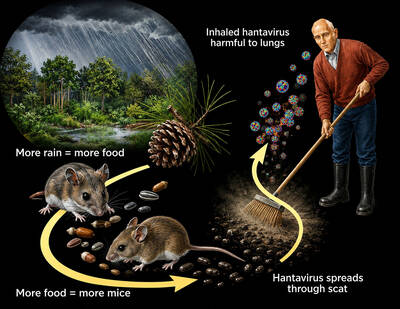
An outbreak aboard a cruise ship of a rare rodent-borne illness called hantavirus has left three passengers dead and sickened others, but global health officials say the risk to the general public remains low because the germ does not easily spread between people. “This is not the next COVID, but it is a serious infectious disease,” said Maria Van Kerkhove, director of epidemic and pandemic preparedness at the World Health Organization (WHO). “Most people will never be exposed to this.” The virus usually spreads when people inhale contaminated residue of rodent droppings. Hantaviruses have been around for centuries and are thought to
A: Apart from the Danjiang Bridge in New Taipei City, the MRT Sanying Line (Light Blue Line) will open in June. B: Is that the new line leading to Yingge District, the ceramic town? A: Yup, the line will connect the Yingge Ceramics Museum and the Old Streets in Sanxia and Yingge Districts. B: The eastward extension of the Tamsui-Xinyi Line (Red Line) that goes through Taipei’s Xinyi District will also open in June. A: Plus, Taoyuan’s Aerotropolis Line (Green Line) will partially open by the end of the year. In the future, it will connect the

1. 他病了三天。 ˇ He has been sick for three days. χ He has been sick since three days. 註︰這裡現在完成時態 have / has been 表示從過去某一時日到現在的一段時間存在的行為或狀態,與它連用的時間副詞應為 「for +若干時」,如 for a year, for three hours 等,意思是歷時多少。 2. 他自從星期三以來都很忙。 ˇ He has been busy since Wednesday. χ He has been busy from Wednesday. 註︰「自從……以來」,該用 since。說從某一天(某一時刻)到某一天(某一時刻)才用 from,如 from Monday till Friday。 3. 房間角落裡散放著一些零星物件。 ˇ There were some odds and ends lying in the corner of the room. χ There were some odds and ends lying at the corner of the room. 註︰「在房間角落裡」該用介詞 in。例如: He stood in the corner. There is a lamp in the corner of the room. at the corner 指房子外部的拐角。例如: A little boy

A growing green movement allows hotel guests to fund tree planting projects simply by opting out of daily room cleans. This approach turns an ordinary hotel stay into a direct contribution to nature. Founded in the Netherlands, the nonprofit “Hotels for Trees” operates on the principle that one skipped cleaning equals one new tree. It has planted more than 750,000 trees since 2021. Similarly, Sarnia Hotels in Guernsey donates £2 per refused clean. Since 2024, over 3,300 services have been cancelled, raising sufficient money to plant 1,100 native trees and hedgerows. Simplicity has been central to this success.


 RSS
RSS