


Hsiao Tsai-kan is the first resident of Hsinchu City to receive a ceremonial “The Soul of the Craftsman” award from the General Association of Chinese Culture. Hsiao, who has 80 years of experience crafting paper lanterns, was presented the award by Hsinchu Mayor Lin Chih-chien at a ceremony held by the association last week. A specially-produced short film featuring Hsiao, entitled “Heartfelt prayers come true,” premiered at the ceremony. The film is the 21st installment in the “The Soul of the Craftsman” series of short films.
The 94-year-old Hsiao is regarded as a national treasure in Taiwan and continues to craft exquisitly-made lanterns. He has received a large number of awards for his work and his lanterns have previously featured in exhibitions overseas. A collection of Hsiao’s lanterns are currently on display at Du Cheng Huang Temple as part of this year’s Lantern Festival.
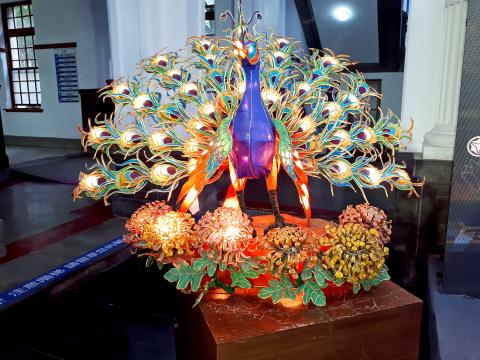
Photo: Hung Mei-hsiu, Liberty Times
照片:自由時報記者洪美秀
In the film, which was produced by the association, Hsiao describes how, as a child, he would watch his elderly relatives make paper lanterns. Once grown up, Hsiao had acquired the skill and was propelled to fame after entering a paper lantern competition. Hsiao went on to win awards for his works year after year.
Hsiao says that in the early years he enjoyed making “three mythical creatures” — dragons, phoenixes and unicorns, but later on started to incorporate social stories into his lantern making. Hsiao says he hopes his lanterns can help bring to life these tales from the past.
Hsiao was born in Hsinchu in 1927. From an early age he enjoyed playing with traditional children’s toys and as a teenager, Hsiao began to learn the skill of making paper lanterns. Hsiao scooped first prize at the Hsinchu Du Cheng Huang Temple Lantern Completion three years on the trot between 1991 and 1993, earning a spot on the temple’s coveted Kinmen Honor Board.
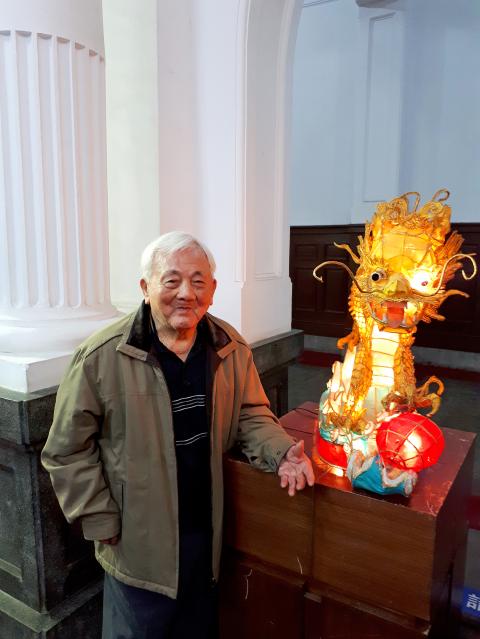
Photo: Hung Mei-hsiu, Liberty Times
照片:自由時報記者洪美秀
Hsiao went on to receive awards at many other paper lantern competitions up and down the country, and was even invited to exhibit his works in Europe, the US and Canada, elevating Hsiao to the status of a “national treasure.”
(Translated by Edward Jones, Taipei Times)
新竹市首位獲中華文化總會頒「匠人魂」錦旗的蕭在淦,擁有八十年的花燈製作經歷,文化總會上週與市長林智堅頒發錦旗,並發表《匠人魂》系列第二十一部花燈篇「祈心成願」影片。
現年九十四歲的國寶級花燈燈藝師蕭在淦,堅持用雙手製作絢麗花燈,作品獲獎無數、更受邀到各國參展,且今年元宵節會在城隍廟展出。
文總製作的「祈心成願」影片,描述蕭在淦兒時看過長輩做花燈,長大後也習得這項技藝,並在競賽中一舉成名,年年得獎的紀錄。
蕭在淦說,早年喜歡糊「人間三奇」龍、鳳凰與麒麟,後來他也喜把社會故事糊成燈,希望透過花燈製作,有如述說歷史故事般。
蕭在淦一九二七年出生在新竹,從小喜歡接觸童玩物件,十幾歲就習得製作花燈的技藝。曾在一九九一到一九九三年連續三年拿下新竹都城隍廟花燈競賽首獎,獲贈都城隍廟之寶「金門保障」複刻版匾額一只。
後來更參加全國性比賽獲獎無數,且受邀到歐美、加拿大參展,成為台灣國寶級的花燈藝師。
(自由時報記者洪美秀)

Many consumers are guilty of filling drawers or closets with old laptops, cellphones, fitness trackers and other electronic devices once they are no longer needed. It’s hard to know where to recycle such items, or it seems costly and inconvenient to do so. The world generates millions of tons of electronic waste — also called e-waste — each year. According to the UN’s most recent estimate, people worldwide produced 62 million metric tons of e-waste in 2022, and only about 22 percent of it was properly recycled. The US’ Environmental Protection Agency estimates that less than a quarter of e-waste is

You’re sitting in class when a classmate asks to borrow a pencil. It seems like a small favor, so you agree without hesitation. The following week, the same classmate asks to share your notes. Later, they request help with a group project. You agree each time — after all, you helped out the first time — but before you know it, it has become automatic. This scenario demonstrates the “foot-in-the-door technique,” a psychological concept that shows how agreeing to small, acceptable demands makes it easier to accept larger ones later on. The name for this strategy comes from door-to-door

A: The four-day Tomb Sweeping Day long weekend begins Friday and will run until Monday. Are you going to sweep your ancestors’ tombs? B: I did in advance last weekend, so I can go to Kaohsiung to see the musical “The Phantom of the Opera.” A: Wow, is “Phantom” touring Taiwan again? It debuted in 1986, so this year marks the 40th anniversary of the show. B: And it’s not just touring Kaohsiung starting March 31, but also Taipei starting April 21 and Taichung starting May 26. A: “Phantom” is one of the world’s Four Major Musicals. I’ve seen all of them, except “Les

Dos & Don’ts — 想想看,這句話英語該怎麼說? 1. 我們很早到達電影院。 ˇ We arrived at the theater very early. χ We arrived the theater very early. 註︰arrive 為不及物動詞,後面如果有受詞要用 at 或 in。例如:They arrived in Taipei yesterday.。一般大地方,如國家、省、大城市等前面用 in,凡小地方城鎮、學校等則用 at。 2. 開車半小時以後,我們到達了海灘。 ˇ After half an hour’s drive, we got to the beach. χ After half an hour’s drive, we got the beach. 註︰come, go, get(來、去、到達)某地時,在表示地點的名詞前面應該用 to,如 go to school, go to Taipei, come to Shanghai 等。如果這些動詞後面所跟的是 here, there, home 等副詞,則不用 to。 3. 明天我會回辦公室。 ˇ I will be back in the office tomorrow. χ I will be back to office tomorrow. 註︰to be back 一語裡的 back 是副詞,不是介詞,所以後面要用 at (the market) 或 in (the office)。 假如假期結束,要回學校上課了則可說: ? Kids will be back


 RSS
RSS