


Scientists have identified Earth’s oldest-known impact crater, and in doing so may have solved a mystery about how our planet emerged from one of its most dire periods.
Researchers have determined that the 70km-wide Yarrabubba crater in Australia formed when an asteroid struck Earth just over 2.2 billion years ago. The collision occurred at a time when the planet was believed to have been encased in ice and the impact may have driven climate warming that led to a global thaw.
“Looking at our planet from space, it would have looked very different,” said isotope geology professor Chris Kirkland of Curtin University in Australia, one of the researchers in the study published in the journal Nature Communications. “You would see a white ball, not our familiar blue marble.”
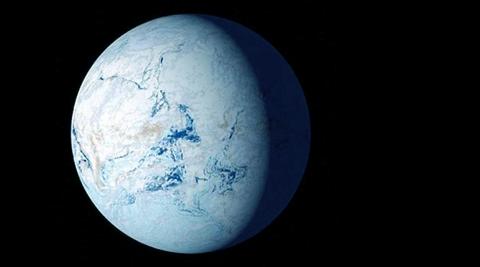
Photo: Reuters
照片:路透
The researchers suspect the region was covered in an ice sheet up to 5km thick at the time. They calculated that the violent asteroid strike may have transformed immense amounts of ice into water vapor — sending perhaps 200 billion tonnes of it billowing into the atmosphere. It would have served as a greenhouse gas trapping heat in the atmosphere.
The researchers are wondering whether this thaw helped shepherd Earth into a climate more favorable for the simple microbes that inhabited the planet at the time to thrive and evolve, possibly making it a pivotal event in the history of life on Earth.
The planet descended into one of its two primordial “snowball Earth” periods 2.4 billion years ago amid a rise in oxygen, which consumed the greenhouse gases — methane and carbon dioxide — that formerly dominated the atmosphere. The asteroid, estimated at 7km wide, landed at Yarrabubba in the state of Western Australia, coinciding with the end of the deep freeze.
“During the time of the Yarrabubba impact, life was more simple but did contain organisms like stromatolites, algal mounds that are still in existence today,” said study lead author Timmons Erickson, a NASA research scientist at the Johnson Space Center’s Astromaterials Research and Exploration Science division. “It is curious to think of an asteroid impact shifting the Earth’s atmosphere to something more clement for life than a ‘snowball’ scenario,” Erickson added.
The researchers determined the crater’s age by examining tiny crystals of the minerals monazite and zircon formed in the asteroid impact. Earth has been hit by space rocks many times since it formed 4.5 billion years ago. For example, an asteroid wiped out the dinosaurs 66 million years ago. But the inexorable movement of Earth’s tectonic plates and surface erosion have erased most of the oldest craters.
Until now, the oldest-known impact crater was one in South Africa with a diameter of more than 200km that formed just over 2 billion years ago. The other “snowball Earth” period lasted from 700 million to 600 million years ago.
(Reuters)
科學家日前鑑定出地球目前已知最古老的隕石撞擊坑,並在研究過程中有望解開一項謎團:那就是,我們的地球當時是如何擺脫一段最為極端的時期。
研究人員近日確定,寬達七十公里的澳洲亞拉布巴隕石坑,是在二十二億年前,因為一顆小行星撞擊地球而形成。這場撞擊發生在科學家認為地球被冰層包覆的時期,而當時的撞擊可能促使氣候暖化,進一步導致全球解凍。
澳洲科廷大學的同位素地質學教授克里斯‧柯克蘭是研究團隊的一員,他表示:「如果當時從太空看地球,我們這顆行星看起來會非常不一樣。」柯克蘭指出:「你會看到一顆雪白的球體,而不是我們熟悉的藍色彈珠。」這份研究日前發表於期刊《自然通訊》。
研究人員懷疑,該地區當時被厚達五公里的冰層所覆蓋。根據科學家計算,那次激烈的小行星撞擊很可能讓數量龐大的冰變成水蒸氣──並且釋放出大約兩千億噸的水蒸氣奔騰進入大氣層中。大量水蒸氣可能在當時發揮溫室氣體的作用,鎖住大氣層中的熱能。
研究人員目前在猜想,這次解凍是否有助於引導地球氣候改變,變得更有利於當時地球棲息的簡單微生物進行繁衍與演化,成為地球上生命歷史的一個關鍵事件。
地球曾經兩度進入原始的「雪球地球」時期,第一次發生在二十四億年前:原本充斥著甲烷和二氧化碳的大氣層中,氧氣逐漸增加,消耗溫室氣體,使得地球進入冰封狀態。這顆估計直徑七公里的小行星,墜落在西澳洲亞拉布巴的時間點剛好發生於地球冰封的尾聲。
該研究的主要作者提蒙斯‧艾瑞克森是美國太空總署的研究科學家,任職於詹森太空中心的天體物質研究和探索科學部門。他指出:「在亞拉布巴撞擊當時,生命形態較為簡單,但是已經出現疊層石、藻丘這類今日仍然存在的有機體。」他補充說:「想像一場小行星撞擊,讓地球大氣層變得對生命較為仁慈,勝過『雪球』情境,這相當引人思索。」
小行星撞擊產生獨居石(磷鈰鑭礦)和鋯石等礦物的微小結晶體,而研究人員藉由檢驗這些結晶體來判定撞擊坑的年代。地球自從在四十五億年前形成後,已經多次遭到來自太空的岩石撞擊。六千六百萬年前毀滅恐龍的小行星就是一個例子。只是,地球勢不可擋的地殼板塊移動和表面侵蝕幾乎抹去了絕大多數的古老撞擊坑。
在此之前,科學家所知最古老的小行星撞擊坑位於南非,直徑超過兩百公里,大約形成於二十億年前。另一次「雪球地球」時期則是介於七億年前到六億年前之間。
(台北時報章厚明編譯)

Many consumers are guilty of filling drawers or closets with old laptops, cellphones, fitness trackers and other electronic devices once they are no longer needed. It’s hard to know where to recycle such items, or it seems costly and inconvenient to do so. The world generates millions of tons of electronic waste — also called e-waste — each year. According to the UN’s most recent estimate, people worldwide produced 62 million metric tons of e-waste in 2022, and only about 22 percent of it was properly recycled. The US’ Environmental Protection Agency estimates that less than a quarter of e-waste is

You’re sitting in class when a classmate asks to borrow a pencil. It seems like a small favor, so you agree without hesitation. The following week, the same classmate asks to share your notes. Later, they request help with a group project. You agree each time — after all, you helped out the first time — but before you know it, it has become automatic. This scenario demonstrates the “foot-in-the-door technique,” a psychological concept that shows how agreeing to small, acceptable demands makes it easier to accept larger ones later on. The name for this strategy comes from door-to-door

A: The four-day Tomb Sweeping Day long weekend begins Friday and will run until Monday. Are you going to sweep your ancestors’ tombs? B: I did in advance last weekend, so I can go to Kaohsiung to see the musical “The Phantom of the Opera.” A: Wow, is “Phantom” touring Taiwan again? It debuted in 1986, so this year marks the 40th anniversary of the show. B: And it’s not just touring Kaohsiung starting March 31, but also Taipei starting April 21 and Taichung starting May 26. A: “Phantom” is one of the world’s Four Major Musicals. I’ve seen all of them, except “Les

Continued from yesterday(延續自昨日) https://www.taipeitimes.com/News/lang Gig Tripping “Gig tripping” combines concerts with travel. People fly to see their favorite artists perform — usually abroad—and spend a few days sightseeing before or after the show. While die-hard fans have done this since the 1960s, the post-pandemic travel boom changed the game. Even people who aren’t superfans are now booking international concert trips because they want to make the most of travel opportunities. This trend exploded in the US, as the math makes sense. Domestic concert tickets are so costly that flying abroad for the show plus tourism expenses often matches or even beats the price


 RSS
RSS