


From love songs to dance tunes to lullabies, music made in disparate cultures worldwide displays certain universal patterns, according to a study by researchers who suggest a commonality in the way human minds create music.
The study, published on Nov. 21, focused on musical recordings and ethnographic records from 60 societies around the world including such diverse cultures as the Highland Scots in Scotland, Nyangatom nomads in Ethiopia, Mentawai rain forest dwellers in Indonesia, the Saramaka descendants of African slaves in Suriname and Aranda hunter-gatherers in Australia.
Music was broadly found to be associated with behaviors including infant care, dance, love, healing, weddings, funerals, warfare, processions and religious rituals. The researchers detected strong similarities in musical features across the various cultures, according to Samuel Mehr, a Harvard University research associate in psychology and the lead author of the study published in the journal Science. “The study gives credence to the idea that there is some sort of set of governing rules for how human minds produce music worldwide. And that’s something we could not really test until we had a lot of data about music from many different cultures,” Mehr said.
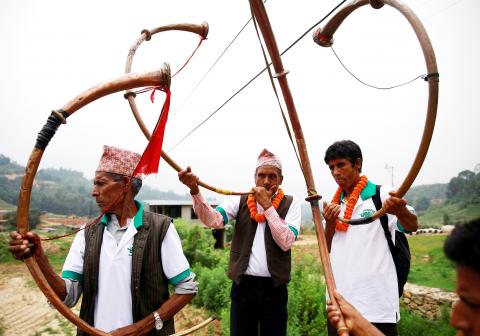
Photo: Reuters
照片:路透
Penn State University anthropology professor Luke Glowacki, a study co-author, said many ethnomusicologists have believed that the features in a given piece of music are most heavily influenced by the culture from which the music originates. “We found something very different,” Glowacki said. “Instead of music being primarily shaped by the culture it is from, the social function of the piece of music influences its features much more strongly.”
“Dance songs sound a certain way around the world because they have a specific function. Lullabies around the world sound a certain way because they have a specific function. If music were entirely shaped by culture and not human psychology you wouldn’t expect these deep similarities to emerge in extremely diverse cultures,” Glowacki added.
Manvir Singh, a graduate student in Harvard’s department of human evolutionary biology and another study co-author, noted that lullabies tended to be slow and fluid across societies while dance songs tended to be fast, lively, rhythmic and pulsating.
The researchers examined hundreds of recordings from libraries and private collections globally. “The fact that a lullaby, healing song or dance song from the British Isles or anywhere else in the world has many musical features in common with the same kind of song from hunter-gatherers in Australia or horticulturalists in Africa is remarkable,” Glowacki said.
(Reuters)
研究發現,從情歌到舞曲,乃至於搖籃曲,從世界各地迥然相異的文化中誕生的音樂,呈現出某些特定的普遍型態。研究人員推測,人類心智創造音樂的方式可能有某種共通性。
十一月二十一日發表的這份研究,聚焦於來自世界上六十個不同社會的音樂錄音以及民族誌紀錄,涵蓋殊異的文化,包括蘇格蘭的高地蘇格蘭族群、衣索比亞的年加頓游牧民族、印尼明塔威群島上的雨林居民、蘇利南國內非洲黑奴後代的薩拉馬卡人,以狩獵採集為生的澳洲阿蘭達人等。
音樂被廣泛認為和人類行為相關,包括照顧嬰兒、跳舞、示愛、療癒、婚禮、喪禮、戰爭、列隊行進,以及宗教儀式。根據哈佛大學的心理學研究員山繆‧梅爾表示,研究人員查覺到音樂特徵中具有強烈的相似性,跨越不同文化的藩籬。該研究發表於期刊《科學》,梅爾為主要作者。他指出:「這份研究為一項論點提供了可信度,那就是某種像規則的一套東西,主導著世界各地人類心智創造音樂的方式。不過,直到我們從許多不同文化獲得大量跟音樂有關的資料之前,我們仍然無法真正驗證這個論點。」
賓州州立大學的人類學教授路克‧格洛瓦斯基是該研究的共同作者之一。他表示,許多民族音樂學家相信,特定一首音樂裡的特徵,受到該音樂起源地文化的影響最為重大。格洛瓦斯基說:「我們發現非常不同的結果。」他指出:「與其認為音樂主要受到它來自的文化所形塑,那首音樂的社會功能影響其特徵的程度更大。」
格洛瓦斯基補充說:「世界各地的舞曲聽起來有某種規律,是因為它們具備特定的功能。世界各地的搖籃曲聽起來有某種規律,也是因為它們具備特定的功能。如果音樂是完全受到文化形塑,而非人類心理,你就不會料想得到,這些深刻的相似性會浮現於極端多元的不同文化中。」
哈佛大學的人類演化生物學系研究生曼維爾‧辛格是該研究的另一位共同作者。他提到搖籃曲在不同社會中通常都有速度慢、帶有流動感的傾向,而舞曲則經常是快速、活潑、有節奏感,且讓人悸動的。
研究人員檢驗了來自全球圖書館和私人收藏的上百份錄音。格洛瓦斯基表示:「一首來自不列顛群島,或是世界任何其他角落的搖籃曲、療癒歌曲,或是舞曲,跟澳洲的狩獵採集者或是非洲混作農業的原住民創作的同類型音樂,會有這麼多相同的音樂特徵,這是相當值得注目的。」
(台北時報章厚明譯)

A: Several Japanese and South Korean acts, such as BigBang, are participating in this year’s Coachella Music Festival. Have any Mando-pop singers ever performed at Coachella? B: Yup, K-pop group GOT7’s Hong Kong member Jackson Wang, and Taiwanese band Sunset Rollercoaster, which primarily performs in English, attended the festival before. A: It’s a pity that we didn’t fly to Coachella. But in fact, Taipei has also gradually become an Asian music hub in recent years. B: That’s true. K-pop sensation Twice just held three concerts at the Taipei Dome, followed by Hong Kong singer G.E.M., who is going

Concertgoers know the rush all too well — the moment the first notes play, your heart races, and nothing else seems to matter. For many, the excitement doesn’t end when the lights come back on. Some fans try to relive the performance by listening to the same songs for days afterward. __1__ A few days after an amazing show, they begin to feel unexpectedly low. Psychologists have coined a term for this phenomenon: “post-concert depression,” or “PCD.” PCD is primarily related to hormone levels. When you’re at a concert, the excitement causes your brain to release feel-good chemicals like
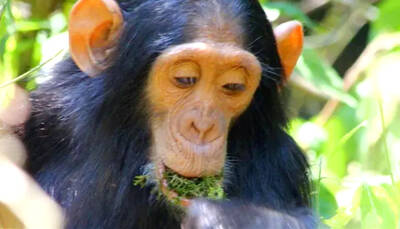
A new study suggests that chimpanzees can weigh evidence and make rational judgments. In the experiment, researchers placed two boxes in front of the chimpanzees. One box was set up to give strong evidence, such as letting the chimpanzees actually see food inside. The other was designed to provide weak evidence, like producing a rattling sound when it was shaken. The chimps consistently chose the box with strong evidence, even when the weaker clue appeared first. This indicated that they were not fooled by the order of presentation. In another trial where no strong evidence was available, the chimps

1. 明天她將談法國環境保護的情形。 ˇ Tomorrow she will speak on environmental protection in France. χ Tomorrow she will speak environmental protection in France. 註︰speak 作「談論」解時,是不及物動詞,按照不同的意義,後面接 on, of 或 about。一般說 to speak on a subject ( / a point); to speak of / about a person or thing; to speak to / with a person。 在下列句中,speak 當及物動詞用: His father can speak English, French and German. He is speaking the truth.(他說的是真話。) 2. 我們不應瞧不起經濟弱勢者。 ˇ We should not look down on/upon those who are financially weak. χ We should not look down those who are financially weak. 註︰look down on 是慣用語,用 on 或 upon 均可,但決不可省去。 3. 請不要打擾我工作。 ˇ Don’t interfere with my work. χ Don’t


 RSS
RSS