


Scientists on Monday unveiled the first global geological map of Saturn’s moon Titan including vast plains and dunes of frozen organic material and lakes of liquid methane, illuminating an exotic world considered a strong candidate in the search for life beyond Earth.
The map was based on radar, infrared and other data collected by NASA’s Cassini spacecraft, which studied Saturn and its moons from 2004 to 2017. Titan, with a diameter of 5,150km, is the solar system’s second-biggest moon behind Jupiter’s Ganymede. It is larger than the planet Mercury.
Organic materials — carbon-based compounds critical for fostering living organisms — play a leading role on Titan. “Organics are very important for the possibility of life on Titan, which many of us think likely would have evolved in the liquid water ocean under Titan’s icy crust,” said planetary geologist Rosaly Lopes of NASA’s Jet Propulsion Laboratory in California. “Organic materials can, we think, penetrate down to the liquid water ocean and this can provide nutrients necessary for life, if it evolved there,” added Lopes, who led the research published in the journal Nature Astronomy.
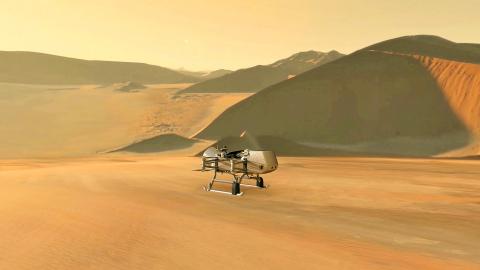
Photo: Reuters
照片:路透
On Earth, water rains down from clouds and fills rivers, lakes and oceans. On Titan, clouds spew hydrocarbons like methane and ethane — which are gases on Earth — in liquid form due to the moon’s frigid climate. Rainfall occurs everywhere on Titan, but the equatorial regions are drier than the poles, said study co-author Anezina Solomonidou, a European Space Agency research fellow.
Plains (covering 65 percent of the surface) and dunes (covering 17 percent of the surface) made up of frozen bits of methane and other hydrocarbons dominate Titan’s mid-latitudes and equatorial regions, respectively.
Titan is the only solar system object other than Earth boasting stable liquids on the surface, with lakes and seas full of methane being major features at its polar regions. Hilly and mountainous areas, thought to represent exposed portions of Titan’s crust of water ice, represent 14 percent of the surface.
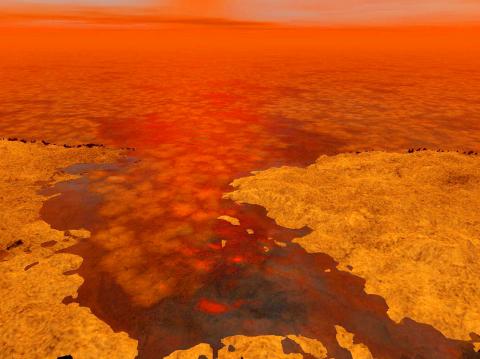
Photo: Reuters
照片:路透
“What is really fun to think about is if there are any ways that those more complex organics can go down and mix with water in the deep icy crust or deep subsurface ocean,” JPL scientist and study co-author Michael Malaska said. Noting that on Earth there is a bacterium that can survive just on a hydrocarbon called acetylene and water, Malaska asked, “Could it or something like it live in Titan deep in the crust or ocean where temperatures are a little warmer?”
The map was created seven years before the US space agency is set to launch its Dragonfly mission to dispatch a multi-rotor drone to study Titan’s chemistry and suitability for life. Dragonfly is scheduled to reach Titan in 2034. “It is not only scientifically important but also really cool — a drone flying around on Titan,” Lopes said. “It will be really exciting.”
(Reuters)
科學家在週一公布史上第一張土星衛星「泰坦」的全球地質圖,其中包含許多廣闊的平原,冰凍有機物質構成的沙丘,以及液態甲烷形成的湖泊,揭露這片咸認為是地球以外生命搜尋重要候選地點的奇特世界。
該地質圖是根據美國國家航空暨太空總署的卡西尼太空探測船,在二○○四年到二○一七年間研究土星及其衛星時,收集到的雷達、紅外線等資料。直徑達五千一百五十公里的泰坦星,是我們太陽系第二大的衛星,僅次於木星的衛星蓋尼米德。泰坦甚至比水星還大。
有機物質──也就是對於培養生物體而言非常關鍵的碳基化合物──在泰坦星上扮演重要角色。美國太空總署加州噴射推進實驗室的行星地質學家羅莎莉‧洛佩茲指出:「有機物對於泰坦形成生命的可能性至關重要,我們有許多人認為,生命可能在泰坦結冰地殼底下的液態海洋中進行演化。」這篇研究發表於《自然‧天文》期刊,主持該研究的洛佩茲補充說:「我們認為,有機物質會向下滲透到液態海洋,如果其中有生命演化,就能為生命提供必要營養物。」
在地球上,水從雲層降下,注入河流、湖泊和海洋。在泰坦星上,雲層則會噴出液態的甲烷或乙烷等碳氫化合物。這類碳氫化合物在地球上以氣態存在,但在泰坦星上卻因為嚴寒氣候而呈現液態。這份研究的共同作者是歐洲太空總署的研究員安聶琦娜‧所羅門妮朵,她表示泰坦星上各處都有降雨,不過赤道地區比起兩極較為乾燥。
由結冰的甲烷和其他碳氫化合物形成的碎屑組成的平原(佔其地表百分之六十五)與沙丘(佔其表面百分之十七),分別分布於泰坦星的中緯度和赤道地區。
除了地球以外,泰坦星是太陽系中唯一表面擁有穩定液體的星球,充滿甲烷的湖泊和海洋是兩極地區的主要特徵。丘陵和高山區域則被認為是泰坦地殼部分裸露出來的冰塊,佔其表面百分之十四。
噴射推進實驗室的科學家麥可‧馬拉斯加是這篇研究的另一位共同作者,他指出:「真正有趣的是,我們可以想像那些更複雜的有機物,有什麼方法能夠滲入冰凍的地殼深處、或是沉入地殼下的深層海洋,和水混合。馬拉斯加提到,地球上有一種細菌只靠乙炔這種碳氫化合物跟水就可以生存,於是他問:「這種細菌,或是類似的有機物,會不會也存在於泰坦地殼深處或是底下溫度較暖的海洋中呢?」
這張地圖的誕生將為美國太空總署即將於七年後啟動的「蜻蜓號」任務做好準備。該任務將派遣一架多旋翼無人機,前往泰坦星探索其化學性質和適合生命存在的可能性。「蜻蜓號」預計於二○三四年抵達泰坦星。洛佩茲表示:「這項任務不只具有重要的科學意義,同時也很酷──派一架無人機在泰坦星上四處盤旋,這將會非常讓人興奮。」
(台北時報章厚明譯)
Many consumers are guilty of filling drawers or closets with old laptops, cellphones, fitness trackers and other electronic devices once they are no longer needed. It’s hard to know where to recycle such items, or it seems costly and inconvenient to do so. The world generates millions of tons of electronic waste — also called e-waste — each year. According to the UN’s most recent estimate, people worldwide produced 62 million metric tons of e-waste in 2022, and only about 22 percent of it was properly recycled. The US’ Environmental Protection Agency estimates that less than a quarter of e-waste is

You’re sitting in class when a classmate asks to borrow a pencil. It seems like a small favor, so you agree without hesitation. The following week, the same classmate asks to share your notes. Later, they request help with a group project. You agree each time — after all, you helped out the first time — but before you know it, it has become automatic. This scenario demonstrates the “foot-in-the-door technique,” a psychological concept that shows how agreeing to small, acceptable demands makes it easier to accept larger ones later on. The name for this strategy comes from door-to-door

A: The four-day Tomb Sweeping Day long weekend begins Friday and will run until Monday. Are you going to sweep your ancestors’ tombs? B: I did in advance last weekend, so I can go to Kaohsiung to see the musical “The Phantom of the Opera.” A: Wow, is “Phantom” touring Taiwan again? It debuted in 1986, so this year marks the 40th anniversary of the show. B: And it’s not just touring Kaohsiung starting March 31, but also Taipei starting April 21 and Taichung starting May 26. A: “Phantom” is one of the world’s Four Major Musicals. I’ve seen all of them, except “Les

Dos & Don’ts — 想想看,這句話英語該怎麼說? 1. 我們很早到達電影院。 ˇ We arrived at the theater very early. χ We arrived the theater very early. 註︰arrive 為不及物動詞,後面如果有受詞要用 at 或 in。例如:They arrived in Taipei yesterday.。一般大地方,如國家、省、大城市等前面用 in,凡小地方城鎮、學校等則用 at。 2. 開車半小時以後,我們到達了海灘。 ˇ After half an hour’s drive, we got to the beach. χ After half an hour’s drive, we got the beach. 註︰come, go, get(來、去、到達)某地時,在表示地點的名詞前面應該用 to,如 go to school, go to Taipei, come to Shanghai 等。如果這些動詞後面所跟的是 here, there, home 等副詞,則不用 to。 3. 明天我會回辦公室。 ˇ I will be back in the office tomorrow. χ I will be back to office tomorrow. 註︰to be back 一語裡的 back 是副詞,不是介詞,所以後面要用 at (the market) 或 in (the office)。 假如假期結束,要回學校上課了則可說: ? Kids will be back


 RSS
RSS