


US Governor Gavin Newsom on July 3 signed into law a bill making California the first US state to ban workplace and school discrimination against black people for wearing hairstyles such as braids, twists and locks. The law, initiated by Democratic Senator Holly Mitchell of Los Angeles, a black woman who wears her hair in locks, makes California the first state to explicitly say that those hairstyles are associated with race and therefore protected against discrimination in the workplace and in schools.
“We are changing the course of history, hopefully, across this country by acknowledging that what has been defined as professional hair styles and attire in the work place has historically been based on a Euro-centric model based on straight hair,” Mitchell said.
Stephanie Hunter-Ray, who works at a makeup counter, says she typically wears her hair braided or in an afro, but one day she showed up to work with it straightened and styled in a bob. Her manager told Hunter-Ray her hair had never looked so normal.
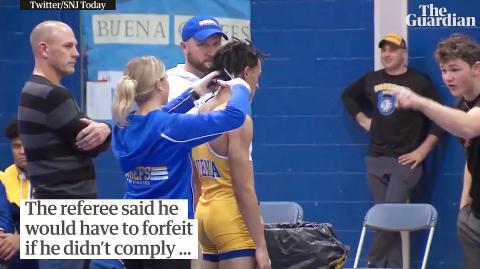
Photo: Screen grab from YouTube
照片:擷圖自YouTube
“It bothered me,” Hunter-Ray said in an interview at the hair salon she owns in Sacramento that specializes in natural hair styles. “What do you mean by ‘normal?’ Your normal is not my normal. My normal is my ‘fro or my braids.” Alikah Hatchett-Fall, who runs Sacred Crowns Salon in Sacramento, said she’s had black men come into her salon asking to have their hair cut off because they can’t find jobs.
The law, she said, “means that psychologically and mentally people can be at ease and be able to get the jobs they want, keep the jobs they want, and get promoted at the jobs they want.” California’s new law, which takes effect on Jan. 1 next year, is significant because federal courts have historically held that hair is a characteristic that can be changed, meaning there’s no basis for discrimination complaints based on hairstyle. The US Supreme Court recently declined to hear the case of an Alabama woman who said she didn’t get a job because she refused to change her hair. The issue burst into public view last December, when a black high school wrestler in New Jersey was told by a referee that he had to cut off his dreadlocks if he wanted to compete. California’s Democratic governor said the video was a clear example of the discrimination black Americans face.
Mitchell’s bill adds language to the state’s discrimination laws to say that “race” also includes “traits historically associated with race,” including hair texture and protective hairstyles. It further defines protective hairstyles as braids, twists and locks.
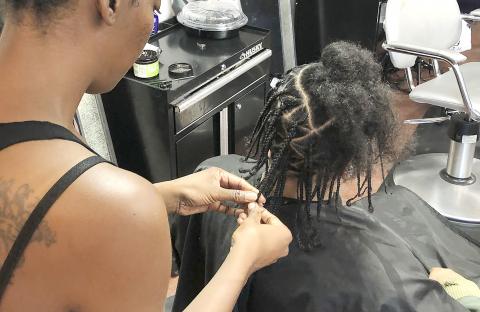
Photo: AP
照片:美聯社
(AP)
美國加州州長葛文‧紐森上週三簽署了一項法案,禁止在工作場所及學校因黑人留辮子頭、編髮和雷鬼頭等髮型而對其加以歧視,使加州成為有相關法令的第一州。該法案是由洛杉磯民主黨參議員荷莉‧米契爾所提出──米契爾本身即為留著髮辮的黑人女性。這項法案的通過,使加州成為第一個明確將這些髮型與種族聯繫起來的州,因此可以保護黑人在工作場所和學校免於受到歧視。
「透過定義何為專業、符合工作禮儀的髮型及服裝,我們希望這是在改變整個國家歐洲中心主義、以直髮為模範的歷史進程」,米契爾說。
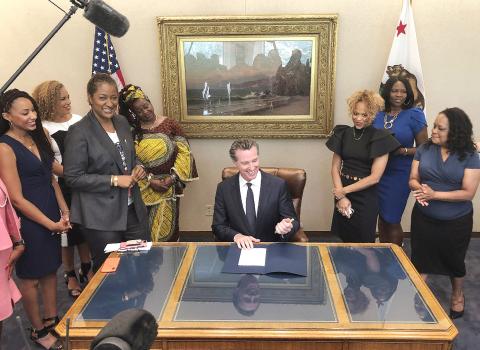
Photo: AP
照片:美聯社
在美容專櫃工作的史蒂芬妮‧亨特雷說,她的髮型通常是辮子頭或爆炸頭,但有天上班,她的頭髮是燙直的,並梳成鮑伯頭。上司跟她說,她的頭髮從來沒看起來這麼正常過。
「這讓我感到很困擾」,亨特雷在她位於加州首府沙加緬度的髮廊受採訪時說道,該髮廊是做自然髮型的專門店。「你說的『正常』是什麼意思?你的正常不是我的正常。我的正常髮型是爆炸頭或髮辮」。在沙加緬度經營聖冠髮廊的艾利卡‧海切佛說,有黑人男子到她的髮廊說要把頭髮剪掉,因為不然的話會找不到工作。
她說,這項法律「意味人們在心理和精神上能夠釋懷,可以得到想要的工作、保住想要的工作、晉升到想要的工作」。加州明年一月一日起生效的這項新法意義重大,因為聯邦法院歷來皆認為頭髮是可改變的特徵,這就表示若投訴因髮型而受歧視,會沒有根據。美國最高法院最近便拒絕審理一個案件──阿拉巴馬州一名婦女投訴,說她因為不願改變頭髮而找不到工作。此議題在去年十二月由於一事件而突然變得眾所矚目──紐澤西州有位高中角力比賽裁判告訴一名黑人選手說,若他要參賽,就必須剪掉他的雷鬼頭編髮。民主黨籍的加州州長表示,這段影片是美國黑人所面臨歧視的明顯例子。
米契爾的法案為加州的反歧視法增加了語彙,將「種族」的定義含括了「傳統上與種族相關的特徵」,包括髮質和具保護功能的髮型。該法還進一步定義了具保護功能的髮型,即辮子頭、編髮和雷鬼頭。
(台北時報林俐凱編譯)

Many consumers are guilty of filling drawers or closets with old laptops, cellphones, fitness trackers and other electronic devices once they are no longer needed. It’s hard to know where to recycle such items, or it seems costly and inconvenient to do so. The world generates millions of tons of electronic waste — also called e-waste — each year. According to the UN’s most recent estimate, people worldwide produced 62 million metric tons of e-waste in 2022, and only about 22 percent of it was properly recycled. The US’ Environmental Protection Agency estimates that less than a quarter of e-waste is

You’re sitting in class when a classmate asks to borrow a pencil. It seems like a small favor, so you agree without hesitation. The following week, the same classmate asks to share your notes. Later, they request help with a group project. You agree each time — after all, you helped out the first time — but before you know it, it has become automatic. This scenario demonstrates the “foot-in-the-door technique,” a psychological concept that shows how agreeing to small, acceptable demands makes it easier to accept larger ones later on. The name for this strategy comes from door-to-door

A: The four-day Tomb Sweeping Day long weekend begins Friday and will run until Monday. Are you going to sweep your ancestors’ tombs? B: I did in advance last weekend, so I can go to Kaohsiung to see the musical “The Phantom of the Opera.” A: Wow, is “Phantom” touring Taiwan again? It debuted in 1986, so this year marks the 40th anniversary of the show. B: And it’s not just touring Kaohsiung starting March 31, but also Taipei starting April 21 and Taichung starting May 26. A: “Phantom” is one of the world’s Four Major Musicals. I’ve seen all of them, except “Les

Continued from yesterday(延續自昨日) https://www.taipeitimes.com/News/lang Gig Tripping “Gig tripping” combines concerts with travel. People fly to see their favorite artists perform — usually abroad—and spend a few days sightseeing before or after the show. While die-hard fans have done this since the 1960s, the post-pandemic travel boom changed the game. Even people who aren’t superfans are now booking international concert trips because they want to make the most of travel opportunities. This trend exploded in the US, as the math makes sense. Domestic concert tickets are so costly that flying abroad for the show plus tourism expenses often matches or even beats the price


 RSS
RSS