


A rare total solar eclipse plunged a vast swath of Latin America’s southern cone into darkness Tuesday, briefly turning day into night and enthralling huge crowds in much of Chile and Argentina. Hundreds of thousands of people flocked to Chile’s northern Coquimbo region near the Atacama desert — festooned with some of the planet’s most powerful telescopes — which was situated directly on the eclipse’s 150km-wide “path of totality.”
Large crowds congregated in the town of La Higuera near the landmark La Silla Observatory, some 2,400m above sea level and operated by the European Southern Observatory. The La Silla observatory and its fleet of powerful telescopes live streamed the event and opened the site to the public, hosting school tours along with talks and workshops. The eclipse had its longest duration as it made to La Silla: 2.36 minutes.
Solar eclipses happen when the Sun, the Moon and Earth line up, allowing the Moon to cast its shadow on Earth. The area where the observatory is located, with its dry weather, crystal-clear air and low light pollution, is a stargazers’ paradise. La Silla was one of the first international observatories installed in northern Chile. Today the region has almost half the world’s astronomical observation capacity.
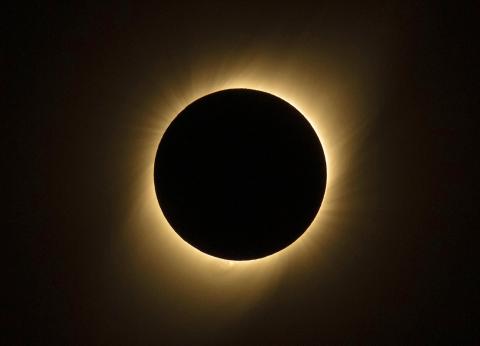
Photo: AFP
照片:法新社
To the west, in the coastal town of La Serena, thousands of people on the beach cheered and clapped at the moment when the Moon closed over the Sun and blocked it out completely. Many remained silent, enchanted and moved by one of nature’s spectacles.
Total solar eclipses are rare, but what is even rarer about Tuesday’s event is that it occurred directly over an area of the Earth most prepared to study the heavenly bodies. “Very seldom has it happened that the whole of an eclipse is seen over an observatory, the last time this happened was in 1991 at the Mauna Kea observatory in Hawaii, said Matias Jones, an astronomer at La Silla.
Both Chile and Argentina were situated under the narrow, 9,600km band of Earth that experienced the eclipse. The eclipse began at 1:01pm local time in the Pacific Ocean, and a 150km-wide band of total darkness reached Chile’s coast at 4:38pm, before crossing into southeastern Argentina and into the wastes of the South Atlantic.
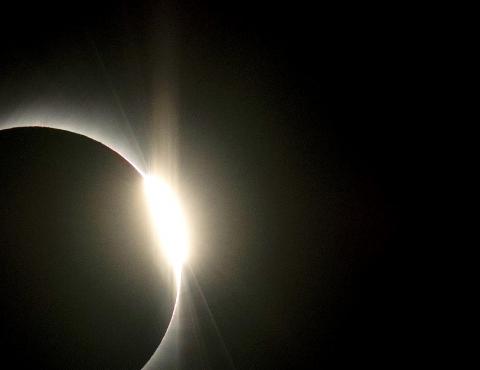
Photo: AFP
照片:法新社
Scientists and astronomers will use data collected from studying the eclipse to verify theories and carry out experiments. “Eclipses are a chance to study the outer part of the atmosphere, which is the corona, since the moon is covering the entire central part of the Sun,” said Jones. The next total eclipse will be visible in southern Chile on Dec. 14 next year.
(AFP)
罕見的日全食奇景週二降臨在拉丁美洲南部,使得南回歸線以南地區的大片土地頓時陷入黑暗,短暫地把白天變成黑夜,在智利和阿根廷的大部份地區吸引大批群眾觀賞。數十萬名民眾紛紛湧入智利科金博區北部,接近阿塔卡瑪沙漠附近──此處點綴著地球上威力最強的幾座天文望遠鏡──該地區直接坐落在這次日食一百六十公里寬的「日全食帶」。
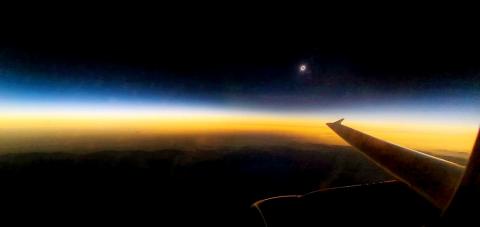
Photo: AFP
照片:法新社
大群民眾聚集在拉伊格拉城,附近就是著名地標「拉西拉天文台」。天文台位於海拔兩千四百多公尺的高處,由歐洲南方天文台營運。「拉西拉天文台」和其威力強大的望遠鏡群全程線上直播這場天文奇景,也開放場地供大眾參觀、接待學校參訪,並舉辦多場演講和研討會。這次日食長度也創下拉西拉觀測到的最長紀錄:兩分三十六秒。
當太陽、月球,和地球排成一直線的時候,會使月球的陰影投射到地球上,就會發生日食。「拉西拉天文台」位處的地區天氣乾燥、空氣澄淨、光害又低,遂成為觀星者的天堂。該天文台是最早建造於智利北方的國際性天文台之一。時至今日,這塊區域已擁有全世界將近一半的天文觀測能量。
再往西邊走,數千位民眾聚集在濱海城市拉塞雷納的沙灘上。當月球覆蓋太陽、將其完全遮住的那一刻,民眾紛紛爆出歡呼和鼓掌。許多人安靜無語,深深沉醉於大自然的這場奇觀,內心大受撼動。
日全食相當少見,但週二這場日全食更少見的地方在於,它直接發生在地球上對天體研究準備最為完善的地區。「拉西拉天文台」的天文學家馬蒂亞斯‧瓊斯表示:「一整段日全食的過程都可以在一座天文台上觀測到,這種情況極少發生。上一次這種情況發生要追溯到一九九一年,在夏威夷的毛納基山天文台。」
智利跟阿根廷同樣位處於這段長達九千六百公里、能夠體驗這次日食的狹長地帶上。日食在當地時間下午一點零一分開始,位於太平洋上,一百五十公里寬、完全黑暗的日全食帶在下午四點三十八分抵達智利的海灘,最後跨過阿根廷東南部,落入南大西洋的荒涼海域。
科學家和天文學家將會利用這次研究日全食所收集到的資料來驗證多項理論,並且進行實驗。瓊斯表示:「日食是研究太陽的大氣層外圈──也就是日冕──的絕佳機會,因為這時月球遮住整個太陽的中心部分。」下一次日全食預計會在明年十二月十四日,於智利南方觀測到。
(台北時報章厚明翻譯)

Many consumers are guilty of filling drawers or closets with old laptops, cellphones, fitness trackers and other electronic devices once they are no longer needed. It’s hard to know where to recycle such items, or it seems costly and inconvenient to do so. The world generates millions of tons of electronic waste — also called e-waste — each year. According to the UN’s most recent estimate, people worldwide produced 62 million metric tons of e-waste in 2022, and only about 22 percent of it was properly recycled. The US’ Environmental Protection Agency estimates that less than a quarter of e-waste is

You’re sitting in class when a classmate asks to borrow a pencil. It seems like a small favor, so you agree without hesitation. The following week, the same classmate asks to share your notes. Later, they request help with a group project. You agree each time — after all, you helped out the first time — but before you know it, it has become automatic. This scenario demonstrates the “foot-in-the-door technique,” a psychological concept that shows how agreeing to small, acceptable demands makes it easier to accept larger ones later on. The name for this strategy comes from door-to-door

A: The four-day Tomb Sweeping Day long weekend begins Friday and will run until Monday. Are you going to sweep your ancestors’ tombs? B: I did in advance last weekend, so I can go to Kaohsiung to see the musical “The Phantom of the Opera.” A: Wow, is “Phantom” touring Taiwan again? It debuted in 1986, so this year marks the 40th anniversary of the show. B: And it’s not just touring Kaohsiung starting March 31, but also Taipei starting April 21 and Taichung starting May 26. A: “Phantom” is one of the world’s Four Major Musicals. I’ve seen all of them, except “Les

Dos & Don’ts — 想想看,這句話英語該怎麼說? 1. 我們很早到達電影院。 ˇ We arrived at the theater very early. χ We arrived the theater very early. 註︰arrive 為不及物動詞,後面如果有受詞要用 at 或 in。例如:They arrived in Taipei yesterday.。一般大地方,如國家、省、大城市等前面用 in,凡小地方城鎮、學校等則用 at。 2. 開車半小時以後,我們到達了海灘。 ˇ After half an hour’s drive, we got to the beach. χ After half an hour’s drive, we got the beach. 註︰come, go, get(來、去、到達)某地時,在表示地點的名詞前面應該用 to,如 go to school, go to Taipei, come to Shanghai 等。如果這些動詞後面所跟的是 here, there, home 等副詞,則不用 to。 3. 明天我會回辦公室。 ˇ I will be back in the office tomorrow. χ I will be back to office tomorrow. 註︰to be back 一語裡的 back 是副詞,不是介詞,所以後面要用 at (the market) 或 in (the office)。 假如假期結束,要回學校上課了則可說: ? Kids will be back


 RSS
RSS