


Dwelling in the dark ocean depths, the dragonfish is a frightful marvel that would fit nicely into any horror movie, boasting exotic adaptations such as virtually transparent fangs that help it thrive in this extreme environment.
The nature of these see-through teeth had been a mystery, until now. Scientists on Wednesday described what makes these teeth so clear, saying they are made of the same basic material as human teeth but that it has been dramatically reorganized.
The researchers studied the dragonfish species called Aristostomias scintillans, caught at depths up to about 1,000m in the Pacific Ocean off California’s coast. This pencil-sized species reaches 25cm long, but possesses plenty of sci-fi monster qualities despite its small size.
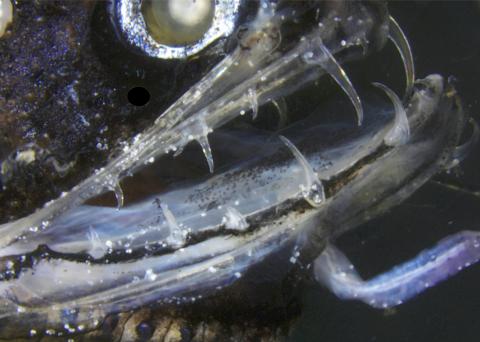
Photo: AP
照片:美聯社
It has a black, elongated, eel-like body, with a long, fleshy filament called a barbel hanging from its lower jaw with a bioluminescent organ called a photophore on the end to lure prey. It also has two rows of photophores along the length of its body. Its long, sharp teeth are big relative to its body size. Its face looks like the creatures from the “Alien” movies, and it has a similarly vicious disposition.
Its teeth, like ours, are made up of an outer layer of enamel and an inner layer of hard, dense, bony tissue called dentin. But there is a twist. The enamel consists of nanoscale crystals embedded in the surrounding structure. The dentine consists of nanoscale fibers of the protein called collagen coated with a crystalline form of a mineral called hydroxyapatite, common in bones and teeth. These traits prevent any light existing in the near blackness from reflecting off the tooth surface, adding stealth to its hunt for other fish and shrimp.
“Thus, the mouth is invisible and the prey is caught more easily,” said materials scientist Marc Andre Meyers of the University of California, San Diego, who led the research published in the journal Matter. “Initially, we thought the teeth were made of another, unknown material,” Meyers said. “However, we discovered that they are made of the same materials as our human teeth: hydroxyapatite and collagen. However, their organization is significantly different from that of other fish and mammals. This was a surprise for us: same building blocks, different scales and hierarchies. Nature is amazing in its ingeniosity.”
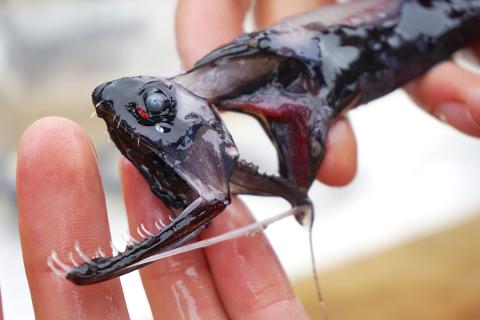
Photo: AP
照片:美聯社
A small number of other fish such as the anglerfish and hatchetfish have transparent teeth. “These have not been investigated yet, but I suspect they have a similar structure,” Meyers said.
(Reuters)
棲息在黑暗海洋深處的巨口魚,是一種讓人毛骨悚然的驚奇生物,出現在任何恐怖電影裡面都不會顯得突兀。這種魚類具備許多奇特的變異,其中包括幾近透明的尖牙,有助它們在極端的環境中成長茁壯。
長久以來,巨口魚透明牙齒的原理是一個謎團,直到近日才獲得解答。科學家於週三解釋這些牙齒如此透明清澈的原因──構成它們的基本物質其實跟人類牙齒相同,只是同樣材料在巨口魚身上受到戲劇性的重組。
科學家研究一種被稱為「閃亮奇巨口魚」的巨口魚物種,捕獲於加州外海深達約一千公尺的太平洋深處。這個物種體型如鉛筆般,身長達二十五公分,身形雖小,卻擁有多項只會出現在科幻怪獸身上的特質。
這種魚類身體呈黑色,瘦長如鰻魚般,下顎垂吊著一條長長而具肉質感的細絲結構,稱作魚鬚,尾端附有一個稱為「發光器」的生物螢光器官,用來引誘獵物,同時還有兩排發光器沿身體兩側排列。相對於體型而言,它們長而尖銳的牙齒顯得相當巨大。這種巨口魚的臉看起來像是從《異形》系列電影中走出來的生物,而且也有類似的兇惡性情。
巨口魚牙齒像我們人類一樣,是由琺瑯質外層以及象牙質內層組成,所謂的象牙質是一種堅硬、密度高,如骨頭般的組織。特別的地方在於:這種魚的牙齒琺瑯質是由眾多奈米尺度的結晶體,嵌入周圍結構後所組成;象牙質則是奈米尺度的蛋白質纖維,也就是膠原蛋白,被一種常見於骨骼和牙齒中的礦物質──「氫氧基磷灰石」──的晶體結構包裹住。這些特質防止任何光線在近乎全黑的環境中反射於牙齒表面,讓它們獵捕其他小魚跟蝦類時更加神出鬼沒。
加州大學聖地牙哥分校的材料科學家馬克‧安德烈‧梅耶斯指出:「因此,巨口魚的嘴巴幾乎是隱形的,而且更容易抓到獵物。」梅耶斯是這篇發表於期刊《Matter》(材料科學)研究的主要作者,他表示:「最初,我們以為這種魚的牙齒是由另外一種未知的材料所構成。」他解釋說:「但是我們發現,構成那些牙齒的物質跟人類是一樣的:氫氧基磷灰石以及膠原蛋白。然而,這些材料的組織方式跟其他魚類和哺乳類有顯著的差異。這讓我們相當驚訝:就像是相同的磚塊,因為不同的比例和分層結構,造成相異的成果。大自然的匠心獨具讓人讚嘆。」
還有其他少許魚類的牙齒也是透明的,其中包括??魚和褶胸魚。梅耶斯說:「這些物種都還沒被調查過,但我懷疑它們牙齒也是類似的結構。」
(台北時報章厚明譯)
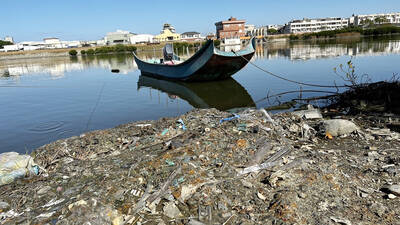
Many consumers are guilty of filling drawers or closets with old laptops, cellphones, fitness trackers and other electronic devices once they are no longer needed. It’s hard to know where to recycle such items, or it seems costly and inconvenient to do so. The world generates millions of tons of electronic waste — also called e-waste — each year. According to the UN’s most recent estimate, people worldwide produced 62 million metric tons of e-waste in 2022, and only about 22 percent of it was properly recycled. The US’ Environmental Protection Agency estimates that less than a quarter of e-waste is
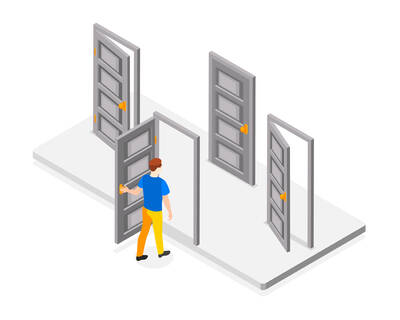
You’re sitting in class when a classmate asks to borrow a pencil. It seems like a small favor, so you agree without hesitation. The following week, the same classmate asks to share your notes. Later, they request help with a group project. You agree each time — after all, you helped out the first time — but before you know it, it has become automatic. This scenario demonstrates the “foot-in-the-door technique,” a psychological concept that shows how agreeing to small, acceptable demands makes it easier to accept larger ones later on. The name for this strategy comes from door-to-door

A: The four-day Tomb Sweeping Day long weekend begins Friday and will run until Monday. Are you going to sweep your ancestors’ tombs? B: I did in advance last weekend, so I can go to Kaohsiung to see the musical “The Phantom of the Opera.” A: Wow, is “Phantom” touring Taiwan again? It debuted in 1986, so this year marks the 40th anniversary of the show. B: And it’s not just touring Kaohsiung starting March 31, but also Taipei starting April 21 and Taichung starting May 26. A: “Phantom” is one of the world’s Four Major Musicals. I’ve seen all of them, except “Les

Dos & Don’ts — 想想看,這句話英語該怎麼說? 1. 我們很早到達電影院。 ˇ We arrived at the theater very early. χ We arrived the theater very early. 註︰arrive 為不及物動詞,後面如果有受詞要用 at 或 in。例如:They arrived in Taipei yesterday.。一般大地方,如國家、省、大城市等前面用 in,凡小地方城鎮、學校等則用 at。 2. 開車半小時以後,我們到達了海灘。 ˇ After half an hour’s drive, we got to the beach. χ After half an hour’s drive, we got the beach. 註︰come, go, get(來、去、到達)某地時,在表示地點的名詞前面應該用 to,如 go to school, go to Taipei, come to Shanghai 等。如果這些動詞後面所跟的是 here, there, home 等副詞,則不用 to。 3. 明天我會回辦公室。 ˇ I will be back in the office tomorrow. χ I will be back to office tomorrow. 註︰to be back 一語裡的 back 是副詞,不是介詞,所以後面要用 at (the market) 或 in (the office)。 假如假期結束,要回學校上課了則可說: ? Kids will be back


 RSS
RSS