


The time of coral spawning depends on the lunar cycle and the water temperature. The coral colony in the waters off Pingtung County’s Kenting National Park spawns around 23rd day of the third month of the lunar calendar, which also happens to be sea goddess Matsu’s birthday. Commissioned by the Kenting National Park Administration Office, a group of divers led by senior diving coach Tsai Yung-chun dove to observe the spawning event. Last Thursday evening the divers went into the waters near the outlet of the Maanshan Nuclear Power Plant, where they observe the event every year.
Tsai reported that at 8pm, only occasional spawning was seen. At around 9pm, a variety of corals simultaneously released their tiny eggs and sperm, called gametes, into the ocean. A colorful cloud of red, orange, white and pink gametes was released, floating above the sea bed.
More than 20 kinds of corals spawned that evening, including Fayia speciosa, Porites corals, Favites corals and Montipora corals. The spawning blizzard of the Fayia speciosa corals was so spectacular that the divers couldn’t get enough photos, and were reluctant to return to shore.
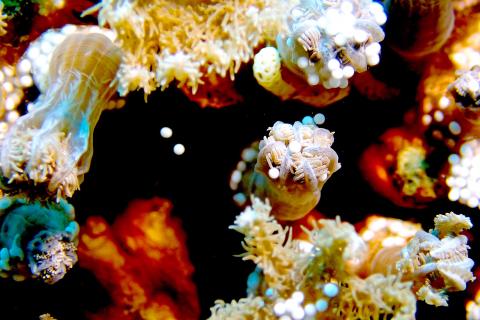
Photo courtesy of Tsai Yung-chun
照片:蔡永春提供
The office’s conservation research department said that Kenting’s waters are well known in coral studies for its natural wonders of coral spawning. Scenes of the “stars under the water” are a favorite photographic subject for divers. Divers are urged not to step on the coral colonies when observing them.
There is a great variety of corals in Kenting. An academic report published Thursday, commissioned by the office, shows that there are 212 species of Octocorallia (soft) corals in Kenting waters, with seven new coral species now discovered and named.
According to the office, the recorded live video of the coral spawning in Kenting has been available online since last Friday.
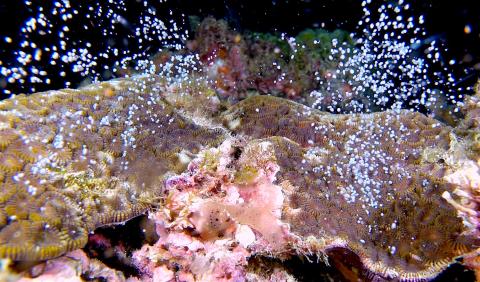
Photo courtesy of Tsai Yung-chun
照片:蔡永春提供
(Translated by Lin Lee-kai, Taipei Times)
珊瑚產卵的時間,是跟月亮週期及水溫有關,墾丁海域的珊瑚在每年農曆三月二十三日媽祖生日前後會大量產卵。墾丁國家公園管理處委託資深潛水教練蔡永春等人下海觀察,上週四晚間在每年觀察珊瑚產卵的海域核三廠出水口下海。
蔡永春表示,晚間八時下海,只看到零星產卵現象,在九時左右,多種珊瑚陸續噴發精卵(亦即「配子」),此起彼落大量產卵。紅色、橘色、白色、粉紅色精卵團噴發、布滿海底的美麗景象,不少人大呼「美極了」。
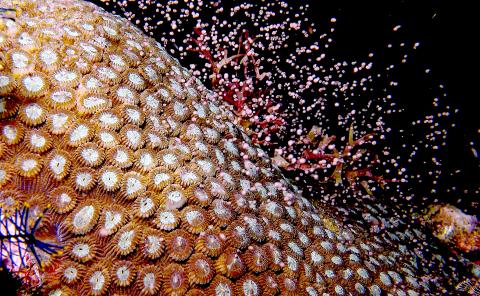
Photo courtesy of Tsai Yung-chun
照片:蔡永春提供
當晚產卵的有菊珊瑚、微孔珊瑚、角菊珊瑚、表孔珊瑚等多達二十多種。大量噴發的菊珊瑚,讓潛客們拍照拍到捨不得上岸。
墾管處保育研究課說,墾丁海域珊瑚礁釋精、排卵在海中漂盪的自然奇景,在全球珊瑚學界聞名,「海底星空」更是潛客最愛的拍攝畫面。墾管處提醒潛水客觀賞珊瑚產卵時,注意勿踩踏珊瑚礁生態。
墾丁的珊瑚種類多樣,墾管處上週四才發布委託學者所做的調查,顯示墾丁海域的八放珊瑚(俗稱軟珊瑚)多達兩百一十二種,同時還命名了七種新種類。
墾管處表示,墾丁珊瑚產卵的實況錄影上週五已放上官網,民眾可以觀賞到珊瑚產卵的繽紛畫面。
(中央社)
DO YOU KNOW ? 你知道嗎?
Corals mainly inhabit tropical and subtropical waters and are formed in shallow, clear waters.
Corals are fixed animals that cannot move — they are not plants.
Mature corals release their gametes — reproductive cells — all at the same time. This synchrony is crucial, because the gametes of most coral species are viable for only a few hours. The “blizzard” makes it more likely that fertilization will occur.
珊瑚主要棲息於熱帶、亞熱帶海域,在陽光充足、水質清澈的淺海區形成。
珊瑚是固著的動物,不能移動,並非植物。
成熟的珊瑚群會同時釋放配子,也就是精卵等生殖細胞。這種同步性至關重要,因為大多數珊瑚物種的配子只能存活數小時。珊瑚如風雪紛飛大量釋放配子,會提高受精成功的機率。
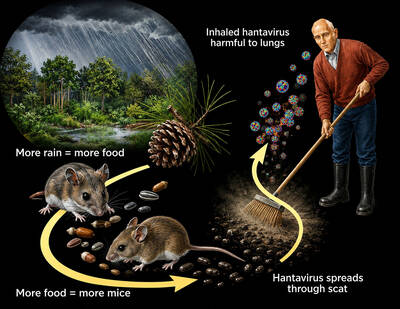
An outbreak aboard a cruise ship of a rare rodent-borne illness called hantavirus has left three passengers dead and sickened others, but global health officials say the risk to the general public remains low because the germ does not easily spread between people. “This is not the next COVID, but it is a serious infectious disease,” said Maria Van Kerkhove, director of epidemic and pandemic preparedness at the World Health Organization (WHO). “Most people will never be exposed to this.” The virus usually spreads when people inhale contaminated residue of rodent droppings. Hantaviruses have been around for centuries and are thought to

Have you ever wondered how people navigate the world when they can’t see a map? For individuals with visual impairments, conventional maps are nearly impossible to use. This is where tactile maps come in — essential tools that allow people to “see” the world through touch. A tactile map is specially designed with raised lines, textures, and symbols to represent geographical features such as roads, rivers, and buildings. Users explore it with their fingertips. However, these maps are not exclusively for people with visual disabilities. They serve as valuable multisensory learning tools that enhance spatial understanding for everyone, making

A: In early May, there were concerts by Icyball, Chyi Yu, Korea’s EXO and Japan’s Anisama, but I missed them all. What a shame. B: That’s OK. There are shows coming up by various artists, including Power Station, Accusefive, Japanese singer Mika Nakashima, Chinese-Icelandic jazzer Laufey, and even Singaporean diva Stefanie Sun. A: After a 12-year hiatus, Stefanie is finally returning to Taipei again. B: In late May, there will be more shows by Crowd Lu, WeiBird, Korea’s Donghae, 2AM, EXID, and Thailand’s BUS. A: The Thai boyband is so popular. It looks like “T-pop” is catching up with J-pop

Since 2005, the third Monday in January has come to be known as “Blue Monday.” In other words, that day is believed to be the most depressing day of the year. This concept seems logical at first. After all, Monday marks the start of the school or workweek after two days of rest and fun. Also, blue is a color that is often associated with sadness. Furthermore, in many parts of the world, January is a time when the weather is cold, rainy, and gloomy. But is there any scientific proof that this January day is truly sadder than any of


 RSS
RSS