


The great white shark, one of the most fearsome predators in the world’s oceans in both fact and fiction, is a formidable creature — right down to its genes.
Scientists on Monday said they have decoded the genome of Earth’s largest predatory fish, detecting numerous genetic traits that help explain its remarkable evolutionary success, including molecular adaptations to enhance wound healing as well as genomic stability such as DNA repair and DNA damage tolerance.
The great white shark, scientific name Carcharodon carcharias, boasts a very large genome, 1.5 times bigger than the human genome. In theory, large genomes with a lot of repeated DNA, like this shark possesses, and its large body size should promote a high incidence of genome instability, with much more DNA and many more cells seemingly vulnerable as targets for damage through an accumulation of routine mutations.
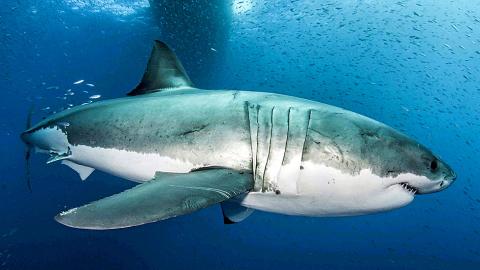
Photo: Reuters
照片:路透
Just the opposite seems to be the case for this shark, thanks to adaptations in genes involved in preserving genome integrity. “This knowledge, in addition to providing understanding into how sharks work at their most fundamental level — their genes — may also be useful in downstream applications to human medicine to combat cancers and age-related diseases that result from genome instability,” said Mahmood Shivji, director of the Save Our Seas Foundation Shark Research Center and Guy Harvey Research Institute at Nova Southeastern University in Florida, US.
This species, star of the 1975 Hollywood blockbuster “Jaws” and its multiple sequels, roams the world’s oceans, primarily in cool coastal waters. Gray with a white underbelly and torpedo-shaped body, it can reach 6m long, weigh 3.18 tonnes and dive to nearly 1,200m deep. It uses its mouthful of large, serrated teeth to rip into prey including fish, seals and dolphins, swallowing mouth-sized chunks of flesh whole.
Sharks are an evolutionary success story, thriving for more than 400 million years. Our species — Homo sapiens — appeared roughly 300,000 years ago. The great white shark also displayed genetic adaptations in several genes that play fundamental roles in wound healing. For example, a key gene involved in producing a major component of blood clots was found to have undergone adaptations.
“These adaptations and enrichments of essential wound-healing genes may underlie the ability of sharks to heal from wounds so efficiently,” said Cornell University’s Michael Stanhope, co-leader of the research published in the Proceedings of the National Academy of Sciences.(Reuters)
無論就事實還是虛構層面而言,大白鯊都是世界海洋中最駭人的掠食者之一,而且這種生物從頭到尾──甚至它的基因──都令人生畏。
科學家於週一表示,他們已順利解碼這種地球上最大型掠食性魚類的基因體,並且發現多種遺傳特徵,有助於解釋大白鯊在演化上獲得的非凡成功。這些特徵包括多種分子適應機制,以增強傷口的癒合能力,並藉由DNA修復和DNA損傷耐受機制,來提升基因體的穩定性。
大白鯊,學名為「Carcharodon carcharias」,具有非常巨大的基因體,比起人類基因體大上一倍到二分之一倍。理論上,大型基因體內含有非常多重複的DNA,這種鯊魚也是如此,再加上巨大的身型,照理來說會促使基因體不穩定的發生率升高。原因在於,在例行性變異不斷累積的過程中,更多的DNA和細胞可能會變得脆弱,成為受損的對象。
然而,多虧這種鯊魚基因中的適應作用,協助保存基因體的完整性,讓鯊魚能夠反其道而行。「拯救我們的大海基金會」旗下的鯊魚研究中心主任,同時也是美國佛羅里達州諾瓦東南大學居伊‧哈維研究院主任的馬赫穆德‧席夫吉指出:「這項知識,除了讓我們深入了解鯊魚在最根本層面上──也就是它們的基因──活動的機制,也會有助於下游應用,協助人類醫學對抗肇因於基因體不穩定的癌症和年紀相關疾病。」
大白鯊是一九七五年好萊塢同名賣座電影及其多部續集中的巨星。這類物種在現實中悠游於世界各地的海洋裡,主要棲息在涼爽的沿岸水域。大白鯊一身灰色、下腹部呈白色,身型如魚雷,身長可達六公尺,重可達三‧一八噸,能夠下潛到一千兩百公尺深。它用一整張血盆大口的大型鋸齒狀牙齒猛力刺進魚類、海豹、海豚等獵物體內,再一口吞下相當於嘴巴大小的整塊肉。
鯊魚是演化史上的成功範例,繁衍超過四億年之久。我們這類物種──「智人」──則大約在三十萬年前才出現。大白鯊的基因適應機制也展現於某些對傷口癒合扮演重要角色的基因中。舉例來說,有一個和血凝塊主要成分製造過程相關的關鍵基因,被科學家發現歷經過多次適應。
這份研究發表於《美國國家科學院院刊》,來自康乃爾大學的研究共同主持人麥可‧史丹霍普表示:「這些對於傷口癒合極其重要的基因,它們的適應歷程和豐富程度,構成鯊魚能夠如此有效率地從傷口中復原的基礎。」
(台北時報章厚明譯)
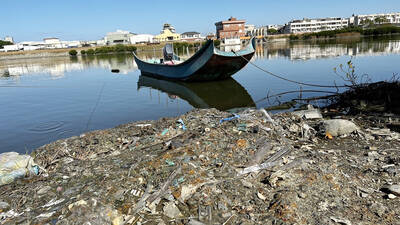
Many consumers are guilty of filling drawers or closets with old laptops, cellphones, fitness trackers and other electronic devices once they are no longer needed. It’s hard to know where to recycle such items, or it seems costly and inconvenient to do so. The world generates millions of tons of electronic waste — also called e-waste — each year. According to the UN’s most recent estimate, people worldwide produced 62 million metric tons of e-waste in 2022, and only about 22 percent of it was properly recycled. The US’ Environmental Protection Agency estimates that less than a quarter of e-waste is
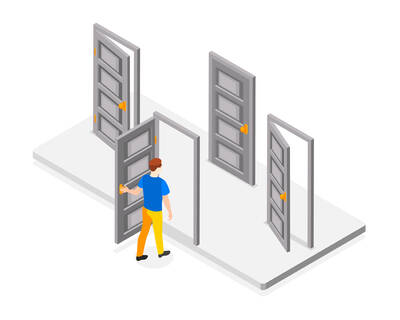
You’re sitting in class when a classmate asks to borrow a pencil. It seems like a small favor, so you agree without hesitation. The following week, the same classmate asks to share your notes. Later, they request help with a group project. You agree each time — after all, you helped out the first time — but before you know it, it has become automatic. This scenario demonstrates the “foot-in-the-door technique,” a psychological concept that shows how agreeing to small, acceptable demands makes it easier to accept larger ones later on. The name for this strategy comes from door-to-door

A: The four-day Tomb Sweeping Day long weekend begins Friday and will run until Monday. Are you going to sweep your ancestors’ tombs? B: I did in advance last weekend, so I can go to Kaohsiung to see the musical “The Phantom of the Opera.” A: Wow, is “Phantom” touring Taiwan again? It debuted in 1986, so this year marks the 40th anniversary of the show. B: And it’s not just touring Kaohsiung starting March 31, but also Taipei starting April 21 and Taichung starting May 26. A: “Phantom” is one of the world’s Four Major Musicals. I’ve seen all of them, except “Les

Dos & Don’ts — 想想看,這句話英語該怎麼說? 1. 我們很早到達電影院。 ˇ We arrived at the theater very early. χ We arrived the theater very early. 註︰arrive 為不及物動詞,後面如果有受詞要用 at 或 in。例如:They arrived in Taipei yesterday.。一般大地方,如國家、省、大城市等前面用 in,凡小地方城鎮、學校等則用 at。 2. 開車半小時以後,我們到達了海灘。 ˇ After half an hour’s drive, we got to the beach. χ After half an hour’s drive, we got the beach. 註︰come, go, get(來、去、到達)某地時,在表示地點的名詞前面應該用 to,如 go to school, go to Taipei, come to Shanghai 等。如果這些動詞後面所跟的是 here, there, home 等副詞,則不用 to。 3. 明天我會回辦公室。 ˇ I will be back in the office tomorrow. χ I will be back to office tomorrow. 註︰to be back 一語裡的 back 是副詞,不是介詞,所以後面要用 at (the market) 或 in (the office)。 假如假期結束,要回學校上課了則可說: ? Kids will be back


 RSS
RSS