


Voyager 2, a NASA probe launched in 1977 and designed for just a five-year mission, has become only the second human-made object to enter interstellar space as it continues its marathon trek billions of kilometers from Earth, scientists said on Monday. Data from instruments aboard the spacecraft showed it crossed the outer edge of the heliosphere, a protective bubble of particles and magnetic fields produced by the sun, on Nov. 5, the US space agency said.
The boundary crossed by the intrepid probe as it journeys a bit more than 18 billion km from Earth is called the heliopause, a place where the hot solar wind runs up against the interstellar medium, the soup of stuff residing between the stars of our Milky Way galaxy. “This is a very exciting time again in Voyager’s 41-year journey, so far, of exploring the planets and now the heliosphere and entering interstellar space,” Ed Stone, Voyager project scientist based at Caltech, told a news briefing.
Voyager 2 was launched in 1977, 16 days before its twin probe Voyager 1, which reached interstellar space in 2012. Voyager 2’s instrument called the Plasma Science Experiment (PLS) is able to provide observations of the nature of this region of space. While Voyager 1 is still going strong on its own journey in interstellar space, its PLS stopped working in 1980. The Voyager probes were designed to last five years and study the giant gas planets Jupiter and Saturn. Their refusal to die has also let them study Uranus and Neptune, the solar system’s outermost giant planets.
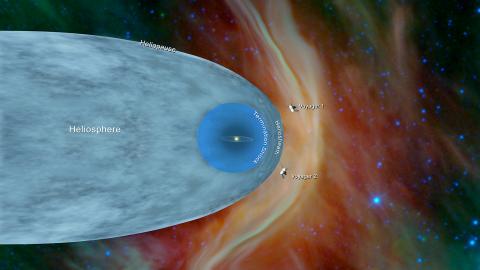
Photo: Reuters
照片:路透
Both probes carry a phonograph record. The gold-plated copper disk bears sounds, images and spoken greetings in multiple languages to depict Earth’s diversity of life and culture, intended to communicate with potential extraterrestrial beings who may encounter them. The two probes have not officially exited the solar system, whose outermost region is a shell called the Oort Cloud comprised of numerous small icy objects still under the sun’s gravitational influence.
“I often get asked, ‘So, is this it for Voyager? You’ve crossed out of the heliopause. Is it done? Are we finished?’ Absolutely not. This is really, for me, the beginning of a new era of heliophysics science,” said Nicola Fox, director of the heliophysics division at NASA headquarters. “We are fortunate enough to have two very brave sentinels that have left our heliosphere and are out truly looking at the other side of the boundary,” Fox added.
(Reuters)
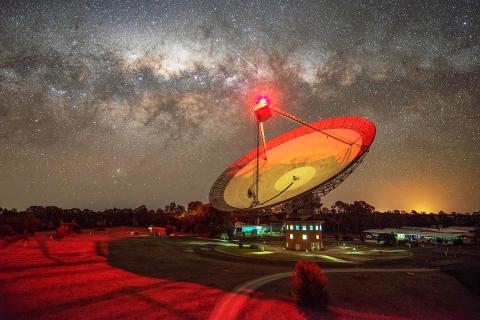
Photo: EPA
照片:歐新社
科學家週一表示,美國國家航空暨太空總署在一九七七年發射的旅行家二號探測船,原本只是為五年期任務打造,現在卻成為第二個進入星際空間的人造物體,而且這趟距離地球數十億公里遠的馬拉松之旅仍在持續進行中。美國太空總署指出,太空船上搭載的儀器傳回資料,顯示探測船已於十一月五日跨越太陽圈。「太陽圈」指的是由太陽發散出的粒子和磁場構成的一層保護性氣泡。
這艘無畏的探測船從地球向外航行超過一百八十億公里後,跨越的邊界稱為「太陽層頂」,也就是熱太陽風撞上星際介質之處。所謂的星際介質,指的是我們銀河星系的恆星間存在物質構成的濃霧。隸屬於加州理工學院的旅行家探測船專案科學家艾德‧史東,在新聞簡報中表示:「在旅行家探測船至今四十一年的旅途中,先是探測行星,現在探索太陽圈,更進入星際空間,又是一次讓人興奮的時刻。」
旅行家二號發射於一九七七年,比雙胞胎探測船「旅行家一號」早十六天出發,後者在二○一二年就已抵達星際空間。旅行家二號搭載的儀器稱為「電漿科學實驗」,能夠提供太空中這塊區域獨特面貌的觀察資訊。雖然旅行家一號目前仍在星際空間獨自勇敢闖蕩,但上頭搭載的「電漿科學實驗」器材早在一九八○年就已停止運作。兩艘「旅行家探測船」原本設計僅能夠維持五年,用以研究大型氣體行星木星與土星。不過,兩艘探測船「拒絕退役」,因此得以持續向外探索,研究太陽系最外圍的巨大行星──天王星和海王星。
這兩具探測船上都載著一張留聲機唱片。鍍金的銅唱片中收錄了聲音、圖像、以及用多種語言錄製的問候,刻畫出地球上生命與文化的多樣性,為的是和可能遇上探測船的外星生命溝通。這兩具探測船都尚未正式離開太陽系,因為最外層區域是一塊被稱為「歐特雲」的星體雲團外殼,由許多小顆的冰組成,仍然受太陽的引力影響。
美國太空總署總部太陽物理學部主任尼可拉‧佛克斯說:「我經常被人問說,『所以,旅行家就這樣了嗎?你已經穿越太陽層頂,這樣算完成了嗎?我們任務結束了嗎?』當然沒有。對我來說,這其實真的是太陽物理科學領域的一段新時代開始。」佛克斯補充表示:「我們何其有幸,擁有兩名非常勇敢的哨兵,它們現在已經離開我們的太陽圈,真正在外面為我們看著邊界的另一端。」
(台北時報章厚明譯)

Many consumers are guilty of filling drawers or closets with old laptops, cellphones, fitness trackers and other electronic devices once they are no longer needed. It’s hard to know where to recycle such items, or it seems costly and inconvenient to do so. The world generates millions of tons of electronic waste — also called e-waste — each year. According to the UN’s most recent estimate, people worldwide produced 62 million metric tons of e-waste in 2022, and only about 22 percent of it was properly recycled. The US’ Environmental Protection Agency estimates that less than a quarter of e-waste is

You’re sitting in class when a classmate asks to borrow a pencil. It seems like a small favor, so you agree without hesitation. The following week, the same classmate asks to share your notes. Later, they request help with a group project. You agree each time — after all, you helped out the first time — but before you know it, it has become automatic. This scenario demonstrates the “foot-in-the-door technique,” a psychological concept that shows how agreeing to small, acceptable demands makes it easier to accept larger ones later on. The name for this strategy comes from door-to-door

A: The four-day Tomb Sweeping Day long weekend begins Friday and will run until Monday. Are you going to sweep your ancestors’ tombs? B: I did in advance last weekend, so I can go to Kaohsiung to see the musical “The Phantom of the Opera.” A: Wow, is “Phantom” touring Taiwan again? It debuted in 1986, so this year marks the 40th anniversary of the show. B: And it’s not just touring Kaohsiung starting March 31, but also Taipei starting April 21 and Taichung starting May 26. A: “Phantom” is one of the world’s Four Major Musicals. I’ve seen all of them, except “Les

Continued from yesterday(延續自昨日) https://www.taipeitimes.com/News/lang Gig Tripping “Gig tripping” combines concerts with travel. People fly to see their favorite artists perform — usually abroad—and spend a few days sightseeing before or after the show. While die-hard fans have done this since the 1960s, the post-pandemic travel boom changed the game. Even people who aren’t superfans are now booking international concert trips because they want to make the most of travel opportunities. This trend exploded in the US, as the math makes sense. Domestic concert tickets are so costly that flying abroad for the show plus tourism expenses often matches or even beats the price


 RSS
RSS