


Farewell My Concubine, produced by Taiwanese actress Hsu Feng and filmed by Chinese director Chen Kaige, is the only Chinese-language film to win the prestigious Palme d’Or, the highest prize awarded at the Cannes Film Festival. To celebrate the 25th anniversary of its 1993 release, the digitally-restored version is set to hit the screens in Taiwan tomorrow.
The film tells the fascinating story of two actors — Cheng Dieyi (played by Leslie Cheung) and Duan Xiaolou (Zhang Fengyi) — who grow up together at a Beijing opera troupe. Their hit show is the play “Farewell My Concubine,” in which Cheng plays the concubine and Duan plays the king. Cheng’s love for Duan is later tested by a woman as well as the outbreak of the Cultural Revolution.
The film also made it to the All-Time 100 Movies list compiled by Time magazine. The other three Chinese-language classics on the list include the 1971 film A Touch of Zen, and Chungking Express and The Legend of Drunken Master II, both from 1994.

Photo courtesy of Applause Entertainment Ltd
照片︰甲上娛樂提供
(Eddy Chang, Taipei Times)
台灣影后徐楓監製、中國導演陳凱歌拍攝的《霸王別姬》,是唯一榮獲坎城影展最高榮譽金棕櫚獎的華語電影。為了慶祝該片一九九三年上映二十五週年,「數位修復版」明日起將在台重登大銀幕。
該電影是關於兩位演員——程蝶衣(張國榮飾)和段小樓(張豐毅飾)——迷人的故事,兩人從小在京劇團裡一起長大。他們最紅的一齣戲就是霸王別姬,由程蝶衣飾演虞姬,段小樓則飾演霸王。但程對段的愛慕卻因一個女人的介入,及隨後爆發的「文化大革命」而遭到考驗。
該片曾被《時代》雜誌評選為「全球百大最佳電影」,其它三部上榜的華語經典包括︰一九七一年的《俠女》、一九九四年的《重慶森林》和《醉拳II》。
(台北時報張聖恩)
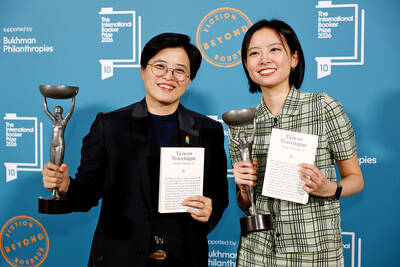
Taiwan Travelogue, the novel by Taiwanese author Yang Shuang-zi and translated into English by Lin King, won the prestigious International Booker Prize in London on May 19. It marks the first time a Taiwanese literary work has received the International Booker Prize, setting a historic milestone both for Taiwanese literature and for the award itself. Prior to this achievement, Taiwan had only once appeared on the Booker radar, when Taiwanese author Wu Ming-yi was longlisted for the Booker Prize in 2018 with The Stolen Bicycle. The International Booker Prize honors works of fiction translated into English and published in the UK or Ireland.

A: Time magazine recently released its list of “The 100 Most Influential People of 2026.” It’s categorized into six groups: Artists, Pioneers, Titans, Icons, Leaders and Innovators. B: TSMC chairman C.C. Wei made the list this year. Which category is he in? A: Wei is actually among the Pioneers, with figures including Disney CEO Josh D’Amaro and MrBeast — the first YouTuber ever to surpass 400 million subscribers. B: Led by Wei, Taiwan’s “silicon shield” TSMC is the sixth-largest company in the world. A: As Nvidia founder Jensen Huang wrote in his introduction, “C.C. Wei is truly one of the
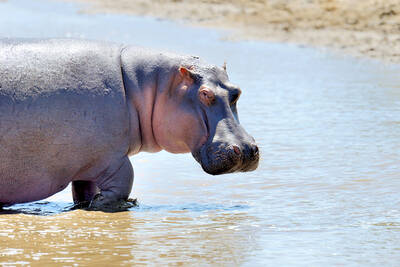
The animal kingdom is full of surprises that challenge our understanding of biology. From remarkable feeding mechanisms to extreme defense strategies, some creatures possess traits so unusual that they seem like pure fiction. Here are four fascinating examples that show nature’s endless creativity. The humble snail may appear simple, but its mouth tells a different story. Snails possess a ribbon-like tongue called a radula, densely covered with anywhere from 1,000 to 12,000 tiny teeth. This structure works like a cheese grater, allowing them to scrape and grind food with surprising efficiency. Far from being passive creatures, snails are actually

A: In the 2026 Time 100 list, besides TSMC chairman C.C. Wei in the Pioneers category, Blackpink’s Jennie also stands out in the Artists group. B: What about the Titans and Icons? A: The Titans include legendary fashion designer Ralph Lauren, Google CEO Sundar Pichai, and Intel CEO Tan Lip-bu. The Icons include actor Wagner Moura, Olympic gold figure skater Alysa Liu and singer Victoria Beckham. B: What about the Leaders and Innovators? I bet US President Donald Trump and Chinese President Xi Jinping are on the list. A: You got it. Other Leaders include Japanese PM Sanae


 RSS
RSS