


China’s sharing economy has expanded far more rapidly than in Taiwan with share schemes available for everything from bicycles, computers, mobile phones, battery recharging packs, umbrellas and even shopping trolleys. In China, almost anything can be “shared.”
However, due to the low barriers to entry into China’s sharing economy, investors with varying degrees of business acumen have piled in. The lower the entry threshold to a particular industry, the more rapidly start-ups have fallen by the wayside. For a while, shared bicycle schemes in China rode the wave of a share bike mania. However, due to poor management and maintenance of the bikes, entrepreneurs quickly burnt through their money, one after the other falling into liquidation and leaving China’s streets and alleyways chock-a-block with superfluous share bikes, piled up on top of each other in giant scrap-metal mountains.
Turning to Taiwan, the now successful YouBike share bike scheme was once described as a “hot potato” by King Liu, the founder and chairman of Giant Manufacturing Co, which operates the YouBike scheme. However, after adjusting its operating strategy and adopting international standards, Giant was able to turn YouBike into a success. YouBike’s back office staff now provide a 24-hour service and bicycles docked at docking stations are overhauled on a daily basis. Due to the high concentration of docking stations, the bikes’ easy ride-ability and the effortlessness of borrowing and returning them, using either an EasyCard, credit card or mobile phone, YouBike has the highest turnover of any public bike scheme in the world.
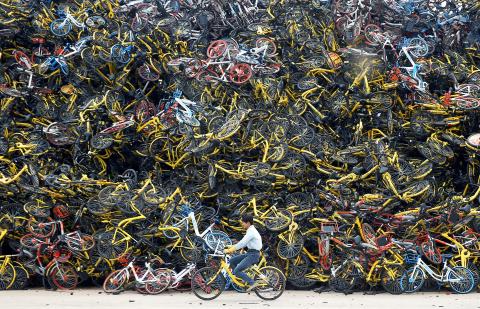
Photo: Reuters
照片:路透
YouBike’s success in Taiwan has greatly inspired car sharing companies. According to the nation’s leading car leasing company, Hotai Leasing Corp, lease cars are changed on average every three years, while the average age of a privately owned sedan car exceeds 10 years. As such, the features and performance of private vehicles lag behind the latest developments in the car industry. For consumers who only use a car on an occasional basis, and for whom hiring makes more sense that purchasing, renting a car would mean that they always have access to a better, newer vehicle. By pooling the resources of its parent company Hotai Motor Co, Hotai Leasing Corp, using the brand iRent, is actively investing in Taiwan’s car share market.
Due to the high unit price of the vehicles, Hotai Leasing Corp will perform a high level of due diligence on iRent car share scheme members. Members will first need to upload two forms of identification and link a credit card to their accounts before they will be able to hire an iRent car. The only method of payment will be by credit card. Additionally, the company will enlist the help of technology to tightly monitor the movements of vehicles for any anomalies. If a member maliciously conceals a vehicle’s location or flees the scene after damaging a car, the company can use GPS location and credit card information to track down the user, the vehicle and recover money, making it all the more difficult for users to cheat the system.
(Liberty Times, translated by Edward Jones)
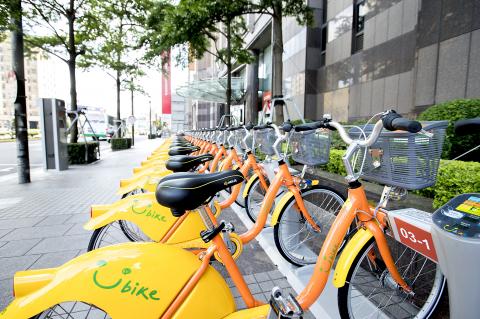
Photo courtesy of Hsinchu City Government
照片:新竹市政府提供
中國共享經濟跑得比台灣快,共享單車、共享電腦、共享手機、共享充電寶、共享雨傘,甚至共享購物車等等,什麼都能「共享」。
由於進入門檻不高,投入者營運能力參差不齊,進入門檻愈低的行業凋零得愈快。
中國曾經紅極一時的共享單車,因管理和維修不善,新創者錢燒光了,陸續傳出倒閉潮,街頭巷尾的共享單車已變成廢銅爛鐵、堆積成山。
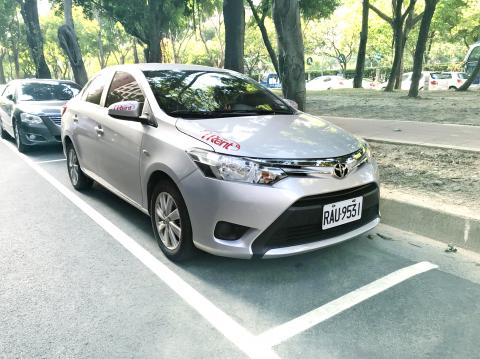
Photo: Yang Ya-min, Liberty Times
照片:自由時報記者楊雅民
反觀台灣,目前經營得很成功的微笑單車共享單車,曾被巨大集團創辦人劉金標形容是燙手山芋,後來巨大調整營運策略,以世界級規格量身打造。後台並提供二十四小時服務,每天都會逐站檢修車輛,由於站點設置密集、車子好騎,借車可以甲地借乙地還,並使用悠遊卡、信用卡及手機借還車,至今已成為全球周轉率最高的公共自行車系統。
微笑單車在台灣的成功經驗,也給予共享汽車業者很大鼓舞,租車業龍頭和運表示,租賃車平均三年換車,自用小客車平均車齡都在十年以上,性能跟不上汽車產業的發展。因此對汽車使用頻率不高的消費者而言,「買不如租」,租車永遠可以使用較好、較新的車子。和運於是結合母公司和泰汽車資源,以iRent積極投入共享汽車市場。
由於汽車是高單價的商品,和運對於iRent會員也嚴格把關,所有要租用iRent車輛的會員,須上傳雙證件資料,並綁定信用卡資料,一律使用信用卡付款。同時借科技之助,嚴密監控車輛的移動是否有異狀,若會員惡意隱藏車子或損毀車子落跑,和運皆可透過車輛衛星定位及信用卡資料追人、追車、追錢,租用人要耍賴是難上加難。
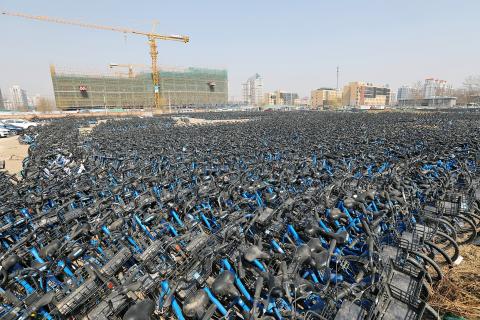
Photo: EPA
照片:歐新社
(自由時報記者楊雅民)
Follow up
讀後練習
Bluegogo goes bust
Bluegogo was a Chinese bicycle-sharing company based in Tianjin, China, founded in 2016 by chief executive Li “Tony” Gang (李剛). The company began operating in Shenzhen, before expanding to five other cities across China in direct competition with China’s two largest bike-share companies Mobike and Ofo. Bluegogo’s area of operations also included a short-lived foray into San Francisco, US. At its peak, the company claimed to have 20 million registered users as the company rode the wave of China’s bike-share mania.
However, in November 2017 reports began to surface in Chinese media that China’s third-largest bike-share company had entered into bankruptcy and suspended operations, having burnt through 600 million yuan (approx. US$86.6 million) of funding. According to reporting by the Global Times, Bluegogo had racked up more than 10 million yuan in unpaid debts.
Chinese social media was flooded with reports of disgruntled users claiming they were unable to retrieve their deposits, while a rumor began to spread that Li had fled the country. Li penned a contrite open letter, denying he had fled China and apologizing for his mistakes, saying he had been “filled with arrogance.”
Meanwhile, massive clean-up operations took place in cities across China to clear the streets of Bluegogo’s approximately 700,000 orphaned bicycles, all of which were now locked and unable to be used. In December 2017, Chinese ride-share company Didi Chuxing signed a deal to take over Bluegogo’s assets.
(Edward Jones, Taipei Times)

A: The Danjiang Bridge in New Taipei City is to open on May 12, and the MRT Sanying Line (Light Blue Line) will also open in June. Isn’t that great? B: Is that the bridge connecting the city’s Tamsui and Bali Districts? What’s so special about this new landmark spanning the Tamsui River? A: The Danjiang Bridge will become the world’s longest-span single-mast asymmetric cable-stayed bridge — with a total river-crossing section of 920 meters and main span of 450 meters. B: The news says there are sidewalks and bike lanes on both sides. Watching the sunset from the
A: Apart from the Danjiang Bridge in New Taipei City, the MRT Sanying Line (Light Blue Line) will open in June. B: Is that the new line leading to Yingge District, the ceramic town? A: Yup, the line will connect the Yingge Ceramics Museum and the Old Streets in Sanxia and Yingge Districts. B: The eastward extension of the Tamsui-Xinyi Line (Red Line) that goes through Taipei’s Xinyi District will also open in June. A: Plus, Taoyuan’s Aerotropolis Line (Green Line) will partially open by the end of the year. In the future, it will connect the

In the dense forests of Tanzania, a young researcher sat quietly among the trees, her gaze fixed on a troop of chimpanzees. It was 1960, and Jane Goodall, armed with nothing but a notebook and endless curiosity, was about to change science forever. Inspired by childhood stories like the Dr. Dolittle series, she had dreamed of Africa — and now, thanks to the encouragement of anthropologist Louis Leakey, she was there, face-to-face with the wild. What Jane discovered shocked the world. Chimpanzees weren’t mere creatures of instinct; they were individuals with emotions, families, and even the capacity for tool

★ Bilingual Story is a fictionalized account. 雙語故事部分內容純屬虛構。 Rain hammered the roof in hard, uneven bursts. “Hold him still!” Baosheng pressed one hand against the stranger’s brow as the man twisted on the wooden bed. His left eye was swollen shut. The right one burned red like a coal. “It feels like fire,” the man gasped. “Like something is clawing inside.” Thunder rolled across the mountain. Baosheng leaned closer. The man’s skin was cold, but heat rose from his face. A strange smell hung in the air. He began the four methods of diagnosis: looking, listening/smelling,


 RSS
RSS