


A copy of a knotted gun sculpture that has become an emblem for peace was unveiled on Tuesday, the International Day of Non-Violence, in Lebanon’s capital Beirut near a tower block whose shattered facade evokes the civil war that once ripped the city apart. The International Day of Non-Violence falls on Oct. 2, the birthday of Mahatma Gandhi, who employed nonviolent civil disobedience and led India to independence.
Swedish artist Carl Fredrik Reutersward made the original sculpture, a revolver with its barrel tied in a knot, as a tribute to John Lennon after he was shot in New York in 1980. It stands outside the UN building in Manhattan, and the Non-Violence Project Foundation, created by Reutersward, has placed copies in other cities around the world.
The version in Beirut stands on the seafront, just around the corner from the old Holiday Inn building, a concrete tower block deeply scarred by shell and bullet holes from the 1975-1990 civil war. The conflict was fought largely between Christians and Muslims and also drew in Palestinians, Syria, Israel and other foreign powers.
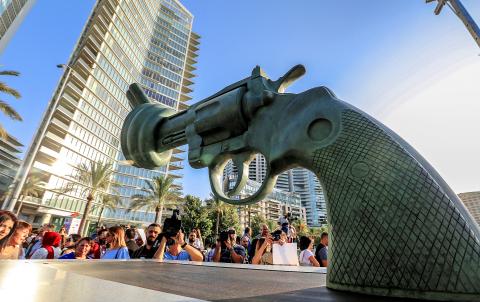
Photo: EPA
照片:歐新社
For much of the war, Beirut was divided along its “green line” separating mostly Muslim west Beirut from the mostly Christian east. Twenty-eight years after the war ended, the damage is still visible in many parts of the city.
While Lebanon is now at peace, conflict has mired many other parts of the region and the seven-year war in neighboring Syria has sent a million refugees to seek refuge in its borders.
(Reuters)
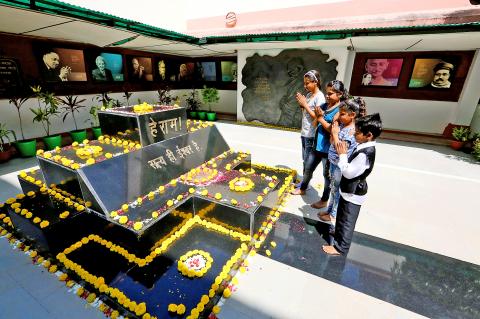
Photo: EPA
照片:歐新社
今已成為和平象徵的一座槍管打結雕塑作品,在週二「國際非暴力日」揭幕於黎巴嫩首都貝魯特。雕塑座落於一棟高樓附近,建築正面碎裂的外牆喚起曾一度撕裂這個城市的內戰記憶。國際非暴力日落在每年的十月二日,以紀念印度聖雄甘地的生日,因他採取非暴力的公民不服從手段,帶領印度走向獨立。
這座雕塑的原件來自於瑞典藝術家卡爾‧弗雷德里克‧陸特斯瓦的創作,他將這件槍管被打成一個結的左輪手槍雕塑,獻給一九八○年在紐約遭到槍擊過世的歌手約翰‧藍儂。雕塑原件現今矗立於曼哈頓的聯合國大廈外,而陸特斯瓦創立的非暴力計畫基金會,今日已在世界各城市豎立多座這件雕塑的複製品。
貝魯特的這件雕塑樹立在城市面海的那一側,就在舊假日酒店建築旁邊的街角。一九七五年到一九九○年期間爆發的內戰帶來砲火與子彈,在這座高聳的水泥大樓牆面留下深刻的傷疤。這場內戰主要源起於基督教徒與穆斯林教徒之間的衝突,同時也將巴勒斯坦、敘利亞、以色列,以及其他外國勢力捲進戰爭中。
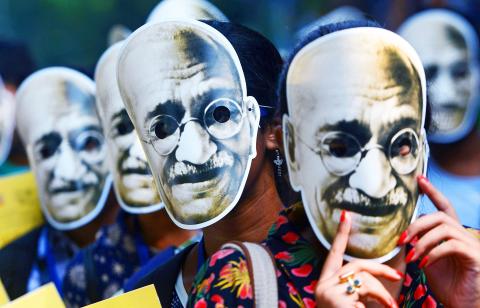
Photo: AFP
照片:法新社
在內戰的大部份時期,貝魯特被一條俗稱的「綠線」分成兩半,一邊是主要人口組成為穆斯林的西貝魯特,另一邊則是大多是基督教徒的東貝魯特。內戰結束後二十八年的今天,這座城市仍然有許多地方可以看到戰亂留下的斷垣殘壁。
儘管黎巴嫩目前處於和平狀態,武裝衝突仍然讓這個地區許多地方深陷困境,鄰國敘利亞的七年內戰已經讓數量多達百萬的難民湧向邊界尋求庇護。
(台北時報章厚明譯)
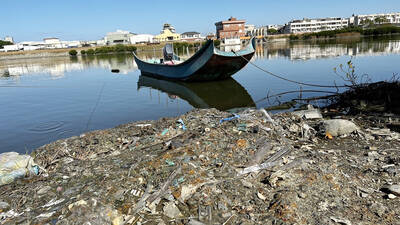
Many consumers are guilty of filling drawers or closets with old laptops, cellphones, fitness trackers and other electronic devices once they are no longer needed. It’s hard to know where to recycle such items, or it seems costly and inconvenient to do so. The world generates millions of tons of electronic waste — also called e-waste — each year. According to the UN’s most recent estimate, people worldwide produced 62 million metric tons of e-waste in 2022, and only about 22 percent of it was properly recycled. The US’ Environmental Protection Agency estimates that less than a quarter of e-waste is
You’re sitting in class when a classmate asks to borrow a pencil. It seems like a small favor, so you agree without hesitation. The following week, the same classmate asks to share your notes. Later, they request help with a group project. You agree each time — after all, you helped out the first time — but before you know it, it has become automatic. This scenario demonstrates the “foot-in-the-door technique,” a psychological concept that shows how agreeing to small, acceptable demands makes it easier to accept larger ones later on. The name for this strategy comes from door-to-door

A: The four-day Tomb Sweeping Day long weekend begins Friday and will run until Monday. Are you going to sweep your ancestors’ tombs? B: I did in advance last weekend, so I can go to Kaohsiung to see the musical “The Phantom of the Opera.” A: Wow, is “Phantom” touring Taiwan again? It debuted in 1986, so this year marks the 40th anniversary of the show. B: And it’s not just touring Kaohsiung starting March 31, but also Taipei starting April 21 and Taichung starting May 26. A: “Phantom” is one of the world’s Four Major Musicals. I’ve seen all of them, except “Les

Dos & Don’ts — 想想看,這句話英語該怎麼說? 1. 我們很早到達電影院。 ˇ We arrived at the theater very early. χ We arrived the theater very early. 註︰arrive 為不及物動詞,後面如果有受詞要用 at 或 in。例如:They arrived in Taipei yesterday.。一般大地方,如國家、省、大城市等前面用 in,凡小地方城鎮、學校等則用 at。 2. 開車半小時以後,我們到達了海灘。 ˇ After half an hour’s drive, we got to the beach. χ After half an hour’s drive, we got the beach. 註︰come, go, get(來、去、到達)某地時,在表示地點的名詞前面應該用 to,如 go to school, go to Taipei, come to Shanghai 等。如果這些動詞後面所跟的是 here, there, home 等副詞,則不用 to。 3. 明天我會回辦公室。 ˇ I will be back in the office tomorrow. χ I will be back to office tomorrow. 註︰to be back 一語裡的 back 是副詞,不是介詞,所以後面要用 at (the market) 或 in (the office)。 假如假期結束,要回學校上課了則可說: ? Kids will be back


 RSS
RSS