


A series of powerful earthquakes have rocked the Indonesian holiday island of Lombok, killing at least 10 people and setting off fresh waves of panic after nearly 500 died there following a huge tremor two weeks ago.
The quakes hit throughout Sunday, with the first measuring 6.3 shortly before midday which triggered landslides and sent people fleeing for cover as parts of the island suffered blackouts.
It was followed nearly 12 hours later by a quake measuring 6.9 magnitude and a string of powerful aftershocks.
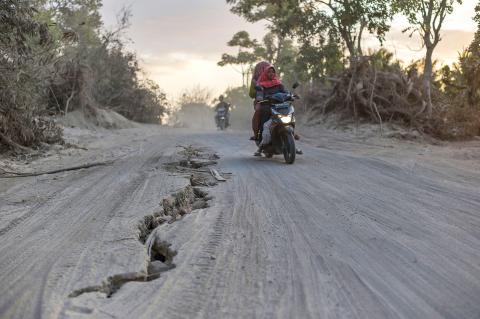
Photo:AP
照片: 美聯社
“Ring of Fire”
The latest tremor comes two weeks after a shallow 6.9-magnitude quake on Aug. 5 leveled tens of thousands of homes, mosques and businesses across Lombok. More than 460 people died and tens of thousands were injured.
The hardest hit region was in the north of the island, which has suffered hundreds of aftershocks since.
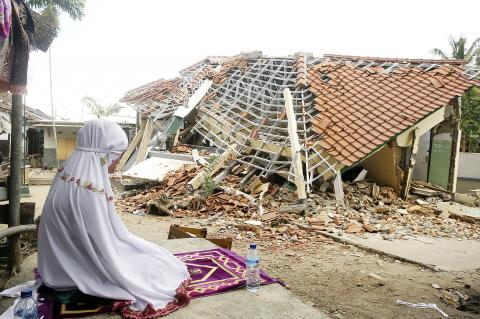
Photo: AP
照片:美聯社
A week before that quake another tremor surged through the island and killed 17.
The Aug. 5 quake left more than 350,000 displaced with many sleeping under tents or tarpaulins near their ruined homes or in evacuation shelters, while makeshift medical facilities were set up to treat the injured.
Badly damaged roads, particularly in the mountainous north of the island, have created a headache for relief agencies trying to distribute aid.
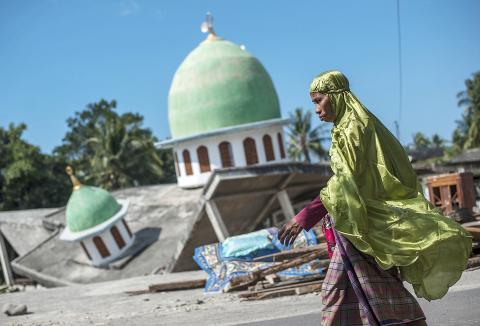
Photo: AP
照片:美聯社
Indonesia, an archipelago of thousands of islands, sits on the so-called Pacific “Ring of Fire,” where tectonic plates collide and many of the world’s volcanic eruptions and earthquakes occur.
The Australian and Eurasian plates, which sit under the archipelago, have been colliding and putting stress on key area fault lines, according to a geologist.
“Clearly there are different parts of the fault that are moving at the moment releasing those stressors,” said Chris Elders, an expert in plate tectonics and structural geology at Curtin University in Western Australia.
In 2004, a tsunami triggered by a magnitude 9.3 undersea earthquake off the coast of Sumatra, in western Indonesia, killed 220,000 people in countries around the Indian Ocean, including 168,000 in Indonesia.
(AFP)
一連串的強烈地震,重創了印尼度假勝地龍目島,造成至少十人死亡,在兩週前造成近五百人死亡的大地震後,再度引發恐慌。
週日整天都震個不停,第一次是發生在中午前,震度六‧三級,還引發了山崩,使該島部分地區停電,民眾紛紛逃離尋找掩護。
大約十二個小時之後,又發生了六‧九級的地震,以及一連串強烈的餘震。
「環太平洋火山帶」
八月五日,也就是八月十九日這次地震的兩週前,龍目島才發生了六‧九級的淺層地震,震垮了島上成千上萬的房屋、清真寺和商家,造成四百六十多人死亡、數萬人受傷。
受創最嚴重的地區是龍目島北部,已發生了數百次餘震。
在八月五日地震的前一週,龍目島已發生過地震,造成十七人死亡。
八月五日的地震使三十五萬餘人流離失所,許多人睡在震毀屋舍旁搭起的帳篷或防水布下,或是避難所,同時建立臨時醫療設施來治療傷患。
嚴重受損的道路,尤其是在多山的龍目島北部,令分發物資的救援機構倍感頭痛。
印尼是由數千個島嶼所組成的群島,位在所謂的太平洋「火環」(或稱「環太平洋火山帶」)上,環太平洋火山帶的構造板塊產生碰撞,世界上許多火山爆發和地震便發生在這裡。
據一位地質學家說,近來的地震是因為印尼群島下的澳洲和歐亞板塊產生碰撞,並對關鍵區域的斷層線施加壓力。
澳洲西部科廷大學的板塊構造及與結構地質學專家克里斯·艾德斯說:「很明顯地,斷層的不同部分正在移動,而將壓力釋放出來。」
二○○四年,印尼西部蘇門答臘島海域發生九‧三級海底地震,地震所引發的海嘯,造成印度洋周邊國家二十二萬人死亡,其中包括印尼的十六萬八千人。
(台北時報林俐凱編譯)
Many consumers are guilty of filling drawers or closets with old laptops, cellphones, fitness trackers and other electronic devices once they are no longer needed. It’s hard to know where to recycle such items, or it seems costly and inconvenient to do so. The world generates millions of tons of electronic waste — also called e-waste — each year. According to the UN’s most recent estimate, people worldwide produced 62 million metric tons of e-waste in 2022, and only about 22 percent of it was properly recycled. The US’ Environmental Protection Agency estimates that less than a quarter of e-waste is

You’re sitting in class when a classmate asks to borrow a pencil. It seems like a small favor, so you agree without hesitation. The following week, the same classmate asks to share your notes. Later, they request help with a group project. You agree each time — after all, you helped out the first time — but before you know it, it has become automatic. This scenario demonstrates the “foot-in-the-door technique,” a psychological concept that shows how agreeing to small, acceptable demands makes it easier to accept larger ones later on. The name for this strategy comes from door-to-door

A: The four-day Tomb Sweeping Day long weekend begins Friday and will run until Monday. Are you going to sweep your ancestors’ tombs? B: I did in advance last weekend, so I can go to Kaohsiung to see the musical “The Phantom of the Opera.” A: Wow, is “Phantom” touring Taiwan again? It debuted in 1986, so this year marks the 40th anniversary of the show. B: And it’s not just touring Kaohsiung starting March 31, but also Taipei starting April 21 and Taichung starting May 26. A: “Phantom” is one of the world’s Four Major Musicals. I’ve seen all of them, except “Les

Dos & Don’ts — 想想看,這句話英語該怎麼說? 1. 我們很早到達電影院。 ˇ We arrived at the theater very early. χ We arrived the theater very early. 註︰arrive 為不及物動詞,後面如果有受詞要用 at 或 in。例如:They arrived in Taipei yesterday.。一般大地方,如國家、省、大城市等前面用 in,凡小地方城鎮、學校等則用 at。 2. 開車半小時以後,我們到達了海灘。 ˇ After half an hour’s drive, we got to the beach. χ After half an hour’s drive, we got the beach. 註︰come, go, get(來、去、到達)某地時,在表示地點的名詞前面應該用 to,如 go to school, go to Taipei, come to Shanghai 等。如果這些動詞後面所跟的是 here, there, home 等副詞,則不用 to。 3. 明天我會回辦公室。 ˇ I will be back in the office tomorrow. χ I will be back to office tomorrow. 註︰to be back 一語裡的 back 是副詞,不是介詞,所以後面要用 at (the market) 或 in (the office)。 假如假期結束,要回學校上課了則可說: ? Kids will be back


 RSS
RSS