


The Hope Diamond, a rare blue diamond that is one of the world’s most famous jewels, has had a complicated history, passing through the hands of monarchs and bankers and heiresses and thieves before landing for all to see at a Washington museum. The geological history of blue diamonds is even more complex, according to research published on Aug. 1 examining these exceptionally scarce and valuable gems.
Scientists analyzed 46 blue diamonds, including one from South Africa that sold for US$25 million in 2016, and determined that they can form at depths of at least 660km, reaching into a part of the Earth’s interior called the lower mantle. Tiny mineral fragments trapped inside them provided clues about the birthplace of the diamonds. Blue diamonds comprise only about 0.02 percent of mined diamonds but include some of the world’s most famous jewels.
Diamonds are a crystalline form of pure carbon, forming under enormous heat and pressure. Blue diamonds crystallize alongside water-bearing minerals that long ago were part of the seafloor but were shoved to great depths during the inexorable movement of the immense tectonic plates that shape Earth’s surface, the researchers said.
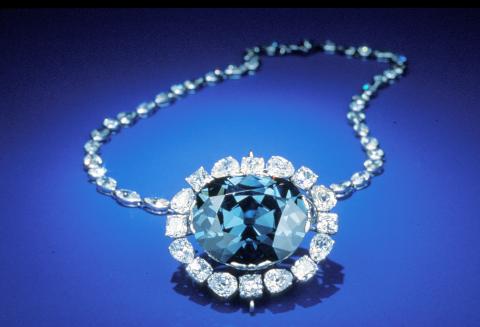
Photo: AP
照片:美聯社
Scientists already knew these diamonds acquired their blue hue from the element boron. This study indicated this boron once had been in ocean water and was incorporated into the seafloor rock that over millions of years moved deep underground.
“This is the first time anyone has come up with a fact-based story or model for how blue diamonds form. Prior to this study we had no idea where they form, what kinds of host-rocks they form in, or where they might be getting their boron from,” said Gemological Institute of America research scientist Evan Smith, who led the study published in the journal Nature.
Most diamonds are not completely colorless, often possessing slight yellowish tints. Although rare, some even have prominent hues of, for example, yellow, brown, pink or green. About 99 percent of all diamonds form roughly 150 to 200km underground — shallower depths than the blue ones.
Aside from the Hope Diamond, on display at the Smithsonian National Museum of Natural History, another blue diamond, called the Oppenheimer Blue, in 2016 sold for US$57.5 million, at the time the highest auction price for any jewel. “These diamonds are among the deepest ever found,” Carnegie Institution for Science geochemist Steven Shirey said of the blue diamonds.
(Reuters)
稀有的藍鑽石「希望鑽石」被譽為世界最著名的珠寶之一。這顆鑽石有著複雜的身世,曾輾轉落在君主、銀行家、女繼承人、盜賊的手中,最後才抵達華盛頓的一間博物館,供大眾欣賞。八月一日發表的一份研究,對這類特別稀少且貴重的寶石進行檢測,指出藍鑽石在地質學上的歷史很可能更加複雜。
科學家分析了四十六顆藍鑽石,其中包括一顆二○一六年以兩千五百萬美元售出的南非藍鑽石,並推定這些寶石形成於深達六百六十公里的地底下,直探地球內部被稱為下部地函的部分。深陷寶石內部的微小礦物碎片為藍鑽石的出生地提供了線索。在開採出土的鑽石中,藍鑽石僅佔百分之零點零二,如此微少的數量卻包含多件世上最富盛名的寶石飾品。
鑽石是純粹碳元素的結晶型態,在巨大的高溫與高壓下形成。研究人員指出,藍鑽石結晶時帶著含水的礦物質,這些礦物質很久以前曾是海床的一部分,卻因為不可抗拒的巨大板塊運動,在形塑地球表面的過程中,被推入地球深處。
科學家早已知道這類鑽石藉由硼元素獲得湛藍色澤。這次研究則指出其中的硼曾經存在於海洋水體,後來被併入海床岩石,經過數百萬年逐漸被推移到地底深處。
美國寶石學院的研究員伊凡‧史密斯是這份研究的主持人,成果已發表於《自然》期刊。史密斯表示:「這是第一次有人能以科學事實作為基礎,構築出藍鑽石來源的故事或形成模式。在這份研究前,我們對於它們的形成地點、於其中成形的主岩體種類,以及從何處獲得硼元素等面向皆一無所知。」
絕大多數的鑽石並非完全無色,而是經常帶有些許淡黃色澤。儘管數量稀少,有些鑽石甚至帶有顯眼的色澤,例如黃色、褐色、粉紅色或綠色。在所有鑽石中,大約百分之九十九都形成於深度大約一百五十到兩百公里之間的地底──比藍鑽石的深度還淺。
除了在美國史密森尼國立自然史博物館展示的「希望鑽石」之外,另一顆被稱為「奧本海默之藍」的藍鑽石在二○一六年以五千七百五十萬美元售出,成為當時所有寶石飾品的最高拍賣價格。卡內基科學研究所的地質化學專家史帝芬‧薛瑞提到藍鑽石時表示:「這些是在地底最深處所能發現的鑽石。」
(台北時報章厚明譯)

A: The Danjiang Bridge in New Taipei City is to open on May 12, and the MRT Sanying Line (Light Blue Line) will also open in June. Isn’t that great? B: Is that the bridge connecting the city’s Tamsui and Bali Districts? What’s so special about this new landmark spanning the Tamsui River? A: The Danjiang Bridge will become the world’s longest-span single-mast asymmetric cable-stayed bridge — with a total river-crossing section of 920 meters and main span of 450 meters. B: The news says there are sidewalks and bike lanes on both sides. Watching the sunset from the
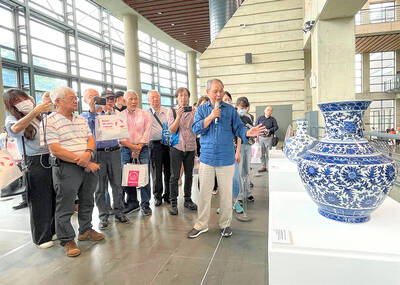
A: Apart from the Danjiang Bridge in New Taipei City, the MRT Sanying Line (Light Blue Line) will open in June. B: Is that the new line leading to Yingge District, the ceramic town? A: Yup, the line will connect the Yingge Ceramics Museum and the Old Streets in Sanxia and Yingge Districts. B: The eastward extension of the Tamsui-Xinyi Line (Red Line) that goes through Taipei’s Xinyi District will also open in June. A: Plus, Taoyuan’s Aerotropolis Line (Green Line) will partially open by the end of the year. In the future, it will connect the

In the dense forests of Tanzania, a young researcher sat quietly among the trees, her gaze fixed on a troop of chimpanzees. It was 1960, and Jane Goodall, armed with nothing but a notebook and endless curiosity, was about to change science forever. Inspired by childhood stories like the Dr. Dolittle series, she had dreamed of Africa — and now, thanks to the encouragement of anthropologist Louis Leakey, she was there, face-to-face with the wild. What Jane discovered shocked the world. Chimpanzees weren’t mere creatures of instinct; they were individuals with emotions, families, and even the capacity for tool
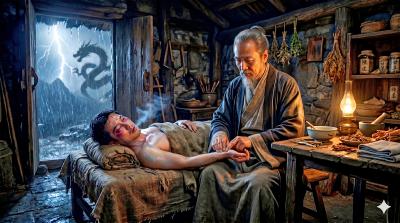
★ Bilingual Story is a fictionalized account. 雙語故事部分內容純屬虛構。 Rain hammered the roof in hard, uneven bursts. “Hold him still!” Baosheng pressed one hand against the stranger’s brow as the man twisted on the wooden bed. His left eye was swollen shut. The right one burned red like a coal. “It feels like fire,” the man gasped. “Like something is clawing inside.” Thunder rolled across the mountain. Baosheng leaned closer. The man’s skin was cold, but heat rose from his face. A strange smell hung in the air. He began the four methods of diagnosis: looking, listening/smelling,


 RSS
RSS