


Taiwanese manga artist Chen Uen (1958 — 2017) was known for employing a range of techniques in his illustrations, the breadth of which had not previously been seen in manga comics. Each illustration could be seen as a work of art in its own right.
His 1985 work Legends of Assassins was the world’s first series of manga comics using ink painting, and revisited the spirit and images of the heroes of the Records of the Grand Historian using traditional Chinese painting materials.
His Heroes of the Eastern Zhou Dynasty, serialized in Japan from March, 1990, won him acclaim from the Japanese, who called him an “Asian treasure.” Take Lord Xinling (photo 1) in vol. I for example, Chen paints Lord Xinling’s head, headwear, shield and right hand using classic Western realism painting techniques in meticulous detail, while the outline of his cloak is painted in a few broad sweeps of the brush.
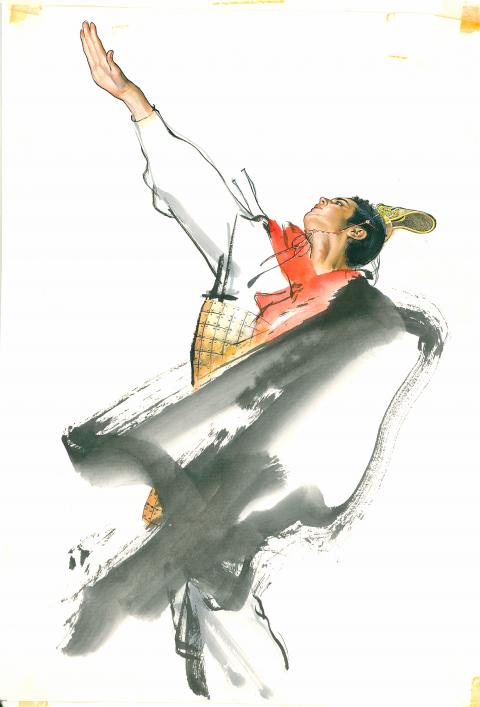
Photo courtesy of Chung Meng-shun, Chen Uen Studio
照片:鄭問工作室鍾孟舜提供
This treatment of clothing and the body give rise to associations with the abstract rendering of Liang Kai of the Southern Song Dynasty, with his Li Bai in Stroll (see Bilingual Arts on Dec. 30). In his extremely realistic rendering of the head coupled with the abstract cloak in the same painting, however, Chen creates the strongest possible juxtaposition of detailed realism and spirited freehand, at once his sensitive nature as well as the bold non-pretension.
Michaelangelo believed the sculptor’s task was to release the statue from inside the stone; Auguste Rodin’s carvings had well-finished forms emerging from roughly hewn stone. Having studied sculpture himself, Chen would have been no stranger to this concept, as we can see from his rendering of Lord Xinling springing out from the paper.
Chen was commissioned to illustrate over 200 characters for the Japanese computer game producer GameArts’ 2001 historical strategy game Chen Uen no San Goku Shi (Chen Uen’s Romance of the Three Kingdoms). Luoyang in Flames (photo 2) depicts the scene of Dong Zhuo setting fire to the city of Luoyang, grasping a young Emperor Xian of the Han Dynasty in his hand. The city of Luoyang in the background, engulfed in flames and black smoke, were unmistakably Chen’s work, something no other artist could have achieved, using the command over perspective and architectural drawing that he had perfected in the interior design studio he had established.
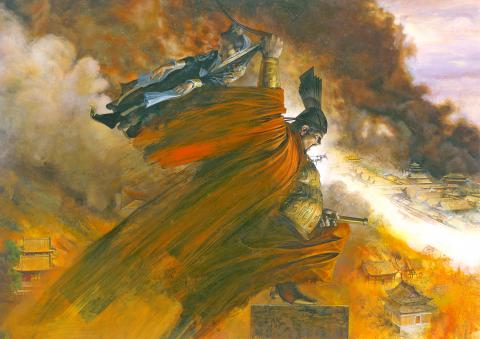
Photo courtesy of Chung Meng-shun, Chen Uen Studio
照片:鄭問工作室鍾孟舜提供
A selection of Chen Uen’s work will be on display at the National Palace Museum in Taipei from June.
(Translated by Paul Cooper)
在鄭問(一九五八~二○一七)之前,我們不知道漫畫竟可以有這麼多樣的技法、這樣氣勢滂礡、這樣令人久久注視,每一格都可以是一件藝術作品。
一九八五年的《刺客列傳》,是史上第一部水墨連環漫畫,以中國傳統的繪畫媒材重現《史記》中俠士的靈魂與身影。
一九九○年三月起在日本連載的《東周英雄傳》,讓日人稱鄭問為「亞洲至寶」。以第一冊中的〈信陵君無忌〉(圖一)為例,信陵君的頭部、冠飾、盔甲及右手掌,是以西洋古典寫實的畫法細緻營造出色彩如真的幻覺,而他的披風卻是以極粗獷的黑白水墨幾筆刷出輪廓。
這樣的衣著身形處理方式,令人聯想起南宋梁楷《李白行吟圖》的抽象寫意(見去年十二月三十日的「雙語藝術」單元)。然而,鄭問以極度寫實的頭部,與極度抽象的披風,將寫實與寫意間的距離拉到最大,並置到同一個畫面,呈現了人物性格的細緻與豪邁。
米開朗基羅認為,雕塑是把靈魂從石頭中解放出來,許多羅丹的作品也保留了原始石材,如形體正由渾沌中創生──學雕塑出身的鄭問想必對此並不陌生。如粗糙石材中逐步雕出的精緻形象,我們彷彿見證〈信陵君無忌〉的肉身自平面竄出。
《鄭問之三國誌》是日本電玩遊戲公司GameArts二○○一年所發行的歷史戰略遊戲,邀請鄭問繪製其中兩百多位人物的肖像。〈洛陽大火〉(圖二)呈現了董卓火燒洛陽城、挾持年幼漢獻帝的景象。背景烈焰與黑煙中的洛陽城,皆為鄭問親筆所繪──他曾開設室內設計公司,因而此處透視法及描繪建築的功力遠非一般畫家所能及。
鄭問的作品六月起將在台北國立故宮博物院展出。
(台北時報林俐凱)

In 2023, an 80-year-old woman in Taipei suffocated her paralyzed son after over five decades of caring for him. Turning herself in immediately, she confessed that worsening health and anxiety about who would care for him after her death had driven her to act. The court, acknowledging her difficult situation, sentenced her to two-and-a-half years in prison while recommending a presidential pardon. This rare judicial recommendation drew a complicated social response. Supporters argue that the mother’s half-century of caregiving renders her deserving of compassion instead of incarceration, believing that allowing her to live her final years in dignity and
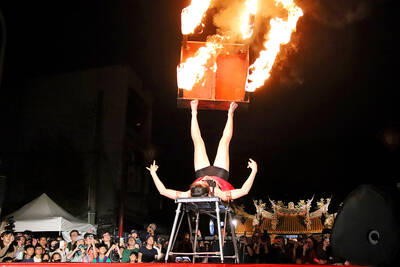
A: Over 130,000 college graduates are about to enter the workforce upon graduation. B: According to a survey, the top 10 most desired careers among Taiwanese are: independent content creator, civil servant, information engineer, financial professional, medical worker, content planner, flight attendant, news anchor, designer and fitness trainer. A: What are the “dream jobs” for young Gen Zers? B: The top three for men are YouTuber, pro gamer and engineer. For women, they are writer, social media editor and YouTuber. A: Every profession has its champion. Just look at Taiwanese fire dancer Yang Li-wei — who was on fire

★ Bilingual Story is a fictionalized account. 雙語故事部分內容純屬虛構。 The mango looked perfect. It sat on the fruit stand like a small sunset, red on one side and gold on the other. “I’ll take this one,” said Daniel. The fruit seller shook her head. “Not that one.” Daniel was surprised. “Why not? It looks beautiful.” “Yes,” she said, “but beautiful is not always ready.” She picked up another mango and held it near his nose. “First, smell here.” Daniel smelled the top of the mango. It was sweet and warm. “Good mangoes have a smell,” she said. “Next, feel the weight.”

1. 他非常討厭偽君子。 ˇ He has a deep hatred for hypocrites. χ He has a deep hatred to hypocrites. 註︰表示「對某人懷著愛、恨」等, 常用 have a love for/of, have a hatred for/of。 例如: We have a love for/of science. The working people have a hatred for/of all forms of exploitation. 2. 問題的答案其實不難找。 ˇ The answer to this question is not difficult to find. χ The answer of this question is not difficult to find. 註︰中文中的「的」在英語中不一定都用 of 來表示,有時須用 to。其他的例子如下: 我把房間的鑰匙弄丟了。 I lost the key to the room. 中間矗立著烈士紀念碑。 In the center stands the monument to the martyrs. 這部電影的續集你看過沒有? Have you seen the sequel to the movie? 3. 比起那家餐廳,他更喜歡這家。 ˇ He prefers this restaurant to that one. ˇ He likes


 RSS
RSS