


Britain and the US launched a US$25 million project last Monday to study the risks of a collapse of a giant glacier in Antarctica that is already shrinking and nudging up global sea levels. The five-year research, involving 100 scientists, will be the two nations’ biggest joint scientific project in Antarctica since the 1940s. Ice is thawing from Greenland to Antarctica and man-made global warming is accelerating the trend.
The scientists will study the Thwaites Glacier, which is roughly the size of Florida or Britain, in West Antarctica, the UK Natural Environment Research Council and US National Science Foundation said in a joint statement. “Rising sea levels are a globally important issue which cannot be tackled by one country alone,” UK science minister Sam Gyimah said.
Thwaites and the nearby Pine Island Glacier are two of the biggest and fastest-retreating glaciers in Antarctica. If both abruptly collapsed, allowing ice far inland to flow faster into the oceans, world sea levels could rise by more than 1m, threatening cities from Shanghai to San Francisco and low-lying coastal regions.
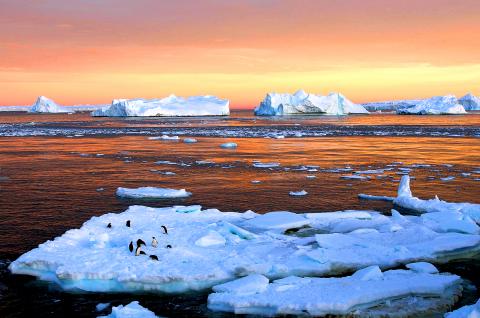
Photo: Reuters
照片:路透
The scientists will deploy planes, hot water drills, satellite measurements, ships and robot submarines to one of the remotest parts of the planet to see “whether the glacier’s collapse could begin in the next few decades or centuries,” the statement said.
Despite satellites, “there are still many aspects of the ice and ocean that cannot be determined from space,” said Ted Scambos, of the National Snow and Ice Data Center and the lead US scientific coordinator.
Other scientists from South Korea, Germany, Sweden, New Zealand and Finland will also contribute.
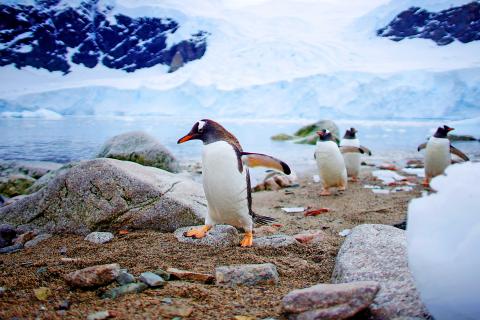
Photo: Reuters
照片:路透
The US is keeping up with research even though US President Donald Trump doubts mainstream scientific findings that human activities, led by the burning of fossil fuels, are the main cause of global warming.
(Reuters)
英國和美國上週一展開一項斥資兩千五百萬美元的研究計畫,以探討南極洲一條巨型冰河的崩塌風險。這條冰河已經開始縮小,並且逐漸造成全球海平面上升。由一百名科學家參與的這項五年研究計畫,將是一九四○年代以來英美兩國所進行最大的科學研究合作計畫。從格陵蘭到南極洲,地球兩極的冰層正在融化,人為的全球暖化效應更加速這個趨勢。
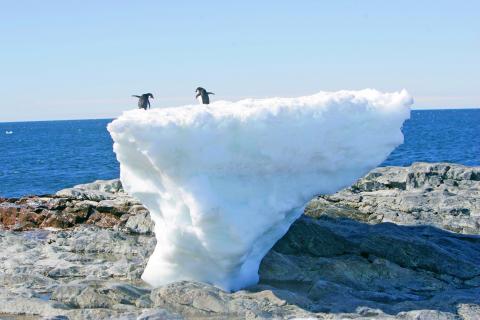
Photo: Reuters
照片:路透
英國自然環境研究委員會與美國國家科學基金會在聯合聲明中指出,科學家將研究南極洲西部的史威茲冰河,該冰河面積相當於佛羅里達州或是整個英國。英國內閣科學大臣山姆·吉馬表示:「上升中的海平面是一項全球性的重要議題,非單一國家能獨力處理。」
史威茲冰河與鄰近的松島冰河是南極洲規模最大而且退縮速度最快的兩條冰河。如果兩條冰河突然崩塌,導致遠在內陸的冰更快流入海洋,可能導致全球海平面上升超過一公尺,將嚴重威脅上海和舊金山等城市,以及其他地勢低矮的沿海區域。
英美聯合聲明表示,科學家將在這個全球有數最偏遠的地區廣泛運用飛機、熱水鑽機、衛星測量、船隻,以及機器潛艇,以檢視「史威茲冰河崩塌是否會在接下來幾十年或幾世紀發生。」
美國國家雪冰資料中心的泰德‧史坎波斯是該研究計畫的美國主協調人。他指出,雖然有衛星協助,「冰層與海洋仍然有許多面相是無法從高空中推斷。」
來自南韓、德國、瑞典、紐西蘭以及芬蘭等國的其他科學家也會為此研究貢獻心力。
儘管美國總統唐納‧川普對於主流科學研究結果抱持著懷疑的態度,並不認為人類活動──主要來自於燃燒化石燃料──是全球暖化的主要原因,然而美國仍然持續進行相關研究。
(台北時報章厚明譯)

The debate surrounding Taipower’s recent corporate identity reboot has gone well beyond the design community. The controversy began after Taipower replaced the familiar “Taiwan Power Company” wording — widely regarded as the calligraphy of Yu You-ren (1879-1964), former Control Yuan president and master calligrapher — with a modern logotype by designer Aaron Nieh’s team, Aaron Nieh Workshop. Taipower said the change was not a wholesale replacement of old signage, but an “optimization of its identity system,” aimed at meeting the needs of digital media, electronic bills, apps, social media graphics and various small-format applications. Existing physical markings, such as building

Since 2005, the third Monday in January has come to be known as “Blue Monday.” In other words, that day is believed to be the most depressing day of the year. This concept seems logical at first. After all, Monday marks the start of the school or workweek after two days of rest and fun. Also, blue is a color that is often associated with sadness. Furthermore, in many parts of the world, January is a time when the weather is cold, rainy, and gloomy. But is there any scientific proof that this January day is truly sadder than any of

Continued from yesterday(延續自昨日) https://www.taipeitimes.com/News/lang For the most part, the idea of “Blue Monday” has been rejected as a myth. Some mental health experts also say there is a danger in labeling a certain day as the most depressing time of the entire year. Some argue that if people expect to feel sadder on the third Monday in January, this belief alone may increase their anxiety. One group that is worried about the negative effect of believing in Blue Monday is Samaritans. A mental health charity based in the UK, Samaritans is working to turn Blue Monday into “Brew Monday.” In this

A: In early May, there were concerts by Icyball, Chyi Yu, Korea’s EXO and Japan’s Anisama, but I missed them all. What a shame. B: That’s OK. There are shows coming up by various artists, including Power Station, Accusefive, Japanese singer Mika Nakashima, Chinese-Icelandic jazzer Laufey, and even Singaporean diva Stefanie Sun. A: After a 12-year hiatus, Stefanie is finally returning to Taipei again. B: In late May, there will be more shows by Crowd Lu, WeiBird, Korea’s Donghae, 2AM, EXID, and Thailand’s BUS. A: The Thai boyband is so popular. It looks like “T-pop” is catching up with J-pop


 RSS
RSS