


Researchers have discovered the first evidence that people can genetically adapt to deep diving, as shown by the unusually large spleens in indigenous people of Indonesia known as the “Sea Nomads,” a study said Thursday.
The spear-fishing Bajau people regularly free-dive to depths of up to 230 feet (70 meters), with only weights and a wooden mask. They spend up to 60 percent of their work day diving for fish, spearing octopus and gathering crustaceans and can stay underwater up to 13 minutes at a time, said the report in the journal Cell.
American researcher Melissa Ilardo, then a post doctoral candidate at the Centre for GeoGenetics at the University of Copenhagen, wondered if they had genetically adapted somehow to be able to spend more time underwater than other people. She spent several months in Jaya Bakti, Indonesia, with the help of a translator, getting to know the Bajau and another nearby group that did not dive, the Saluan. She took genetic samples and did ultrasound scans, which showed that Bajau had spleens about 50 percent larger than the Saluan.
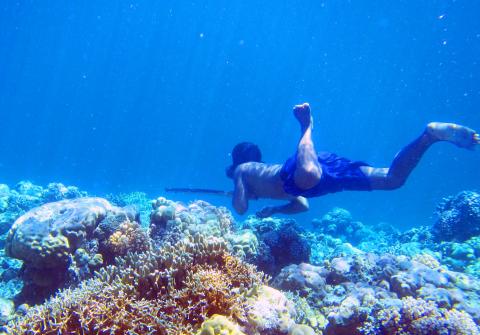
Photo: AFP
照片:法新社
Spleens are important in diving—and are also enlarged in some seals—because they release more oxygen into the blood when the body is under stress, or a person is holding their breath underwater.
Spleens were larger in the Bajau people whether they were regular divers or not, and further analysis of their DNA revealed why.
Comparing the genomes of the Bajau to two different populations, the Saluan and the Han Chinese, scientists found 25 sites that differed significantly. Among them was one site on a gene known as PDE10A, which was determined to be linked to the Bajau’s larger spleen size.
In mice, PDE10A is known for regulating a thyroid hormone that controls spleen size, lending support for the idea that the Bajau might have evolved the spleen size necessary to sustain their long and frequent dives,’ said the study.
The findings could boost research in medicine by helping researchers understand how the body reacts to a loss of oxygen in various contexts, from diving to high-latitude climbing to surgery and lung disease.
(AFP)
上週四發表的一項研究發現,被稱為「海上游牧民族」的印尼原住民,有特別大的脾臟,這是第一次有證據顯示人類可以透過基因的改變來適應深海潛水。
巴瑤族用魚叉捕魚,經常自由潛水(沒有水下氧氣設備的輔助)深達二三○英尺(七十公尺),只攜帶重物和木製面罩。發表於《細胞》期刊的這篇研究報告說,巴瑤族人的工作日有百分之六十的時間是在潛水捕魚、用魚叉刺章魚和採集甲殼類動物,並可一口氣待在水下長達十三分鐘。
美國研究人員梅麗莎‧伊拉多──當時仍是哥本哈根大學地質遺傳學研究中心博士後研究員,想知道巴瑤人的基因是否有所改變,以便能夠比一般人在水下待更久的時間。為了解巴瑤族和附近另一個不潛水的薩盧安族,她在翻譯員的協助下,在印尼的加亞巴提待了數月。她採集了基因樣本並進行超音波掃描,結果顯示巴瑤族人的脾臟比薩盧安族還要大了約百分之五十。
脾臟在潛水時很重要──有些海豹的脾臟也變大了──因為當身體處於壓力下,或人正在水下憋氣時,脾臟會把更多的氧氣釋放進血液中。
巴瑤人的脾臟都比較大,無論他們是否常潛水──對他們DNA的進一步分析揭示了原因。
比較巴瑤人的基因組和另兩個不同的族群──薩盧安族及漢族,科學家發現了二十五處明顯不同。其中一處是在名為PDE10A的基因,這個基因已確知與巴瑤族人較大的脾臟有關。
這項研究說,在老鼠中,「基因PDE10A的功能是調整甲狀腺激素,甲狀腺激素的多寡決定了脾臟的大小,這提供了證據,說明巴瑤族人可能已進化出較大的脾臟,以便能夠適應長時間及頻繁的潛水。」
這些發現可以幫助研究人員了解在各種情況下,包括潛水、高緯度攀爬、手術、肺部疾病,身體對氧氣流失的反應,從而促進醫學研究。
(台北時報林俐凱編譯)
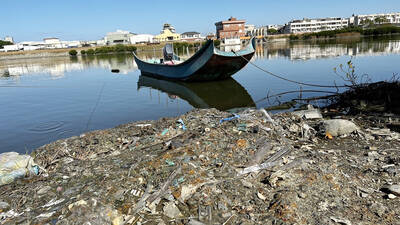
Many consumers are guilty of filling drawers or closets with old laptops, cellphones, fitness trackers and other electronic devices once they are no longer needed. It’s hard to know where to recycle such items, or it seems costly and inconvenient to do so. The world generates millions of tons of electronic waste — also called e-waste — each year. According to the UN’s most recent estimate, people worldwide produced 62 million metric tons of e-waste in 2022, and only about 22 percent of it was properly recycled. The US’ Environmental Protection Agency estimates that less than a quarter of e-waste is

You’re sitting in class when a classmate asks to borrow a pencil. It seems like a small favor, so you agree without hesitation. The following week, the same classmate asks to share your notes. Later, they request help with a group project. You agree each time — after all, you helped out the first time — but before you know it, it has become automatic. This scenario demonstrates the “foot-in-the-door technique,” a psychological concept that shows how agreeing to small, acceptable demands makes it easier to accept larger ones later on. The name for this strategy comes from door-to-door

A: The four-day Tomb Sweeping Day long weekend begins Friday and will run until Monday. Are you going to sweep your ancestors’ tombs? B: I did in advance last weekend, so I can go to Kaohsiung to see the musical “The Phantom of the Opera.” A: Wow, is “Phantom” touring Taiwan again? It debuted in 1986, so this year marks the 40th anniversary of the show. B: And it’s not just touring Kaohsiung starting March 31, but also Taipei starting April 21 and Taichung starting May 26. A: “Phantom” is one of the world’s Four Major Musicals. I’ve seen all of them, except “Les

Dos & Don’ts — 想想看,這句話英語該怎麼說? 1. 我們很早到達電影院。 ˇ We arrived at the theater very early. χ We arrived the theater very early. 註︰arrive 為不及物動詞,後面如果有受詞要用 at 或 in。例如:They arrived in Taipei yesterday.。一般大地方,如國家、省、大城市等前面用 in,凡小地方城鎮、學校等則用 at。 2. 開車半小時以後,我們到達了海灘。 ˇ After half an hour’s drive, we got to the beach. χ After half an hour’s drive, we got the beach. 註︰come, go, get(來、去、到達)某地時,在表示地點的名詞前面應該用 to,如 go to school, go to Taipei, come to Shanghai 等。如果這些動詞後面所跟的是 here, there, home 等副詞,則不用 to。 3. 明天我會回辦公室。 ˇ I will be back in the office tomorrow. χ I will be back to office tomorrow. 註︰to be back 一語裡的 back 是副詞,不是介詞,所以後面要用 at (the market) 或 in (the office)。 假如假期結束,要回學校上課了則可說: ? Kids will be back


 RSS
RSS