


Pepper, a humanoid robot with artificial intelligence (AI), jointly developed by the Taoyuan City Government and the Ministry of Economic Affairs’ Industrial Development Bureau, is now deployed at the main hall of the Taoyuan City Government on the first floor to answer questions from members of the public about the government’s services provided to local residents.
Taoyuan Mayor Cheng Wen-tsan on Dec. 20 welcomed Pepper on joining the city government at a council meeting and presented the robot with an employee ID card. According to Cheng, Pepper can access a wide-ranging cloud database, which allows it to answer questions about the services provided by each bureau under the city government as well as general questions about living in the city. Moreover, the robot’s artificial intelligence enables it to learn and improve itself. The more questions people ask it, the better its answers become.
Head of the Taoyuan City Government Research and Evaluation Commission Chan Ho-shun says that Pepper will be available to help members of the public every day from 9am to 4pm, with no lunch breaks, at the Taoyuan City Government’s main hall on the first floor. In addition to welcoming visitors to the city government and guiding them to where they want to go, it can also answer questions about government services provided to the city’s residents, Chan adds. Pepper is not only helping the government reduce its costs, but is also fun to look at and interact with.
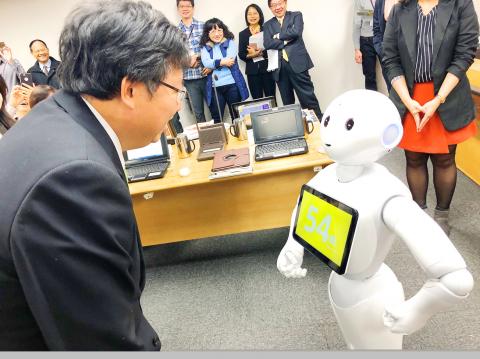
Photo: Chen Yun, Liberty Times
照片:自由時報記者陳昀
(Liberty Times, translated by Tu Yu-an)
桃園市府與經濟部工業局合作打造人工智慧仿人機器人Pepper,即日起在桃園市府一樓大廳服務,供市民諮詢市政問題。
桃園市長鄭文燦十二月二十日在市政會議歡迎Pepper加入市府團隊,並頒發員工證。他說,Pepper有豐富的雲端資料庫,能回答市府各局處申辦項目與一般生活相關問題,並具備人工智慧的學習功能,市民詢問的問題越多,回答能力會越強大。
市府研究考核發展委員會主任委員詹賀舜表示,Pepper每天上午九點至下午四點會在市府一樓大廳服務,中午不休息,除了提供迎賓引導服務,也能供市民諮詢市政問題,不但節省市府服務成本,且吸睛、充滿新鮮感。
(自由時報記者陳昀)

Many consumers are guilty of filling drawers or closets with old laptops, cellphones, fitness trackers and other electronic devices once they are no longer needed. It’s hard to know where to recycle such items, or it seems costly and inconvenient to do so. The world generates millions of tons of electronic waste — also called e-waste — each year. According to the UN’s most recent estimate, people worldwide produced 62 million metric tons of e-waste in 2022, and only about 22 percent of it was properly recycled. The US’ Environmental Protection Agency estimates that less than a quarter of e-waste is

You’re sitting in class when a classmate asks to borrow a pencil. It seems like a small favor, so you agree without hesitation. The following week, the same classmate asks to share your notes. Later, they request help with a group project. You agree each time — after all, you helped out the first time — but before you know it, it has become automatic. This scenario demonstrates the “foot-in-the-door technique,” a psychological concept that shows how agreeing to small, acceptable demands makes it easier to accept larger ones later on. The name for this strategy comes from door-to-door

A: The four-day Tomb Sweeping Day long weekend begins Friday and will run until Monday. Are you going to sweep your ancestors’ tombs? B: I did in advance last weekend, so I can go to Kaohsiung to see the musical “The Phantom of the Opera.” A: Wow, is “Phantom” touring Taiwan again? It debuted in 1986, so this year marks the 40th anniversary of the show. B: And it’s not just touring Kaohsiung starting March 31, but also Taipei starting April 21 and Taichung starting May 26. A: “Phantom” is one of the world’s Four Major Musicals. I’ve seen all of them, except “Les

Continued from yesterday(延續自昨日) https://www.taipeitimes.com/News/lang Gig Tripping “Gig tripping” combines concerts with travel. People fly to see their favorite artists perform — usually abroad—and spend a few days sightseeing before or after the show. While die-hard fans have done this since the 1960s, the post-pandemic travel boom changed the game. Even people who aren’t superfans are now booking international concert trips because they want to make the most of travel opportunities. This trend exploded in the US, as the math makes sense. Domestic concert tickets are so costly that flying abroad for the show plus tourism expenses often matches or even beats the price


 RSS
RSS