


Fourteen-year-old Sota Fujii, a professional shogi (Japanese chess) player, smashed a 30-year shogi record and took his country by storm by pulling off a record-breaking 29-match winning streak.
Fujii, who practices extensively using computer chess software — and is Japan’s youngest professional shogi player, on June 26 broke the 30-year record in shogi of 28 consecutive match wins.
For Japan, a country which has been stuck in a trap of deflation and economic stagnation for more than 15 years, Fujii’s brilliant performance has attracted a posse of diehard fans from all walks of life — and even won him acclaim from Japanese Prime Minister Shinzo Abe.
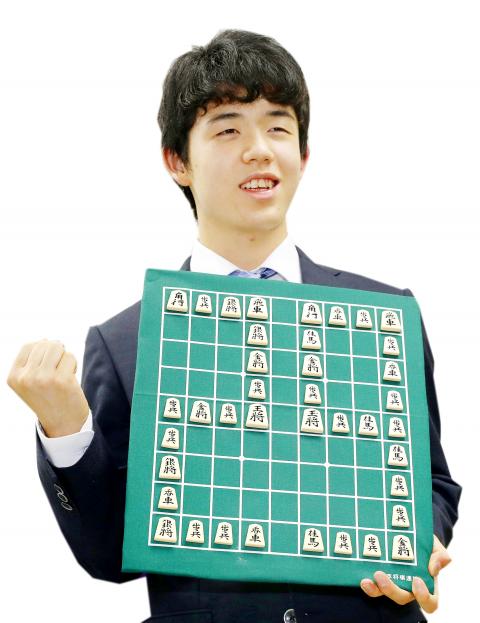
Photo: CNA
照片:中央社
Speaking to reporters, Abe said: “The power of youth has made history. His victory is like a dream that gives hope to the Japanese people.”
Fujii, who battled for 11 hours against a 19-year-old pro, was as cool as a cucumber during the post-match interviews. “I never imagined that I would win 29 matches in a row. I feel very happy, but also extremely surprised.”
Fujii is coached by a veteran professional shogi player. However, according to Japan’s Asahi Shimbun newspaper, after starting to practice with computer software around a year and a half ago, Fujii’s chess skills improved dramatically.
Training with a computer is frowned upon and viewed as unorthodox by many professional shogi players. However, a member of the Japan Shogi Association noted that, “During the course of his or her lifetime, a professional shogi player will be extremely fortunate to participate in as many as 1,000 matches. By using artificial intelligence chess programs, it is possible to play several thousand times more this number and accumulate professional-level skills.”
On July 2, Fujii was beaten while attempting to win a 30th consecutive victory, halting the new record at 29 matches. After the match, Fujii said: “A winning streak always comes to an end eventually. I was utterly defeated.”
(CNA and LIBERTY TIMES, TRANSLATED BY EDWARD JONES)
現年十四歲的將棋職業棋士藤井聰太取得二十九連勝,打破日本將棋三十年來的紀錄,因此風靡全國。
透過與電腦軟體下棋反覆訓練的藤井聰太,為日本最年輕職業棋士。他六月二十六日打破三十年前寫下的二十八連勝紀錄。
在日本陷入逾十五年來的通縮和經濟停滯困境之際,他的精彩表現獲得各行各業、死忠的將棋迷、甚至首相安倍晉三的喝采。
安倍告訴記者:「年輕力量已創造歷史。這項勝利為日本人民帶來夢想和希望。」
藤井聰太跟十九歲職業棋手鏖戰十一個小時後,沉著冷靜地接受記者訪問。藤井聰太說:「我真的完全沒想到能連贏二十九場比賽,我很開心,但也感到非常驚訝。」
藤井聰太有資深職業將棋棋士作為師傅,但根據日本的「朝日新聞」,他一年半前左右開始與電腦軟體對弈後,棋藝有了顯著提升。
許多職業將棋棋士並不認同與電腦軟體下棋的訓練方式。但日本將棋聯盟一名幹部表示:「一名職業將棋棋士如果一生中能參加多達一千場比賽,就很幸運了。而人工智慧程式實際上卻比這個數字再多個好幾千倍,得以累積專業技藝。」
藤井聰太平二日在挑戰第三十勝時敗陣,連勝紀錄在二十九連勝止步。比賽結束之後,藤井聰太平靜地說:「連勝終究是會停止的,我徹底敗北。」
(中央社、自由時報)

Many consumers are guilty of filling drawers or closets with old laptops, cellphones, fitness trackers and other electronic devices once they are no longer needed. It’s hard to know where to recycle such items, or it seems costly and inconvenient to do so. The world generates millions of tons of electronic waste — also called e-waste — each year. According to the UN’s most recent estimate, people worldwide produced 62 million metric tons of e-waste in 2022, and only about 22 percent of it was properly recycled. The US’ Environmental Protection Agency estimates that less than a quarter of e-waste is

You’re sitting in class when a classmate asks to borrow a pencil. It seems like a small favor, so you agree without hesitation. The following week, the same classmate asks to share your notes. Later, they request help with a group project. You agree each time — after all, you helped out the first time — but before you know it, it has become automatic. This scenario demonstrates the “foot-in-the-door technique,” a psychological concept that shows how agreeing to small, acceptable demands makes it easier to accept larger ones later on. The name for this strategy comes from door-to-door

A: The four-day Tomb Sweeping Day long weekend begins Friday and will run until Monday. Are you going to sweep your ancestors’ tombs? B: I did in advance last weekend, so I can go to Kaohsiung to see the musical “The Phantom of the Opera.” A: Wow, is “Phantom” touring Taiwan again? It debuted in 1986, so this year marks the 40th anniversary of the show. B: And it’s not just touring Kaohsiung starting March 31, but also Taipei starting April 21 and Taichung starting May 26. A: “Phantom” is one of the world’s Four Major Musicals. I’ve seen all of them, except “Les

Dos & Don’ts — 想想看,這句話英語該怎麼說? 1. 我們很早到達電影院。 ˇ We arrived at the theater very early. χ We arrived the theater very early. 註︰arrive 為不及物動詞,後面如果有受詞要用 at 或 in。例如:They arrived in Taipei yesterday.。一般大地方,如國家、省、大城市等前面用 in,凡小地方城鎮、學校等則用 at。 2. 開車半小時以後,我們到達了海灘。 ˇ After half an hour’s drive, we got to the beach. χ After half an hour’s drive, we got the beach. 註︰come, go, get(來、去、到達)某地時,在表示地點的名詞前面應該用 to,如 go to school, go to Taipei, come to Shanghai 等。如果這些動詞後面所跟的是 here, there, home 等副詞,則不用 to。 3. 明天我會回辦公室。 ˇ I will be back in the office tomorrow. χ I will be back to office tomorrow. 註︰to be back 一語裡的 back 是副詞,不是介詞,所以後面要用 at (the market) 或 in (the office)。 假如假期結束,要回學校上課了則可說: ? Kids will be back


 RSS
RSS