


Colorful painted pottery statues are a common form of decoration on temple roofs and walls in Taiwan. These are traditionally fashioned from koji pottery, mostly depicting themes from fables and legends or historical stories.
Koji pottery is polychromatic glazed earthenware, fired at low temperatures, using a range of techniques including sculpting, color glazing and firing.
Ye Wang (1826-1887) is known as “the pioneer of koji pottery in Taiwan.” Ye was born in Chiayi. His father, Ye Qingyue, was originally from Zhangzhou in Fujian Province, and came to Taiwan in 1805 to start a new life here, making his living in pottery. Ye Wang continued the techniques and materials of the Fujian and Guangzhou potters, creating realistic statues using clay modeling methods and ways of controlling firing in the kiln.
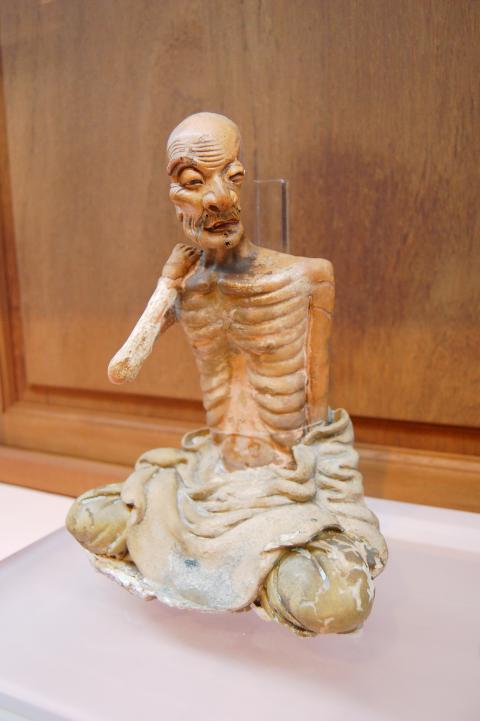
Photo: Yang Chin-cheng, Liberty Times
照片:自由時報記者楊金城
In the year 1860 renovations were carried out on the Cihji Temple in Tainan’s Syuejia District, and Ye was commissioned to make the wall and roof decorations. This was a major project, and it took him over two years to complete.
The facial features of the surviving figures from this project are meticulously carved, with lively expressions and the application of slip to accentuate the facial skin textures, demonstrating outstanding command of contemporary techniques. The figures themselves are quite small. With many of these figures, the body and the limbs would have had to have been fired separately, and later assembled. His work featured in a Paris Exposition during the Japanese colonial period, where it made a storm in art circles.
As koji pottery is predominantly used as architectural decor, after more than a century few of Ye’s works have survived successive renovations of the temples they adorned. The majority and most representative of Ye’s extant works can be seen on Cihji Temple and also Jhensing Temple in Tainan’s Jiali District.
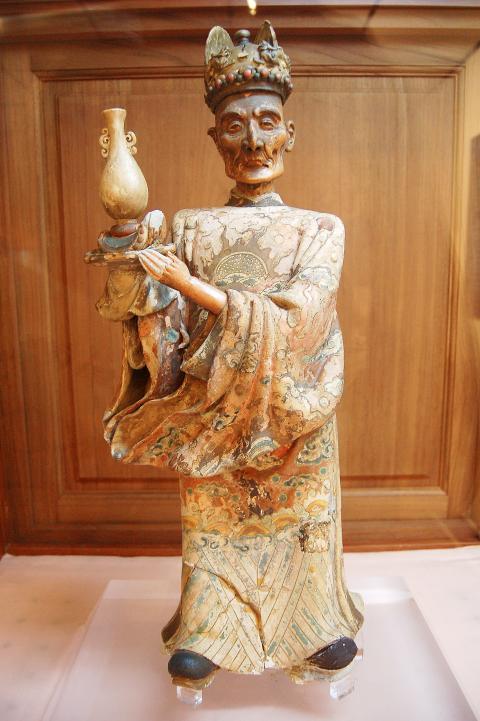
Photo: Yang Chin-cheng, Liberty Times
照片:自由時報記者楊金城
(Translated by Paul Cooper)
在台灣的廟宇建築中,屋頂與牆壁常見彩釉陶塑裝飾,傳統常以交趾陶製作,題材多為神話傳奇或歷史故事。
交趾陶是以低溫燒製而成的多彩釉軟陶,融合雕塑、釉彩及燒陶等多種技法於一體。

Photo: Wikimedia Commons
照片:維基共享資源
葉王被譽為「臺灣交趾陶的第一人」,清道光六年(一八二六)出生於嘉義,卒於光緒十三年(一八八七),其父葉清嶽原籍福建漳州,於嘉慶十年(一八○五)來台灣嘉義定居,以製陶為業。葉王承繼了福建及廣東匠師的技術和材料,以精湛的陶土捏塑技法與窯燒技術控制,表現寫實手法之塑像。
清咸豐十年(一八六○年)台南學甲慈濟宮進行整修,禮聘葉王做壁堵及屋頂的裝飾。此工程浩大,葉王耗時兩年多才完成。
葉王這批傳世之作人物五官刻劃細膩、表情生動,更應用化妝土表現臉部肌理質感,為當時技法之突破。人物塑像尺寸雖不大,但製作之過程須將身體與手腳分開燒製,然後再加以組合。葉王之遺作曾在日治時期被選送參加巴黎萬國博覽會,轟動世界藝壇。
由於交趾陶主要是作為建築裝飾,因此歷經一百多年的時間後,葉王的許多作品早已隨寺廟的翻修而逸失。現存葉王作品在慈濟宮、佳里震興宮這兩間廟宇保存的數量最多、最具代表性。
(台北時報林俐凱)
Many consumers are guilty of filling drawers or closets with old laptops, cellphones, fitness trackers and other electronic devices once they are no longer needed. It’s hard to know where to recycle such items, or it seems costly and inconvenient to do so. The world generates millions of tons of electronic waste — also called e-waste — each year. According to the UN’s most recent estimate, people worldwide produced 62 million metric tons of e-waste in 2022, and only about 22 percent of it was properly recycled. The US’ Environmental Protection Agency estimates that less than a quarter of e-waste is

You’re sitting in class when a classmate asks to borrow a pencil. It seems like a small favor, so you agree without hesitation. The following week, the same classmate asks to share your notes. Later, they request help with a group project. You agree each time — after all, you helped out the first time — but before you know it, it has become automatic. This scenario demonstrates the “foot-in-the-door technique,” a psychological concept that shows how agreeing to small, acceptable demands makes it easier to accept larger ones later on. The name for this strategy comes from door-to-door

A: The four-day Tomb Sweeping Day long weekend begins Friday and will run until Monday. Are you going to sweep your ancestors’ tombs? B: I did in advance last weekend, so I can go to Kaohsiung to see the musical “The Phantom of the Opera.” A: Wow, is “Phantom” touring Taiwan again? It debuted in 1986, so this year marks the 40th anniversary of the show. B: And it’s not just touring Kaohsiung starting March 31, but also Taipei starting April 21 and Taichung starting May 26. A: “Phantom” is one of the world’s Four Major Musicals. I’ve seen all of them, except “Les

Dos & Don’ts — 想想看,這句話英語該怎麼說? 1. 我們很早到達電影院。 ˇ We arrived at the theater very early. χ We arrived the theater very early. 註︰arrive 為不及物動詞,後面如果有受詞要用 at 或 in。例如:They arrived in Taipei yesterday.。一般大地方,如國家、省、大城市等前面用 in,凡小地方城鎮、學校等則用 at。 2. 開車半小時以後,我們到達了海灘。 ˇ After half an hour’s drive, we got to the beach. χ After half an hour’s drive, we got the beach. 註︰come, go, get(來、去、到達)某地時,在表示地點的名詞前面應該用 to,如 go to school, go to Taipei, come to Shanghai 等。如果這些動詞後面所跟的是 here, there, home 等副詞,則不用 to。 3. 明天我會回辦公室。 ˇ I will be back in the office tomorrow. χ I will be back to office tomorrow. 註︰to be back 一語裡的 back 是副詞,不是介詞,所以後面要用 at (the market) 或 in (the office)。 假如假期結束,要回學校上課了則可說: ? Kids will be back


 RSS
RSS