


A: The weather’s so nice today, let’s go to the beach.
B: With the sun this hot, I’m worried I’ll get a sun tan. If we go, I’m wearing my facekini.
A: Oh please no. You look like you’re wearing a facial mask with that thing on. Don’t worry, we can hire an umbrella.
B: OK, let’s compromise. No facekini, but we take the sun tent.
A: 今天天氣真好,我們一起去海邊玩吧。
B: 太陽這麼烈,我怕會曬黑。要去的話,我要帶我的臉基尼。
A: 喔,拜託,不要帶啦。你戴著那個看起來好像在敷臉。我們可以租一把陽傘,這樣你就不用擔心曬黑了。
B: 那這樣吧,我們雙方各退一步。我不戴臉基尼,但我們要有遮陽帳棚。
English 英文:
Chinese 中文:

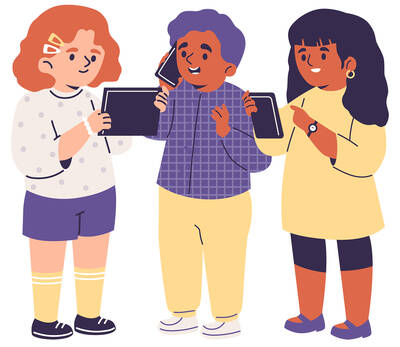
In an effort to fight phone scams, British mobile phone company O2 has introduced Daisy, an AI designed to engage phone con artists in time-wasting conversations. Daisy is portrayed as a kindly British granny, exploiting scammers’ tendency to target the elderly. Her voice, based on a real grandmother’s for authenticity, adds to her credibility in the role. “O2” has distributed several dedicated phone numbers online to direct scammers to Daisy instead of actual customers. When Daisy receives a call, she translates the scammers’ spoken words into text and then responds to them accordingly through a text-to-speech system. Remarkably, Daisy
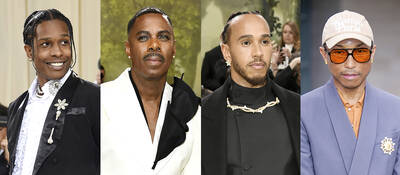
A: Isn’t the Met Gala, the Metropolitan Museum of Art’s fundraiser, chaired by Vogue editor-in-chief Anna Wintour? B: Yeah, the blockbuster “The Devil Wears Prada” is allegedly based on her story. A: This year’s four co-chairs are actor Colman Domingo, F1 driver Lewis Hamilton, rapper A$AP Rocky and Louis Vuitton men’s creative director Pharrell Williams. B: And basketball superstar LeBron James is the honorary chair. A: I can’t wait to see the lineup of stars on the red carpet. A: 大都會博物館慈善晚宴「Met Gala」,是《時尚》雜誌全球總監安娜溫圖為該館服裝學院主辦的募款活動吧? B: 對啊,電影《穿著普拉達的惡魔》據說是以她為範本。 A: 今年晚宴共同主席還有:演員柯爾曼多明哥、F1賽車手路易斯漢米頓、饒舌歌手A$AP洛基、LV男裝創意總監菲董。 B: 籃球巨星勒布朗詹姆斯則是榮譽主席。 A: 紅毯上的全球星光真令人期待! (By Eddy Chang, Taipei Times/台北時報張迪)
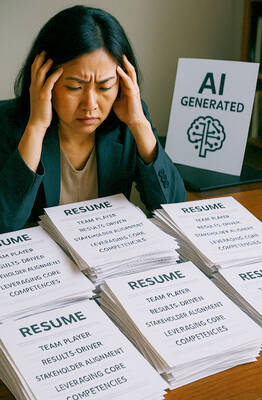
Bilingual Story is a fictionalized account. 雙語故事部分內容純屬虛構。 Emma had reviewed 41 resumes that morning. While the ATS screened out 288 unqualified, she screened for AI slop. She could spot it a mile away. She muttered AI buzzwords like curses under her breath. “Team player.” “Results-driven.” “Stakeholder alignment.” “Leveraging core competencies.” Each resume reeked of AI modeling: a cemetery of cliches, tombstones of personality. AI wasn’t just changing hiring. It was draining the humanity from it. Then she found it: a plain PDF cover letter. No template. No design flourishes. The first line read: “I once tried to automate my

1. 他走出門,左右看一下,就過了馬路。 ˇ He walked outside, looked left and right, and crossed the road. χ He walked outside and looked left and right, crossed the road. 註︰並列連接詞 and 在這句中連接三個述語。一般的結構是 x, y, and z。x and y and z 是加強語氣的結構,x and y, z 則不可以。 2. 他們知道自己的弱點以及如何趕上其他競爭者。 ˇ They saw where their weak points lay and how they could catch up with the other competitors. χ They saw where their weak points lay and how to catch up with the other competitors. 註:and 一般連接同等成分,結構相等的單詞、片語或子句。誤句中 and 的前面是子句,後面是不定詞片語,不能用 and 連接,必須把不定詞片語改為子句,and 前後的結構才相等。 3. 她坐上計程車,直接到機場。 ˇ She took a cab, which took her straight to the airport. ˇ She took a cab and it took her straight


 RSS
RSS