


Artist Chiu Hsien-hsun has been drawing satirical cartoons for over two decades. Recently, he published the first ever history of Taiwan in caricature, a collected volume of satirical cartoons entitled A Hand-drawn Illustration of Taiwan’s 400-Year History.
Chiu says he first read Su Beng’s Taiwan’s 400-Year History in France, where he went to study in 1990. Having been educated under the party-state system, the book left him dumbstruck, and he started to ponder questions such as, “Who am I?” and “What is this country [to which I belong]?” From that moment on, Chiu’s art — and even his life — took on a whole new direction.
Following his return to Taiwan, Chiu became what he describes as someone “on the extreme end of the independence/unification political divide.” Having never concealed his forthright views, Chiu began to put to work his artistic skills, honed through years of professional training, by collaborating with a large number of politicians.
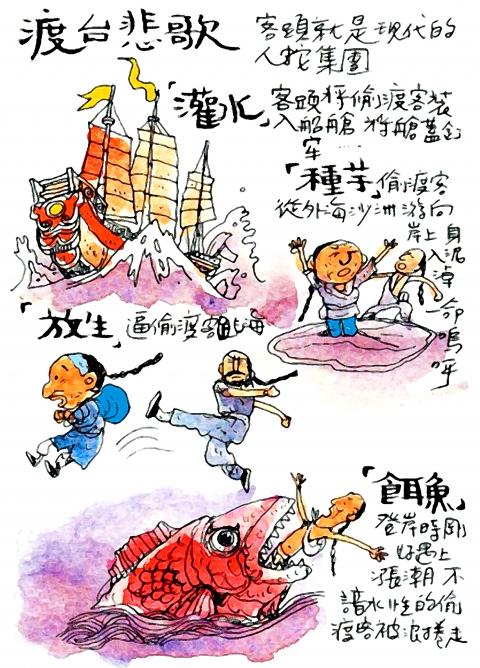
Photo courtesy of INK
照片:印刻/提供
This was the situation in which, about five years ago, Chiu was introduced to Su. One day while at Su’s house, Chiu saw a copy of Taiwan’s 400-Year History in Cartoon, drawn by Su himself. Su had originally hoped he would be able to help more people to understand Taiwan’s history by using entertaining cartoons. As the first volume received a somewhat lukewarm reception on publication, Su decided not to go ahead with the second volume. Chiu then determined to complete the project, and do an illustrated Taiwan’s 400-Year History himself. He managed to obtain Su’s full approval for the idea.
Chiu threw himself into the project, but discovered the drawing did not come easily, since each illustration required him to read up again on each historical episode in order to understand the full sequence of events. Chiu originally thought it would take him one month to complete the illustrated book; in the end it turned into a three-year project.
When the book was published, Chiu rushed over to Su’s house to give him the first look. He says that Su, who is to celebrate his 100th birthday this year, was over the moon.
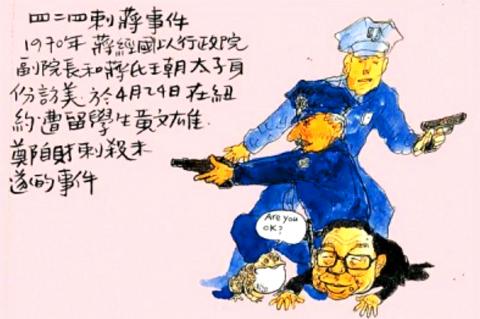
Photo courtesy of Chiu Hsien-hsun
照片:邱顯洵/提供
(Liberty Times, translated by Edward Jones)
從事諷刺漫畫超過二十年的邱顯洵,日前發表國內第一本以台灣史為主題的諷刺畫報圖輯《手繪台灣人四百年史》。
邱顯洵說,一九九○年他赴法國留學,第一次讀到史明寫的《台灣人四百年史》,讓在黨國教育下成長的他萬分驚訝,開始思考:我是誰?我的國家是什麼?甚至讓他的藝術創作與人生有了全新的開始。
回國之後,邱顯洵成為自己口中「統獨光譜最旁邊」的人,從不掩飾鮮明立場的他,發揮科班出身的繪畫技巧和歷練開放文化的創意,陸續和不少政治人物合作。
在這樣的背景下,約莫五年前,邱顯洵經人介紹認識了史明,某日,他在史明家中看到史明親自繪著的《漫畫台灣人四百年史》,原本希望更多人透過趣味的漫畫來了解台灣歷史的這本書,因出版後未引起太多關注,史明畫了上集,就不想再畫下集,邱顯洵便「誇下海口」,要把整本《台灣人四百年史》畫成漫畫,也獲得史明的完整授權和認可。
真正投入創作後,邱顯洵發現「畫起來好困難」,因為每畫一張圖,就得重新閱讀一次歷史,了解整件事的來龍去脈。因此,原以為一個月就能畫完的《手繪台灣人四百年史》,足足畫了三年多。
書一出版,邱顯洵就迫不及待地先拿給史明看,而今年將過百歲生日的史明見了書也很高興。
(自由時報記者楊明怡)
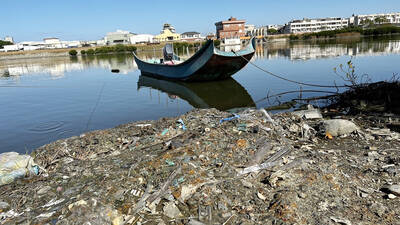
Many consumers are guilty of filling drawers or closets with old laptops, cellphones, fitness trackers and other electronic devices once they are no longer needed. It’s hard to know where to recycle such items, or it seems costly and inconvenient to do so. The world generates millions of tons of electronic waste — also called e-waste — each year. According to the UN’s most recent estimate, people worldwide produced 62 million metric tons of e-waste in 2022, and only about 22 percent of it was properly recycled. The US’ Environmental Protection Agency estimates that less than a quarter of e-waste is
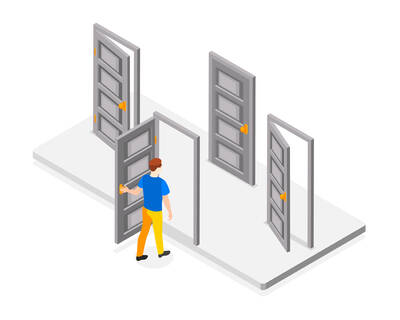
You’re sitting in class when a classmate asks to borrow a pencil. It seems like a small favor, so you agree without hesitation. The following week, the same classmate asks to share your notes. Later, they request help with a group project. You agree each time — after all, you helped out the first time — but before you know it, it has become automatic. This scenario demonstrates the “foot-in-the-door technique,” a psychological concept that shows how agreeing to small, acceptable demands makes it easier to accept larger ones later on. The name for this strategy comes from door-to-door

A: The four-day Tomb Sweeping Day long weekend begins Friday and will run until Monday. Are you going to sweep your ancestors’ tombs? B: I did in advance last weekend, so I can go to Kaohsiung to see the musical “The Phantom of the Opera.” A: Wow, is “Phantom” touring Taiwan again? It debuted in 1986, so this year marks the 40th anniversary of the show. B: And it’s not just touring Kaohsiung starting March 31, but also Taipei starting April 21 and Taichung starting May 26. A: “Phantom” is one of the world’s Four Major Musicals. I’ve seen all of them, except “Les

Dos & Don’ts — 想想看,這句話英語該怎麼說? 1. 我們很早到達電影院。 ˇ We arrived at the theater very early. χ We arrived the theater very early. 註︰arrive 為不及物動詞,後面如果有受詞要用 at 或 in。例如:They arrived in Taipei yesterday.。一般大地方,如國家、省、大城市等前面用 in,凡小地方城鎮、學校等則用 at。 2. 開車半小時以後,我們到達了海灘。 ˇ After half an hour’s drive, we got to the beach. χ After half an hour’s drive, we got the beach. 註︰come, go, get(來、去、到達)某地時,在表示地點的名詞前面應該用 to,如 go to school, go to Taipei, come to Shanghai 等。如果這些動詞後面所跟的是 here, there, home 等副詞,則不用 to。 3. 明天我會回辦公室。 ˇ I will be back in the office tomorrow. χ I will be back to office tomorrow. 註︰to be back 一語裡的 back 是副詞,不是介詞,所以後面要用 at (the market) 或 in (the office)。 假如假期結束,要回學校上課了則可說: ? Kids will be back


 RSS
RSS