


The painting Along the River During the Qingming Festival depicts a bustling scene of the life of ordinary people along the banks of the Bian River by the Northern Song capital of Kaifeng. The earliest version, now in the collection of the Palace Museum in Beijing, was painted by the Northern Song artist Zhang Zeduan. This was modeled on and copied on many occasions, essentially making paintings of the river during the Qingming festival something of a genre in its own right.
The Qing version of Along the River During the Qingming Festival was the combined work of five court painters — Chen Mei, Sun Hu, Jin Kun, Dai Hong and Cheng Zhidao — in 1736AD, the first year of the Qianlong reign. An exquisite work encapsulating the best aspects of previous versions, it is now kept in the collection of the National Palace Museum in Taipei.
Like the majority of Eastern scroll paintings, the scroll starts on the right, and the composition unfolds from right to left, following the direction of flow of the Bian River and drawing the gaze of the viewer gradually and systematically to the left and through the composition. The far right (first photo) is composed of relatively small hills and a couple of boats on the river, creating a sense of distance and depth. The space opens up as the viewer follows the river westward, raising the curtain on the journey ahead.
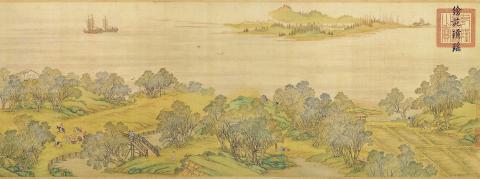
Photo: Wikimedia Commons
照片:維基共享資源
The scroll format is very different from what we are perhaps more familiar with. The roughly 2:3 format of paintings nowadays was heavily influenced by the proportions of framed Western paintings. The Western perspective technique had matured over the course of the Renaissance. It explored how best to represent three-dimensional space on a two-dimensional — that is, flat — surface or, in other words, how to enable the viewer to see, or perceive, three-dimensional space, or even four-dimensional space — incorporating the dimension of time — on the two-dimensions of a painting.
Western realist perspective assumes the scene is surveyed simultaneously from a single point, with all lines within the spatial composition converging at a single “vanishing point” in the distance, uniting the composition as a whole and creating the illusion of reality. While the architectural structures within Along the River During the Qingming Festival do use the perspective techniques introduced from the West, the painting as a whole employs traditional Chinese shifting perspective along its length. That is, there is no single center of the gaze: the point at which the viewers’ line of sight intersects with the painting moves.
Scrolls were not really intended to be seen in their entirety at any one time. The viewer would unfurl it from the left while rolling it back up at the right. In this 11-meter-long painting, a range of different styles, from landscape to figurative to architectural, are incorporated into the work, and the river, space, and motion are unraveled over time as one proceeds through the scroll.
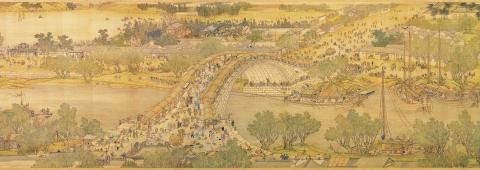
Photo: Wikimedia Commons
照片:維基共享資源
The composition of this painting is roughly divided into two sections, left and right. The right section entails a leisurely stroll through the countryside, taking in farmers, shepherds and people engaging in various outdoor activities. There is an arched bridge full of bustling crowds extending over the river at the city gates in the center of the composition (second photo), and the left section depicts busy life within the city walls, including people engaged in business and various forms of entertainment (third photo).
(Translated by Paul Cooper)
《清明上河圖》描繪的是中國北宋首都開封汴河兩岸庶民生活的繁榮景象,最早由北宋張澤端所畫(現藏北京故宮博物院),後世多有仿作與摹本,使得清明上河圖儼然自成一種繪畫的類別。
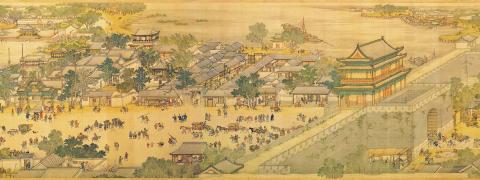
Photo: Wikimedia Commons
照片:維基共享資源
清院本《清明上河圖》為清乾隆元年(西元一七三六年)由陳枚、孫祜、金昆、戴洪、程志道等五位宮廷畫家所協力繪製而成,集各家所長,殊為精品,現藏於臺北故宮博物院。
本圖如同大多數東方長卷繪畫的形式,以右方為卷首,畫幅由右至左展開,隨著汴河的流向,畫幅帶領觀者的目光漸次向左移動。卷首以較小比例的山丘及兩艘船置於畫面上方,營造出河流的深遠,空間隨著江水開闔,拉開時空的序幕。
長卷的繪畫形式非常不同於我們現今所熟悉的,約為二:三的畫面比例,這主要是受到西方硬框式繪畫之影響。西方的透視法在文藝復興發展成熟,透視法所探究的是如何將三度空間呈現在二度空間(即平面)中,或者說,是如何讓觀者在二度平面的畫面中看見,或是感知到三度的空間,甚至是四度空間(即時間—空間)。
西方寫實的透視法注重畫面「一眼看盡」、盡收眼底,空間結構的經緯線集中在一個「消失點」,統一整個畫面,並造成如同真實般的幻覺。而《清明上河圖》雖然在建築結構上應用了西方傳來的透視法,其整體仍是以傳統的「散點透視」來布局,也就是說,畫面中沒有單一的凝視中心點,畫面與觀者視線的交會點是移動的。
「長卷」這一繪畫形式,一般來說不是用來完全展開展示的,其觀看方式是由左側展開,而右側同時捲收起來。在這長十一公尺的畫幅中,山水、人物、建築等不同繪畫的類別都被統整到這個大作品中,隨著時間的長河,空間與動態便延此軸依序展開。
本圖大致分為左、右兩部份,畫幅右邊描述了鄉間的從容步調,包括農人、牧人、踏青活動等。河水流經繁忙雜沓的拱橋,穿越畫面中央的城門。畫幅左半部則是描繪城內繁忙的生活,包括許多商業活動以及表演娛樂等。
(台北時報林俐凱)
Qing court version of Along the River During the Qingming Festival, 1736AD, in the collection of the National Palace Museum, Taipei.
L: 1,152.8 cms; H: 35.6 cms
Material: Ink and colors on silk
清院本《清明上河圖》,一七三六年,台灣國立故宮博物院藏品。
長一千一百五十二點八公分,高三十五點六公分
材質:絹本設色

★ Bilingual Story is a fictionalized account. 雙語故事部分內容純屬虛構。 The mango looked perfect. It sat on the fruit stand like a small sunset, red on one side and gold on the other. “I’ll take this one,” said Daniel. The fruit seller shook her head. “Not that one.” Daniel was surprised. “Why not? It looks beautiful.” “Yes,” she said, “but beautiful is not always ready.” She picked up another mango and held it near his nose. “First, smell here.” Daniel smelled the top of the mango. It was sweet and warm. “Good mangoes have a smell,” she said. “Next, feel the weight.”

In 2023, an 80-year-old woman in Taipei suffocated her paralyzed son after over five decades of caring for him. Turning herself in immediately, she confessed that worsening health and anxiety about who would care for him after her death had driven her to act. The court, acknowledging her difficult situation, sentenced her to two-and-a-half years in prison while recommending a presidential pardon. This rare judicial recommendation drew a complicated social response. Supporters argue that the mother’s half-century of caregiving renders her deserving of compassion instead of incarceration, believing that allowing her to live her final years in dignity and
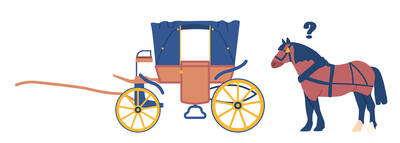
Put the Cart Before the Horse 本末倒置 Iris: I think I’m in love. Carl: What? Iris: We just have so much in common. We like all of the same things. Carl: Yes, but you’ve only chatted with him online. Iris: It doesn’t matter. I know we’ll end up getting married. Carl: I’m afraid you’re putting the cart before the horse. You should at least meet him first. Iris: OK, OK. I’ll do that. 艾瑞絲: 我想我戀愛了。 卡 爾: 什麼? 艾瑞絲: 我們就是有那麼多的共通點。我們喜歡的東西都一樣。 卡 爾: 是沒錯,不過妳和他只在網路上聊過天而已。 艾瑞絲: 那不重要。我知道我們最後一定會步入禮堂。 卡 爾: 妳恐怕是本末倒置了吧。妳至少應該先跟他見個面。 艾瑞絲: 好啦,好啦。我會的啦。 A tough cookie 強悍的人∕堅強的人 Tracy: I heard you went out with Iris last night. Justin: Yeah. We

1. 他非常討厭偽君子。 ˇ He has a deep hatred for hypocrites. χ He has a deep hatred to hypocrites. 註︰表示「對某人懷著愛、恨」等, 常用 have a love for/of, have a hatred for/of。 例如: We have a love for/of science. The working people have a hatred for/of all forms of exploitation. 2. 問題的答案其實不難找。 ˇ The answer to this question is not difficult to find. χ The answer of this question is not difficult to find. 註︰中文中的「的」在英語中不一定都用 of 來表示,有時須用 to。其他的例子如下: 我把房間的鑰匙弄丟了。 I lost the key to the room. 中間矗立著烈士紀念碑。 In the center stands the monument to the martyrs. 這部電影的續集你看過沒有? Have you seen the sequel to the movie? 3. 比起那家餐廳,他更喜歡這家。 ˇ He prefers this restaurant to that one. ˇ He likes


 RSS
RSS