


In the stories of Japanese animation “Doraemon,” the robotic cat has all kinds of amazing gadgets in his pocket. Japan’s TV Asahi Corporation recently conducted a survey on which gadgets were the most popular among adults and children. The “Anywhere Door” — a door that leads to anywhere the user wants to go — was the most popular gadget in both categories, because it makes it easier for them to go to work or school.
Children’s favorite props also included a “Time Machine” that allows you to travel freely through time and space, and the “Bamboo-copter,” a helicopter hat that allows you to fly. Adults’ favorites included the “What-If Phone Booth,” which makes your wishes come true when you make a call from it, and “Memory Toast,” which helps you memorize what is printed on the bread after eating it.
Netizens said the children’s choices show they are free and unrestrained, while the adults’ choices suggest their desire to extricate themselves from their current circumstances.
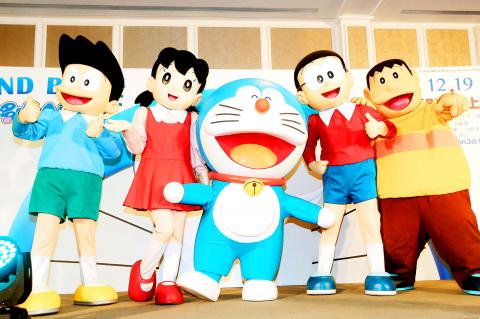
Photo: CNA
照片︰中央社
(CNA, translated by Eddy Chang)
日本卡通「哆啦A夢」的故事中,機器貓從口袋拿出來的許多道具都很神奇。近來日本的朝日電視台調查大人和小孩最想要什麼道具,結果第一名都是「任意門」!因為打開門就能到任何你想去的地方,上班或是上學都很方便。
小孩最愛的還有「時光機」,可自由穿越時間、空間去旅行;「竹蜻蜓」,像直昇機一樣讓人飛翔的帽子。大人最愛的品項,則有「如果電話亭」,打一通電話就能讓你心想事成;「記憶吐司」,將資訊印在吐司上只要吃了就能記住。
而網友認為小孩的選擇,顯示自由自在不受拘束的特性,大人的選擇則代表渴望擺脫現有的狀態。
(中央社)
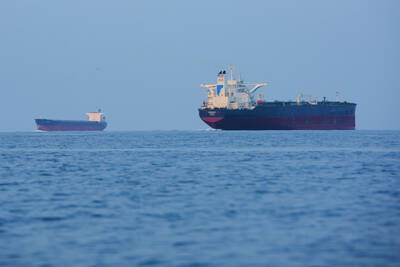
The US-Israeli war with Iran, which began on Feb. 28, has killed thousands of people, destabilized the Middle East and rocked global energy markets by effectively closing the strait. WHAT IS THE STRAIT OF HORMUZ? Lying between Oman and Iran and linking the Gulf north of it with the Gulf of Oman to the south and the Arabian Sea beyond, the strait is 33km wide at its narrowest point, with a shipping lane just 3km wide in either direction. Perhaps the world’s most important energy shipping channel, the waterway is about 167km long. Following through on an old threat, Tehran effectively closed the strait

Have you ever found yourself desperately feeding coins into a claw machine just because you’ve already spent so much trying to win that stuffed animal? Or maybe you’ve continued watching a boring movie simply because you already paid for the ticket? If so, you’ve experienced the “sunk cost fallacy.” A sunk cost refers to time, money or effort that has already been spent and cannot be recovered. This psychological trap is surprisingly common. You might keep playing a video game you no longer enjoy because you’ve invested countless hours in building your character, or maintain a toxic friendship because you’ve known

A: Which TV drama series have been global hits so far this year? B: The US drama “Stranger Things 5,” South Korean drama “Can This Love Be Translated?” and Chinese megahit “Pursuit of Jade” are all popular lately. A: Isn’t “Pursuit of Jade” the costume idol drama about the romance between a charming marquis and a pig-slaughterer? Actor Zhang Linghe and actress Tian Xiwei are both so attractive. B: Plus, Netflix’s Korean-Japanese gay romance drama “Soul Mate” — starring Korea’s Ok Taec-yeon and Japan’s Hayato Isomura — is set to premiere in May. A: These hit international dramas

1. 他甚至還自認為是個了不起的領導人。 ˇ He even went so far as to think himself a great leader. ˇ He even went so far as to think of himself as a great leader. χ He even went so far as to think himself as a great leader. 註:認為某人或某事為何等樣人或何等樣事,可用 think+受詞+受詞補語,或 think of ... as ...,正句第一句比第二句普遍些。用了 of,後面用 as;沒有 of,就不可以用 as。又如: I thought him quite a joke. I thought of him as quite a joke. 2. 你不應該打擾他休息。 ˇ You should not intrude upon him during his time off. χ You should not intrude him during his time off. 註:intrude 作「闖進」、「打擾」、「侵入」解時,是不及物動詞,後面跟 upon。 3. 男孩正在玩陀螺。 ˇ The boy is playing with his top. χ


 RSS
RSS