


I saw this scene at an art gallery in Taipei two years ago. It was part of an open-air installation consisting of hanging fabric. It was a cross between a maze of corridors and doorways and someone’s washing hanging out to dry on a line.
On a calm day, everything was static. When I visited the gallery, the wind was up, and the sheets were flappng in the breeze.
In a two-dimensional photograph, the scene becomes a cacophony of shapes and shadows. There are rectangles and triangles, rhombuses and arrow-heads, irregular shapes, truncated shapes, thin lines bisecting thick lines, thick lines cutting through curves, parallel lines and lines diverging or converging, areas of shade and areas of light, hard lines and creases, sheets hanging vertically and others intruding at an angle, floorboards and a skewed banister, and all framed by an arch.
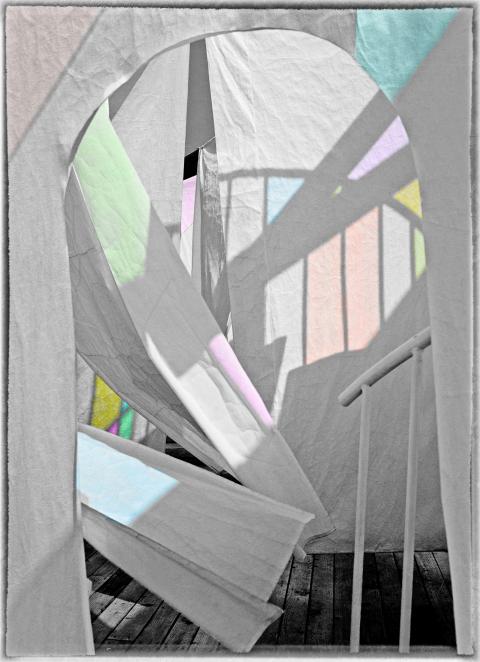
Photo: Paul Cooper, Taipei Times
照片:台北時報記者古德謙攝
The colors were added later.
(Paul Cooper, Taipei Times)
這幅景緻是我兩年前在台北一間藝廊所見。那是一個戶外的裝置藝術,垂掛著布匹,看上去就像是介於某種走廊之迷宮及晒衣場之間的混合體。
在無風的日子,一切都是靜止的。我來到藝廊的那天有風,布匹在微風中飄舞著。
在照片裡,景色平面化,變成了幾何與光影的隨機組合。矩形與三角形,菱形與箭頭,不規則的形狀,被裁切為新的形狀,細小的線條彼此分割,粗大的直線截過圓弧處,線條彼此平行、又時而分岔、時而聚集,光與影形成各自的區塊,堅硬的實線與皺摺,布匹直直地垂下而其他物體則歪斜地湧入,還有地板與傾斜的欄杆,這一切,都鑲在一座拱門裡。
而所有的色彩都是後來才加上的。
(台北時報涂宇安譯)
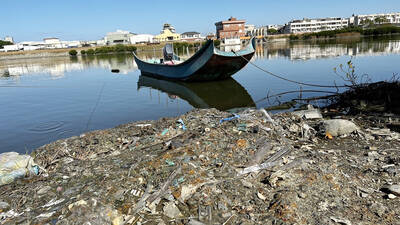
Many consumers are guilty of filling drawers or closets with old laptops, cellphones, fitness trackers and other electronic devices once they are no longer needed. It’s hard to know where to recycle such items, or it seems costly and inconvenient to do so. The world generates millions of tons of electronic waste — also called e-waste — each year. According to the UN’s most recent estimate, people worldwide produced 62 million metric tons of e-waste in 2022, and only about 22 percent of it was properly recycled. The US’ Environmental Protection Agency estimates that less than a quarter of e-waste is
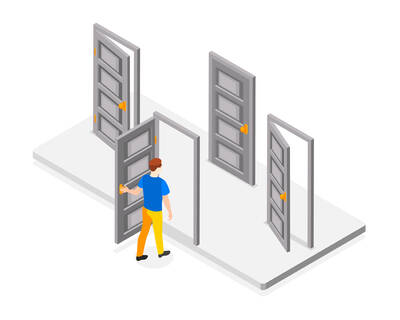
You’re sitting in class when a classmate asks to borrow a pencil. It seems like a small favor, so you agree without hesitation. The following week, the same classmate asks to share your notes. Later, they request help with a group project. You agree each time — after all, you helped out the first time — but before you know it, it has become automatic. This scenario demonstrates the “foot-in-the-door technique,” a psychological concept that shows how agreeing to small, acceptable demands makes it easier to accept larger ones later on. The name for this strategy comes from door-to-door

A: The four-day Tomb Sweeping Day long weekend begins Friday and will run until Monday. Are you going to sweep your ancestors’ tombs? B: I did in advance last weekend, so I can go to Kaohsiung to see the musical “The Phantom of the Opera.” A: Wow, is “Phantom” touring Taiwan again? It debuted in 1986, so this year marks the 40th anniversary of the show. B: And it’s not just touring Kaohsiung starting March 31, but also Taipei starting April 21 and Taichung starting May 26. A: “Phantom” is one of the world’s Four Major Musicals. I’ve seen all of them, except “Les

Dos & Don’ts — 想想看,這句話英語該怎麼說? 1. 我們很早到達電影院。 ˇ We arrived at the theater very early. χ We arrived the theater very early. 註︰arrive 為不及物動詞,後面如果有受詞要用 at 或 in。例如:They arrived in Taipei yesterday.。一般大地方,如國家、省、大城市等前面用 in,凡小地方城鎮、學校等則用 at。 2. 開車半小時以後,我們到達了海灘。 ˇ After half an hour’s drive, we got to the beach. χ After half an hour’s drive, we got the beach. 註︰come, go, get(來、去、到達)某地時,在表示地點的名詞前面應該用 to,如 go to school, go to Taipei, come to Shanghai 等。如果這些動詞後面所跟的是 here, there, home 等副詞,則不用 to。 3. 明天我會回辦公室。 ˇ I will be back in the office tomorrow. χ I will be back to office tomorrow. 註︰to be back 一語裡的 back 是副詞,不是介詞,所以後面要用 at (the market) 或 in (the office)。 假如假期結束,要回學校上課了則可說: ? Kids will be back


 RSS
RSS