


Do you still remember Diu Diu Dang, a popular Taiwanese folk song about trains running through tunnels? Some say that when trains went through the Old Caoling Tunnel, there were water dripping sounds inside the tunnels, which inspired the tune people sang in Yilan.
Lin I-chi, who was from Yilan and married to someone in New Taipei City’s Ruifang District, is no stranger to the Old Caoling Tunnel that connected Yilan and Taipei. This tunnel was built in the Japanese colonial era. Because it could not satisfy the demand for two-way traffic and also because the North Link Line was electrified, the tunnel was eventually decommissioned. After renovation was completed five years ago, it became the way it looks today and biking through the tunnel became popular.
Lin says, if you ride a bicycle here in the summer, you feel the drop in temperature the minute you enter the tunnel, despite the heat of the day outside, with a cold breeze brushing past you. Nature’s air conditioning is extremely comfortable and crisp. As the lights in the tunnel reflected on the age-old bricks, Lin had flashbacks of riding the train as a child. The sound of trains rattling through and the melody of Diu Diu Dang can be heard inside the tunnel, enhancing the ambience.
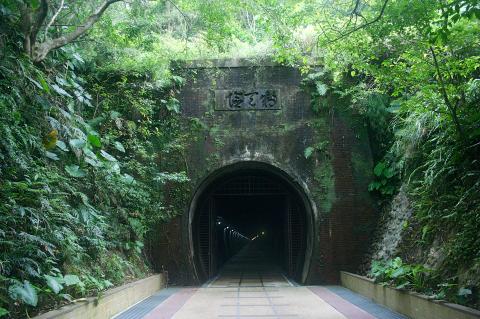
Photo: Wu Chia-i, Liberty Times
照片:自由時報記者吳嘉億攝
If you begin the journey from Fulong Station and ride a bike to the Old Caoling Tunnel, after emerging from the south entrance, you can either go directly to Yilan County’s Shihcheng Township or head north along the No. 2 Provincial Coastal Highway and enjoy the mountain view and the ocean view along the way. You can, for example, get a cup of coffee while getting a good view of the Turtle Island from the sightseeing spot in Shihcheng, pay a visit to the Cape San Diego Lighthouse, enjoy the spectacular view of where the ocean meets the sky, see the geological spectacle of Lailai Marine Terrace, or the devil’s washboard, and explore Maoao Fishery Village, which is best known for its stone houses. Then you can make a round trip back to Fulong, where you can devour a tasty yet very affordable Fulong Biandang mealbox to replenish your batteries.
(Liberty Times, translated by Ethan Zhan)
還記得《丟丟銅仔》這首膾炙人口的火車過山洞歌謠嗎?其中一種說法,就是火車經過舊草嶺隧道時,山洞內滴滴答答的水聲,轉為口中哼出的宜蘭調。
從宜蘭嫁到新北市瑞芳區的林裔綺,對舊草嶺隧道這座聯絡宜蘭及台北間的火車隧道一點也不陌生。這座日治時期興建的火車隧道,因不敷雙向交通需求及北迴鐵路電氣化而荒廢淘汰,五年前重新翻修完成,才有今日面貌和自行車活動盛況。
林裔綺說,如果夏天在這裡騎車,即使外頭氣候炎熱,一進隧道就會立即感到氣溫驟降,沁涼的風不斷吹拂而來,天然的冷氣非常舒爽;而隧道內燈光映照的舊石磚,也讓她回憶起小時候在火車上的過往迎來。特別的是,隧道裡還會播放火車行駛的音效和丟丟銅仔的音樂,超有味道。
若是從福隆火車站出發騎自行車到舊草嶺隧道,出隧道南口後,可選擇直達宜蘭石城,或轉沿台二線濱海公路往北走,沿途欣賞山海風光。譬如,到石城觀景區喝咖啡及遠眺龜山島、造訪三貂角燈塔、到四角窟觀看波瀾壯闊海天一色美景、一覽萊萊海蝕平台有如魔鬼洗衣板之稱的地質景觀,還可以一探卯澳以石頭屋著稱的漁村風情,然後回到福隆吃一個味美價廉的福隆便當,補充體力。
〔自由時報綜合報導〕
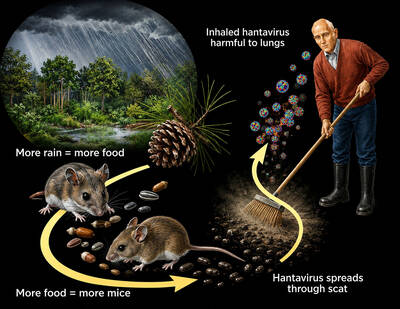
An outbreak aboard a cruise ship of a rare rodent-borne illness called hantavirus has left three passengers dead and sickened others, but global health officials say the risk to the general public remains low because the germ does not easily spread between people. “This is not the next COVID, but it is a serious infectious disease,” said Maria Van Kerkhove, director of epidemic and pandemic preparedness at the World Health Organization (WHO). “Most people will never be exposed to this.” The virus usually spreads when people inhale contaminated residue of rodent droppings. Hantaviruses have been around for centuries and are thought to

Have you ever wondered how people navigate the world when they can’t see a map? For individuals with visual impairments, conventional maps are nearly impossible to use. This is where tactile maps come in — essential tools that allow people to “see” the world through touch. A tactile map is specially designed with raised lines, textures, and symbols to represent geographical features such as roads, rivers, and buildings. Users explore it with their fingertips. However, these maps are not exclusively for people with visual disabilities. They serve as valuable multisensory learning tools that enhance spatial understanding for everyone, making

1. 他病了三天。 ˇ He has been sick for three days. χ He has been sick since three days. 註︰這裡現在完成時態 have / has been 表示從過去某一時日到現在的一段時間存在的行為或狀態,與它連用的時間副詞應為 「for +若干時」,如 for a year, for three hours 等,意思是歷時多少。 2. 他自從星期三以來都很忙。 ˇ He has been busy since Wednesday. χ He has been busy from Wednesday. 註︰「自從……以來」,該用 since。說從某一天(某一時刻)到某一天(某一時刻)才用 from,如 from Monday till Friday。 3. 房間角落裡散放著一些零星物件。 ˇ There were some odds and ends lying in the corner of the room. χ There were some odds and ends lying at the corner of the room. 註︰「在房間角落裡」該用介詞 in。例如: He stood in the corner. There is a lamp in the corner of the room. at the corner 指房子外部的拐角。例如: A little boy

A: In early May, there were concerts by Icyball, Chyi Yu, Korea’s EXO and Japan’s Anisama, but I missed them all. What a shame. B: That’s OK. There are shows coming up by various artists, including Power Station, Accusefive, Japanese singer Mika Nakashima, Chinese-Icelandic jazzer Laufey, and even Singaporean diva Stefanie Sun. A: After a 12-year hiatus, Stefanie is finally returning to Taipei again. B: In late May, there will be more shows by Crowd Lu, WeiBird, Korea’s Donghae, 2AM, EXID, and Thailand’s BUS. A: The Thai boyband is so popular. It looks like “T-pop” is catching up with J-pop


 RSS
RSS