


The Taiwan High Speed Rail Corporation (THSR) has officially inaugurated three new stations this month, and train fares throughout the route have been cut back to the level of the year before last. Currently, there are three types of trains: direct trains, stopping trains and semi-direct trains, but most people do not know about them. The THSR explains that the train numbers that they assign to the trains are actually quite meaningful. As long as people understand what the numbers stand for, they can immediately tell which trains are direct trains.
According to a report in the United Daily News, with the exception of discount tickets, fares for direct trains, stopping trains and semi-direct trains are all the same; they only differ in travel time. For example, a journey from Taipei to Kaohsiung on a stopping train will take 42 minutes longer than on a direct train. However, if members of the public can decipher train numbers, they will be able to know which type of train they are taking.
The THSR says there are two types of numbers: three-digit numbers, which are applicable to daily trains, and four-digit numbers, which apply to non-daily trains. The first digit of a three-digit number and the second digit of a four-digit number reveal how many stops a train makes. If the train number is 1xx, it is a conventional direct train that only calls at Banciao and Taichung between Taipei and Kaohsiung. If the number is 2xx, the train also calls at Chiayi and Tainan. If the number is 3xx, it calls at every station south of Taichung. If the number is 5xx, the train only runs from Taipei to Taichung or Taichung to Zuoying. If the number is 6xx, the train does not call at the three new stations. If it is 8xx, it calls at every station. If it is a four-digit number, just look at the second digit and follow the same logic as with three-digit numbers.
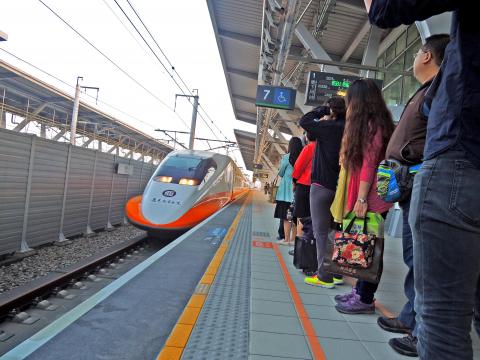
Photo: Liao Shu-ling, Taipei Times
照片:自由時報廖淑玲
The THSR offers some examples. If you want to take a direct train from Taipei to Taichung, you can choose a 1xx, 2xx or 3xx train. If you want to visit Yunlin, you can only take 3xx or 8xx trains. To travel from Taipei to Zuoying, the fastest way is to take a 1xx train.
(Liberty Times, translated by Ethan Zhan)
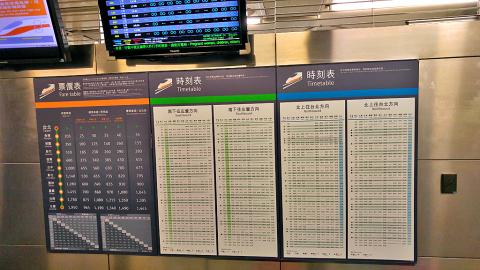
Photo: Ethan Zhan, Taipei Times
照片:台北時報Ethan Zhan攝
高鐵新增三站本月正式通車,全線也同步降回前年價格,目前有「直達車」、「站站停」與「跳蛙式」三種停站模式,不過一般民眾並不清楚。台灣高鐵公司說明,高鐵車次編排其實有其意義,只要了解就能迅速分辨哪班車是直達車。
《聯合報》報導,除了優惠票,高鐵直達車、站站停及跳蛙式三種模式車票價格都一樣,但乘車時間卻有差。以北高為例,若買到站站停,搭車時間就比直達車多了四十二分鐘。其實民眾只要看懂車次編碼,就能知道是哪一種停站模式。
台灣高鐵公司解釋,車次編碼有三碼(每天行駛)、四碼(非每日行駛)兩種。從三碼的第一個數字及四碼的第二個數字,就能分辨停站模式。車次編碼為1XX, 就是只停板橋和台中的傳統北高直達車,2XX為加停嘉義與台南的直達車,3XX是台中以南站站停,5XX是台北到台中或台中到左營,6XX不停新增三站,8XX則是每站停;四碼班車則看第二個數字,邏輯和三碼相同。
台灣高鐵舉例,想搭台北到台中直達車,可選擇車次編碼1、2、3的車次;要到雲林,只能搭3開頭或8開頭的車;台北到左營,要搭1開頭的列車最快。(自由時報報導)


In 2023, an 80-year-old woman in Taipei suffocated her paralyzed son after over five decades of caring for him. Turning herself in immediately, she confessed that worsening health and anxiety about who would care for him after her death had driven her to act. The court, acknowledging her difficult situation, sentenced her to two-and-a-half years in prison while recommending a presidential pardon. This rare judicial recommendation drew a complicated social response. Supporters argue that the mother’s half-century of caregiving renders her deserving of compassion instead of incarceration, believing that allowing her to live her final years in dignity and

A: Over 130,000 college graduates are about to enter the workforce upon graduation. B: According to a survey, the top 10 most desired careers among Taiwanese are: independent content creator, civil servant, information engineer, financial professional, medical worker, content planner, flight attendant, news anchor, designer and fitness trainer. A: What are the “dream jobs” for young Gen Zers? B: The top three for men are YouTuber, pro gamer and engineer. For women, they are writer, social media editor and YouTuber. A: Every profession has its champion. Just look at Taiwanese fire dancer Yang Li-wei — who was on fire

★ Bilingual Story is a fictionalized account. 雙語故事部分內容純屬虛構。 The mango looked perfect. It sat on the fruit stand like a small sunset, red on one side and gold on the other. “I’ll take this one,” said Daniel. The fruit seller shook her head. “Not that one.” Daniel was surprised. “Why not? It looks beautiful.” “Yes,” she said, “but beautiful is not always ready.” She picked up another mango and held it near his nose. “First, smell here.” Daniel smelled the top of the mango. It was sweet and warm. “Good mangoes have a smell,” she said. “Next, feel the weight.”

A: While AI is reshaping the world, “Money Talks News” revealed seven career fields that are “AI-proof.” First is the healthcare field, like nursing jobs, personal care aides, and social work specialists. B: This type of job is indeed in high demand. So what’s next? A: Up next are skill-based positions, like electricians, mechanics, and construction workers. Then there’s the field of education, like teachers, tutors, and education specialists. Fourth is the mental health field, like jobs in counseling, therapy, and social work. B: I didn’t expect teaching to be safe from AI. What else is


 RSS
RSS