


A large quantity of a reddish brown substance, initially believed to have been caused by oil spills, has appeared at Kinmen’s beautiful Liaoluo Bay. Kinmen County’s Environmental Protection Bureau (EPB) and the Fisheries Research Institute (FRI) launched an investigation on Sept. 10 and confirmed that it was caused by a type of algal bloom, which did no harm to the sea water quality.
For several days, the public had seen a strange reddish brown tide at Liaoluo Bay. Since Liaoluo Port, where goods are transported between Kinmen and Taiwan and China, is in the vicinity, many suspected it was a diesel spill.
On Sept. 10, Deputy Council Speaker Hsieh Tung-lung and Jinhu Township representative Chen Hsiang-hsin requested the EPB and the FRI accompany them to the bay to sample the water. It was then confirmed that the reddish unidentified substance was in fact an algal bloom, not an oil spill.

Photo: Wu Cheng-ting, Liberty Times
照片:自由時報記者吳正庭
Hsieh said there was oil pollution at Liaoluo Bay in June this year, which was why it was only natural that the residents would associate strange marine phenomena with pollution when they saw it. Fortunately, it was confirmed to be just algae.
Vincent Fu, director of the county’s EPB, said that muddy water flowed into the ocean after heavy rain, causing an increase of salt nutrients, which, combined with ocean currents, led to an algal bloom by the beach. The algae could be seen in almost all of Kinmen’s coastal waters, but there was no need for the public to be overly concerned.
(Liberty Times, translated by Ethan Zhan)
金門美麗的料羅灣出現大批紅棕色物質,疑似遭油污染。縣環保局會同水試所九月十日會勘,證實是藻華,對水質無影響。
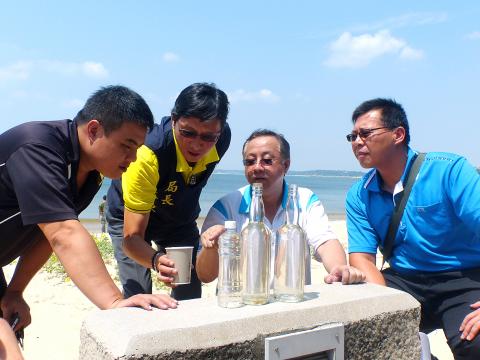
Photo: Wu Cheng-ting, Liberty Times
照片:自由時報記者吳正庭
連日有民眾發現料羅海邊出現不明紅棕色的潮水,由於一旁即是金門對台灣、中國貨物運輸的料羅港,民眾嚴重質疑有柴油外洩。
副議長謝東龍、金湖鎮民代表陳向鑫九月十日邀請環保局、水產試驗所到場採樣,證實紅色不明物是球型棕囊藻,並非油污。
謝東龍說,料羅灣今年六月曾發生油污染,因此村民對於近日海邊出現異樣,難免產生聯想,幸好證明只是藻類。
縣環保局長傅豫東表示,大雨過後陸地污水衝入海中,造成海域營養鹽增加,加上海流蓄積就會在海邊造成藻類的增生;目前金門海域幾乎都有這些藻類存在,民眾不必過於恐慌。
(自由時報記者吳正庭)
Many consumers are guilty of filling drawers or closets with old laptops, cellphones, fitness trackers and other electronic devices once they are no longer needed. It’s hard to know where to recycle such items, or it seems costly and inconvenient to do so. The world generates millions of tons of electronic waste — also called e-waste — each year. According to the UN’s most recent estimate, people worldwide produced 62 million metric tons of e-waste in 2022, and only about 22 percent of it was properly recycled. The US’ Environmental Protection Agency estimates that less than a quarter of e-waste is

You’re sitting in class when a classmate asks to borrow a pencil. It seems like a small favor, so you agree without hesitation. The following week, the same classmate asks to share your notes. Later, they request help with a group project. You agree each time — after all, you helped out the first time — but before you know it, it has become automatic. This scenario demonstrates the “foot-in-the-door technique,” a psychological concept that shows how agreeing to small, acceptable demands makes it easier to accept larger ones later on. The name for this strategy comes from door-to-door

A: The four-day Tomb Sweeping Day long weekend begins Friday and will run until Monday. Are you going to sweep your ancestors’ tombs? B: I did in advance last weekend, so I can go to Kaohsiung to see the musical “The Phantom of the Opera.” A: Wow, is “Phantom” touring Taiwan again? It debuted in 1986, so this year marks the 40th anniversary of the show. B: And it’s not just touring Kaohsiung starting March 31, but also Taipei starting April 21 and Taichung starting May 26. A: “Phantom” is one of the world’s Four Major Musicals. I’ve seen all of them, except “Les

Continued from yesterday(延續自昨日) https://www.taipeitimes.com/News/lang Gig Tripping “Gig tripping” combines concerts with travel. People fly to see their favorite artists perform — usually abroad—and spend a few days sightseeing before or after the show. While die-hard fans have done this since the 1960s, the post-pandemic travel boom changed the game. Even people who aren’t superfans are now booking international concert trips because they want to make the most of travel opportunities. This trend exploded in the US, as the math makes sense. Domestic concert tickets are so costly that flying abroad for the show plus tourism expenses often matches or even beats the price


 RSS
RSS