


To promote Hakka cuisine, the Taichung City government will hold a Dongshih Hakka Cuisine Outdoor Banquet next month. The venue will have one hundred banquet tables and can seat one thousand people. The public can indulge in Hakka cuisine while enjoying a wonderful program of performances and a raffle. Tickets to the event have already gone on sale, with a number of tickets still available; one ticket reserves one table. People that are interested may purchase tickets on the ibon online booking system.
Taichung City Mayor Lin Chia-lung used the slogan “South and north Taiwan eat to get full, while Taichung eats smart” to recommend everyone to head to Dongshih to try out the cuisine. Lin said, aside from eating smart, Taichung food is extordinarily varied, and the authentic cuisine of Dongshih has the purist Hakka flavor. For only NT$3,999, you can enjoy 12 Hakka dishes. Lin recommends that everyone register for the event as early as possible to have a good meal together and experience rich Hakka culture.
The Economic Development Bureau says the Dongshih Hakka Cuisine Outdoor Banquet will bring together Dongshih township’s local Hakka seal meat, drunken chicken and fresh shrimp, assorted Hakka grass jelly, pickled mustard-green pork soup and more, served at an outdoor banquet with one hundred tables and seating for one thousand people. The bureau hopes the event will raise the profile of Taichung’s Hakka food culture.
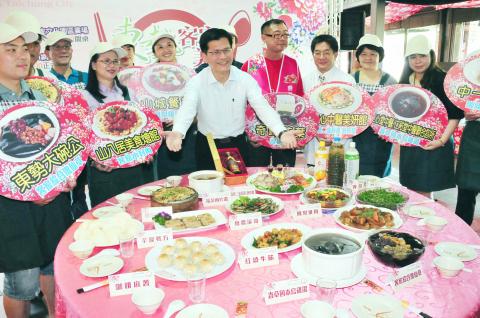
Photo: Lee Chung-hsien, Liberty Times
照片:自由時報記者李忠憲
The bureau says tickets will go on sale on July 15, and there are only a few tickets left. One ticket reserves one table, and one table seats ten people. The city has also arranged for Hakka song and dance performances on the day of the banquet, as well as a raffle with the chance to win the grand prize of a 40 inch LCD TV.(Liberty Times, translated by Zane Kheir)
為推廣客家美食,市府將於下月舉辦「東勢客家美食辦桌囉」活動,現場席開百桌宴千人,民眾可一邊享用客家美食、一邊欣賞精彩節目及摸彩。活動票券已開賣,還有數張名額(一張為一桌),意者可上ibon網路購票系統購買。
市長林佳龍以「南北吃飽,台中吃巧」推薦大家到東勢嚐美食。他說,來台中除了吃巧外,食物還有多重變化,東勢道地美食有最真實的客家風味,只要三九九九元就可以吃到十二道客家美食,他推薦大家盡早報名,一同吃美食並體驗豐富客家文化。
經濟發展局表示,「東勢客家美食辦桌囉」活動集東勢在地客家小封肉、二仙膠醉雞鮮蝦、客家綜合嫩仙草、福菜肉片湯等在地菜色為大成,以百桌千人辦桌方式,盼讓台中客家飲食文化發揚光大。
經發局指出,票券於十五日開賣,目前僅剩幾張名額,一張票等同一桌,一桌十人份,當天還安排客家歌舞演出以及抽獎,有機會抽中最大獎四十吋液晶電視。
(自由時報記者李忠憲)

A: Just like the Democratic Party’s presidential candidate Kamala Harris, the Republican Party’s Donald Trump has received endorsements from some celebrities, including SpaceX founder Elon Musk. B: Plus, a new film, “The Apprentice,” about Trump’s rise was released recently. A: Isn’t it the same title as the reality TV series he hosted? B: Yeah, it was a competition reality show for jobseekers. A: My English teacher even uses it as supplemental material for English courses. A: 就像民主黨的賀錦麗,共和黨的唐納川普也獲得一些名人支持,例如SpaceX的創辦人伊隆馬斯克。 B: 關於川普崛起的電影《誰是接班人》最近也上映了。 A: 這不是跟他主持的電視實境秀同名嗎? B: 對啊,那是一群求職者的實境競賽秀。 A: 我的英文老師還拿它當英文課程的補充教材! (By Eddy Chang, Taipei Times/台北時報張聖恩)

Many patients with certain types of cancers suffer from damage to their blood cells due to the cancer itself or treatments like chemotherapy. To help rebuild healthy blood cells, patients often receive bone marrow transplants by using either pluripotent or hematopoietic stem cells. A bone marrow or stem cell transplant can speed up recovery and boost healthy blood cell production. There are primarily two types of bone marrow transplants: autologous and allogeneic. The former involves using the patient’s own stem cells, while the latter uses stem cells from a matching donor, usually a relative with a compatible human leukocyte

It’s won Oscars. Its television shows and K-pop stars dominate global charts. Its leading novelist just won the Nobel literature prize. How did South Korea become such a global cultural powerhouse? What is Hallyu? From the late 1990s, Korean dramas and K-pop idols started gaining traction in neighboring Asian countries like China and Japan, marking the start of Hallyu, or the Korean Wave. It wasn’t until Psy’s breakout hit “Gangnam Style” that Hallyu hit the West. In the decade that followed, “Babyshark” broke YouTube records, K-pop megastars BTS topped the charts, Bong Joon-ho’s “Parasite” won an Oscar, and Squid Game

在防疫期間,「超前部署」此一用語常見諸報章,成為台灣很夯的熱詞 (buzzword): 超前部署並非2020 年才出現的用語,以下為一些過去台灣政府官員曾使用「超前部署」的語境: 總統馬英九今天指出,八八風災帶來很大教訓,應落實災害防救工作……料敵從寬,禦敵從嚴,超前部署……2010 年 5 月 26 日,《中央社》 行政院副院長張善政……表示,蓮花颱風速度雖然減緩……料敵從嚴,並以超前部署為原則……2015 年 7 月 7 日,《新聞傳播處》 《今日科學》有篇文章 “Outbreak science: Infectious disease research leads to outbreak predictions” 就提到做好預判,有利政府防疫的「超前部署」: Infectious disease outbreaks, whether they be widespread like Influenza or fairly geographically restricted like Ebola, may be difficult to prevent . . . if we can forecast outbreak potential in time, public health officials and governments can preemptively prepare for a potential outbreak event. 傳染病爆發,無論是像流感那樣全面,或像伊波拉那種侷限某些地理區域,都很難預防— 然而,如果我們可以及時預知(疾病)爆發的可能,公衛當局和政府便可以為潛在的疫情爆發提前部署。 Science Daily, January 8, 2020 所以「超前部署」若是在「防災/防疫」的語境下,可譯為preemptive preparation 或 preemptive preparedness,如果用作動詞,可以說 preemptively prepare for (an outbreak, etc.)。 《世界雜誌》上有位作者提到 preemptive 和 preparation 的差異,她說 preemptive 的弦外之音是 heading off something undesirable(避凶/避災): “Preemptive” and “preparation” both refer to work done ahead


 RSS
RSS