


If you were tossing and turning at your pillow, you are not necessarily going crazy. The full moon might be to blame for your poor sleep.
In the days close to a full moon, people take longer to doze off, sleep less deeply, and sleep for a shorter time, even if the moon is not shining in their window, a new study has found.
Anecdotal evidence has long suggested that people’s sleep patterns, moods, and even aggression, is linked to moon cycles.
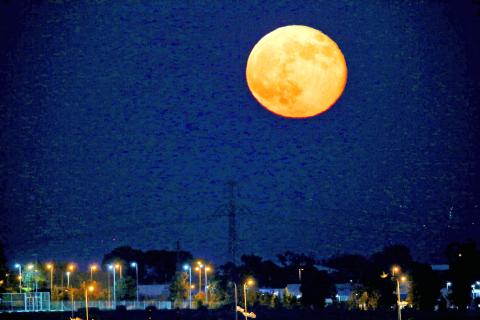
Photo: EPA
照片:歐新社
Between 2000 and 2003, biologist Christian Cajochen of the University of Basel in Switzerland and his colleagues collected detailed data on the sleep patterns of 33 healthy volunteers.
Using electroencephalograms (EEG), which measure brain activity, they recorded how deep and how long each participant’s nightly sleep was in a controlled, laboratory setting. They found a striking association between poor sleep and lunar cycles.
(Liberty Times)
若你在枕頭上輾轉反側,你應該不是發瘋了。你的失眠恐怕得歸咎於滿月。
在即將滿月的數日,即使月光沒有照進窗裡,人們要花更久的時間才能入睡、更少熟睡,而且睡眠時間更短,一份新研究發現。
有些奇聞軼事曾提到人們的睡眠模式、情緒甚至侵略性與月亮週期相關。
二000年到二00三年間,瑞士巴塞爾大學的生物學家克里斯提安‧卡約翰與研究團隊,蒐集三十三名健康志願者睡眠模式的詳細資料。
藉由腦電波測量大腦活動,他們經由實驗室的控制儀器記錄到,每個參與者的夜間睡眠有多深、有多久。他們發現失眠與月亮週期有驚人的關聯。
(自由時報/翻譯:詹立群)
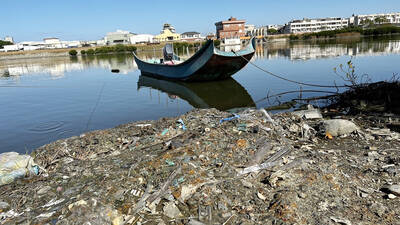
Many consumers are guilty of filling drawers or closets with old laptops, cellphones, fitness trackers and other electronic devices once they are no longer needed. It’s hard to know where to recycle such items, or it seems costly and inconvenient to do so. The world generates millions of tons of electronic waste — also called e-waste — each year. According to the UN’s most recent estimate, people worldwide produced 62 million metric tons of e-waste in 2022, and only about 22 percent of it was properly recycled. The US’ Environmental Protection Agency estimates that less than a quarter of e-waste is
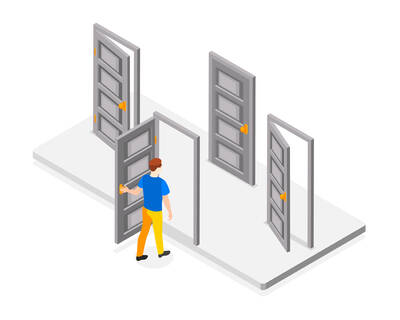
You’re sitting in class when a classmate asks to borrow a pencil. It seems like a small favor, so you agree without hesitation. The following week, the same classmate asks to share your notes. Later, they request help with a group project. You agree each time — after all, you helped out the first time — but before you know it, it has become automatic. This scenario demonstrates the “foot-in-the-door technique,” a psychological concept that shows how agreeing to small, acceptable demands makes it easier to accept larger ones later on. The name for this strategy comes from door-to-door

A: The four-day Tomb Sweeping Day long weekend begins Friday and will run until Monday. Are you going to sweep your ancestors’ tombs? B: I did in advance last weekend, so I can go to Kaohsiung to see the musical “The Phantom of the Opera.” A: Wow, is “Phantom” touring Taiwan again? It debuted in 1986, so this year marks the 40th anniversary of the show. B: And it’s not just touring Kaohsiung starting March 31, but also Taipei starting April 21 and Taichung starting May 26. A: “Phantom” is one of the world’s Four Major Musicals. I’ve seen all of them, except “Les

Dos & Don’ts — 想想看,這句話英語該怎麼說? 1. 我們很早到達電影院。 ˇ We arrived at the theater very early. χ We arrived the theater very early. 註︰arrive 為不及物動詞,後面如果有受詞要用 at 或 in。例如:They arrived in Taipei yesterday.。一般大地方,如國家、省、大城市等前面用 in,凡小地方城鎮、學校等則用 at。 2. 開車半小時以後,我們到達了海灘。 ˇ After half an hour’s drive, we got to the beach. χ After half an hour’s drive, we got the beach. 註︰come, go, get(來、去、到達)某地時,在表示地點的名詞前面應該用 to,如 go to school, go to Taipei, come to Shanghai 等。如果這些動詞後面所跟的是 here, there, home 等副詞,則不用 to。 3. 明天我會回辦公室。 ˇ I will be back in the office tomorrow. χ I will be back to office tomorrow. 註︰to be back 一語裡的 back 是副詞,不是介詞,所以後面要用 at (the market) 或 in (the office)。 假如假期結束,要回學校上課了則可說: ? Kids will be back


 RSS
RSS