


A Catholic church with Confucius and the bodhisattva Avalokitesvara (Guanyin)? When you walk into the main part of the Hualien Catholic Museum off Hualien City’s Chungmei Rd, the first thing that catches your eye is two large portraits of what look to be Confucius and Guanyin. Early in this former church’s history, apparently for missionary work, the appearance and clothing of Jesus’ parents — St Joseph and St Mary — were altered to bring them closer in line with Taiwanese culture.
The museum — previously the Catholic Diocese of Meilun — first opened as a Catholic church in October 1958. At the time it was the tallest building in Hualien City’s Meilun area, which had not yet been developed and was still quite desolate.
More than half a century later, the Catholic Church Hualien Diocese now has a new church. The church bishop Philip Huang began renovating the old church in 2010 to turn it into a museum and also applied for it to be designated a local cultural museum.
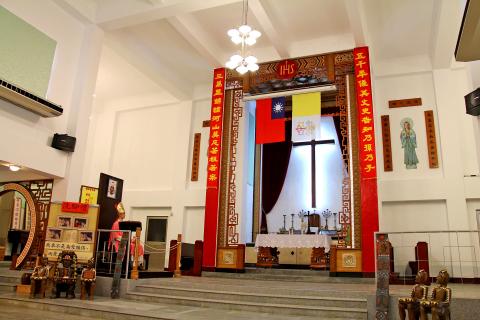
Photo: Hua Meng-ching, Liberty Times
照片:自由時報記者花孟璟
When you walk into the cathedral you immediately see what appear to be portraits of Confucius and Guanyin on two side walls, causing confusion for many tourists about whether this is indeed a Catholic cathedral. The museum says that visitors often mistake the two portraits for Confucius and Guanyin. However, the alterations were actually made by Catholic missionaries to conform to local culture, the museum says, adding that on one side the portrait that looks like Confucius is actually Christ’s father St Joseph, while the other portrait resembling Guanyin is Christ’s mother St Mary. Hopefully locals will feel a sense of familiarity when they see these pictures, which helps make Western religions more accessible, the museum says.
The collection at the museum is actually quite extensive, preserving missionary materials used by clergy members in the early days of the Hualien diocese, including clothes, the church’s Aboriginal-style decorations and carvings, and a number of photographs. All of the artifacts originally belonged to the priests who first came to these remote parts and serve as useful source materials for researching how Hualien has changed over the years.
(Liberty Times, Translated by Kyle Jeffcoat)
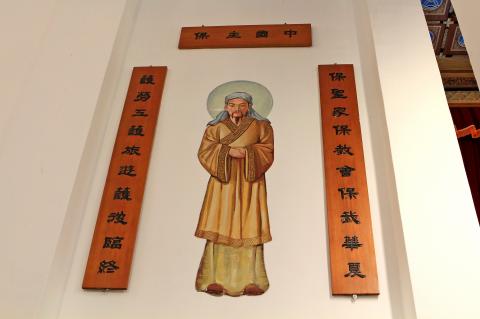
Photo: Hua Meng-ching, Liberty Times
照片:自由時報記者花孟璟
天主教堂也有孔子、觀世音菩薩?花蓮市中美路的「花蓮天主教文物館」,走進大廳赫然發現牆上竟有巨幅的「孔子」、「觀世音」畫像!原來是早年傳教為了融入台灣文化,因此基督的義父、聖母才「變裝」穿上中式服裝。
花蓮天主教文物館位於中美路,前身是「天主教美崙主教座堂」,一九五八年十月落成,時為美崙最高的建築物,當年花蓮市美崙尚未開發,仍十分荒涼。
經過一甲子光陰,天主教花蓮教區已有新的天主堂,天主教花蓮教區主教黃兆明二0一0年將閒置的主教座堂翻修,成為花蓮天主教文物館並申請成為地方文化館。
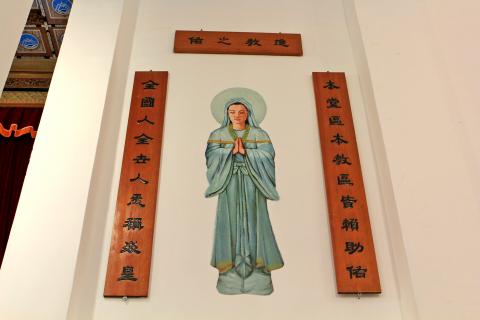
Photo: Hua Meng-ching, Liberty Times
照片:自由時報記者花孟璟
走進主教座堂內,兩側牆壁上的畫像竟神似孔子、觀音菩薩,讓遊客一頭霧水「這不是天主教的教堂嗎」?館方解釋,常有參觀民眾「誤認」這是孔子、觀世音菩薩,其實是天主教傳教為了順應在地文化,而做出的修正,一邊貌似孔子的是耶穌基督的「義父」聖若瑟、一邊則是聖母瑪利亞,希望讓在地人看到感覺親切,增加民眾對西方宗教的接受度。
事實上天主教文物館館藏頗豐,保存花蓮教區早年神職人員傳道的物品,包括服裝、教堂內有原住民風格的裝飾品、雕刻等,還有許多攝影圖片,都是神父進入偏鄉傳道時留下的第一手資料,也是研究花蓮地方變遷的素材。
(自由時報記者花孟璟)
Many consumers are guilty of filling drawers or closets with old laptops, cellphones, fitness trackers and other electronic devices once they are no longer needed. It’s hard to know where to recycle such items, or it seems costly and inconvenient to do so. The world generates millions of tons of electronic waste — also called e-waste — each year. According to the UN’s most recent estimate, people worldwide produced 62 million metric tons of e-waste in 2022, and only about 22 percent of it was properly recycled. The US’ Environmental Protection Agency estimates that less than a quarter of e-waste is
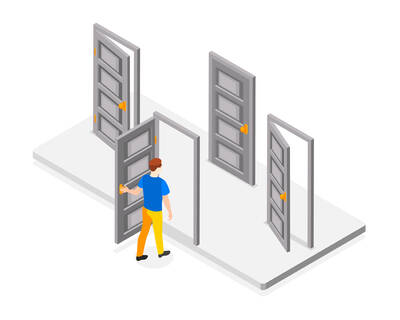
You’re sitting in class when a classmate asks to borrow a pencil. It seems like a small favor, so you agree without hesitation. The following week, the same classmate asks to share your notes. Later, they request help with a group project. You agree each time — after all, you helped out the first time — but before you know it, it has become automatic. This scenario demonstrates the “foot-in-the-door technique,” a psychological concept that shows how agreeing to small, acceptable demands makes it easier to accept larger ones later on. The name for this strategy comes from door-to-door
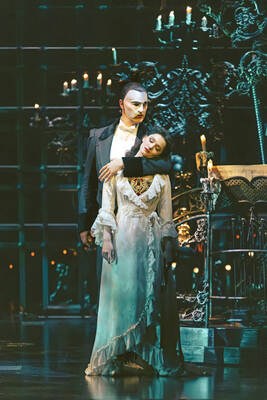
A: The four-day Tomb Sweeping Day long weekend begins Friday and will run until Monday. Are you going to sweep your ancestors’ tombs? B: I did in advance last weekend, so I can go to Kaohsiung to see the musical “The Phantom of the Opera.” A: Wow, is “Phantom” touring Taiwan again? It debuted in 1986, so this year marks the 40th anniversary of the show. B: And it’s not just touring Kaohsiung starting March 31, but also Taipei starting April 21 and Taichung starting May 26. A: “Phantom” is one of the world’s Four Major Musicals. I’ve seen all of them, except “Les

Dos & Don’ts — 想想看,這句話英語該怎麼說? 1. 我們很早到達電影院。 ˇ We arrived at the theater very early. χ We arrived the theater very early. 註︰arrive 為不及物動詞,後面如果有受詞要用 at 或 in。例如:They arrived in Taipei yesterday.。一般大地方,如國家、省、大城市等前面用 in,凡小地方城鎮、學校等則用 at。 2. 開車半小時以後,我們到達了海灘。 ˇ After half an hour’s drive, we got to the beach. χ After half an hour’s drive, we got the beach. 註︰come, go, get(來、去、到達)某地時,在表示地點的名詞前面應該用 to,如 go to school, go to Taipei, come to Shanghai 等。如果這些動詞後面所跟的是 here, there, home 等副詞,則不用 to。 3. 明天我會回辦公室。 ˇ I will be back in the office tomorrow. χ I will be back to office tomorrow. 註︰to be back 一語裡的 back 是副詞,不是介詞,所以後面要用 at (the market) 或 in (the office)。 假如假期結束,要回學校上課了則可說: ? Kids will be back


 RSS
RSS