


Lo De-sheng, 64, worked as a sailor as a young man. Three decades ago he happened to see a Wang Yeh boat on the river, which left him awestruck and deeply moved. Living at the seaside has also frequently exposed him to the religious beliefs surrounding Wang Yeh ships — ships built as part of plague offerings to the Wang Yeh plague gods. After retiring a little over a decade ago, Lo threw himself into making miniature Wang Yeh ships. The materials he uses include scrap wood, toothpicks, resin and disposable chopsticks, applying the techniques of folding, pasting and carving to sculpt detailed, realistic ship art pieces. The amateur artist’s stunning works of art are on display for three months at the art gallery on the first floor of Greater Tainan’s Anping District Office, giving people the chance to take a closer look at these exquisite examples of traditional culture.
Born in Greater Kaohsiung’s Fengshan District, Lo moved to Anping with his mother at the age of four. He was intrigued by the craft of sculpting from an early age, initially studying how to make models of navy ships from a retired naval officer as a child.
Living on the seaside, Lo would often go to Yanshuei River at night as young man to catch fish to supplement family income. He recalls being in the river with a friend drawing the fishing net one night when it was pitch dark, and spotting faintly in the distance several pale-colored, translucent ships coming toward them. In a dim haze Lo recognized ceremonial signs and weaponry on the bow of the ship, sailors wearing ancient costumes, and steersmen rowing, while other sailors beat gongs to make announcements. Leaving an indelible impression on him, the experience sparked Lo’s lifelong interest in making Wang Yeh model ships. He started visiting temples to study the specs for making the ships. Lo also began delving into the art of making Wang Yeh model ships, studying with his father-in-law, master sculptor Chen Chao-hsin. Aside from being fastidious about dimensions and ratios, the lions with swords in their mouths — jianshi — and curled dragon motifs — panlong — are also remarkably lifelike and serve to show Lo’s superb craftsmanship.
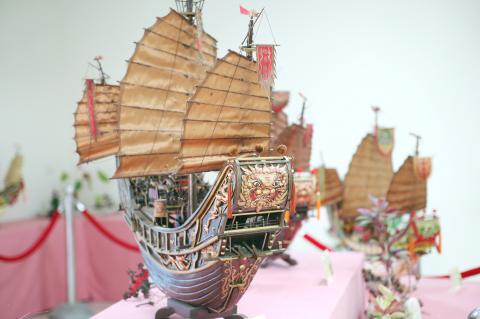
Photo: Huang Wen-huang, Liberty Times
照片:自由時報記者黃文鍠
Anping District Administrator Lin Kuo-ming says that Anping has a rich historical and cultural legacy. The architectural aesthetics and carving work on houses and temples in the past were quite demanding, which Lin says is the reason why so many traditional artisans still continue the tradition — they hope to promote the passing down of traditional artisanship and allow Anping to continue nurturing its artistic roots.
(Liberty Times, Translated by Kyle Jeffcoat)
今年六十四歲的羅德勝,年輕時曾討海為生,三十幾年前,因緣際會,在河上目睹「王爺」船隊出巡,深受震撼。加上住在海濱,時常接觸「王船」信仰,十幾年前退休後,一頭栽入迷你「王船」製作,利用廢棄木材、牙籤、樹脂及衛生筷等材料,以摺疊、粘捏及雕刻並用的技巧,雕琢出細緻如真的「船」藝作品,素人創作,令人驚艷,將在安平區公所一樓「安平藝廊」展出三個月,讓民眾就近感受精緻傳統文化。
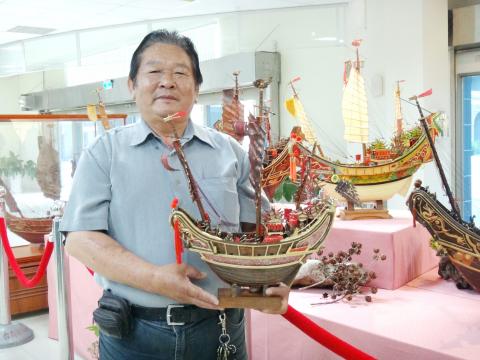
Photo: Huang Wen-huang, Liberty Times
照片:自由時報記者黃文鍠
出生於高雄鳳山的羅德勝,四歲時跟著母親移居安平,從小對雕刻工藝特別感興趣,早期就在一名海軍退伍老兵啟蒙下,嘗試製作軍艦模型。
由於家住海濱,年輕的羅德勝也常利用夜間到附近鹽水溪從事漁撈貼補家用,他回憶有一晚深夜,他和一名友人在河中收魚網,當時天色漆黑一片,卻隱約看到三、四艘呈淺白色、半透明船艦駛來,朦朧間看到船頭陳列有執事牌、儀仗,船上水手身穿古裝,舵工划船、水手敲鑼通報,讓他為之震撼。這次的經驗,也開啟他對製作王船模型的興趣,此後走訪各地廟宇,研究王船規制,並在專精雕刻的丈人陳朝心指導下,開始深入鑽研王船模型製作,除了尺寸比例相當講究外,王船船身雕繪的劍獅、蟠龍等,更是維妙維肖,巧奪天工。
安平區長林國明表示,安平擁有深厚歷史文化底蘊,過去傳統民宅及廟宇對建築外觀美感及雕工非常講究,因此至今仍有不少傳統藝術工匠師藏身其中,藉由類似展出,希望帶動傳統工藝傳承,讓傳統藝術在安平扎根。
(自由時報記者黃文鍠)
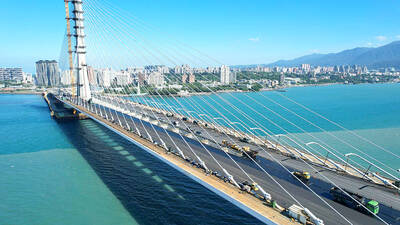
A: The Danjiang Bridge in New Taipei City is to open on May 12, and the MRT Sanying Line (Light Blue Line) will also open in June. Isn’t that great? B: Is that the bridge connecting the city’s Tamsui and Bali Districts? What’s so special about this new landmark spanning the Tamsui River? A: The Danjiang Bridge will become the world’s longest-span single-mast asymmetric cable-stayed bridge — with a total river-crossing section of 920 meters and main span of 450 meters. B: The news says there are sidewalks and bike lanes on both sides. Watching the sunset from the
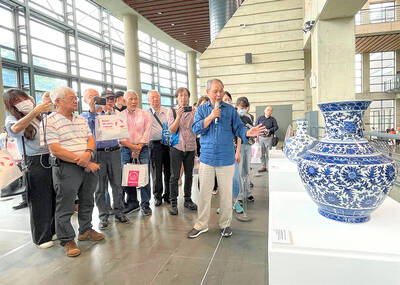
A: Apart from the Danjiang Bridge in New Taipei City, the MRT Sanying Line (Light Blue Line) will open in June. B: Is that the new line leading to Yingge District, the ceramic town? A: Yup, the line will connect the Yingge Ceramics Museum and the Old Streets in Sanxia and Yingge Districts. B: The eastward extension of the Tamsui-Xinyi Line (Red Line) that goes through Taipei’s Xinyi District will also open in June. A: Plus, Taoyuan’s Aerotropolis Line (Green Line) will partially open by the end of the year. In the future, it will connect the

In the dense forests of Tanzania, a young researcher sat quietly among the trees, her gaze fixed on a troop of chimpanzees. It was 1960, and Jane Goodall, armed with nothing but a notebook and endless curiosity, was about to change science forever. Inspired by childhood stories like the Dr. Dolittle series, she had dreamed of Africa — and now, thanks to the encouragement of anthropologist Louis Leakey, she was there, face-to-face with the wild. What Jane discovered shocked the world. Chimpanzees weren’t mere creatures of instinct; they were individuals with emotions, families, and even the capacity for tool
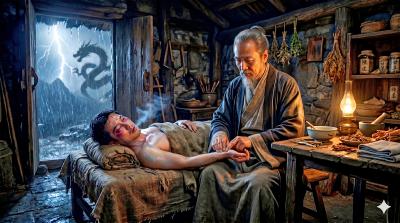
★ Bilingual Story is a fictionalized account. 雙語故事部分內容純屬虛構。 Rain hammered the roof in hard, uneven bursts. “Hold him still!” Baosheng pressed one hand against the stranger’s brow as the man twisted on the wooden bed. His left eye was swollen shut. The right one burned red like a coal. “It feels like fire,” the man gasped. “Like something is clawing inside.” Thunder rolled across the mountain. Baosheng leaned closer. The man’s skin was cold, but heat rose from his face. A strange smell hung in the air. He began the four methods of diagnosis: looking, listening/smelling,


 RSS
RSS