


Comprising three generations performing together as part of the Gongshan Association’s “infernal generals troupe,” or shijiajiang in Chinese, in Pingtung County’s Donggang Township, 75-year-old Tsai Cheng-hsiung performs the role of civil judge while his son, Tsai Ming-che, plays the second eldest Lord Shen, and his grandson, Yang Chia-en, fills the role of the “white sword general.” They participate as a family in Donggang’s ritual ceremony for welcoming the Wang Yeh gods, also known as the plague gods. But the grandfather laments that he is getting on in years and says people might not be able to see all three generations performing together as infernal generals much longer.
Gongshan Association’s infernal generals troupe was first created around 80 years ago, and was the first of its kind in Donggang. There are 12 members in all, including a civil judge and martial judge, a civil envoy and martial envoy, four generals, and four gods representing the four seasons. The scope of Donggang’s ceremony for welcoming the gods was initially quite small, and the troupe was always in charge of organizing the ceremony and protecting the gods. But as the number of people taking part in the ceremony grew, it eventually became a more elaborate event, and a large Songjiang battle formation troupe with 108 members took over the responsibility of inviting, welcoming and protecting the Wang Yeh gods. Gongshan Association’s troupe still plays an important role in the local event though.
This year the 75-year-old Tsai is performing the old general’s role, teaching newcomers how to perform their parts as generals, and passing on the local traditions of the art form. Seeing the grandfather perform as an infernal general together with his son and grandson is an extraordinary scene.
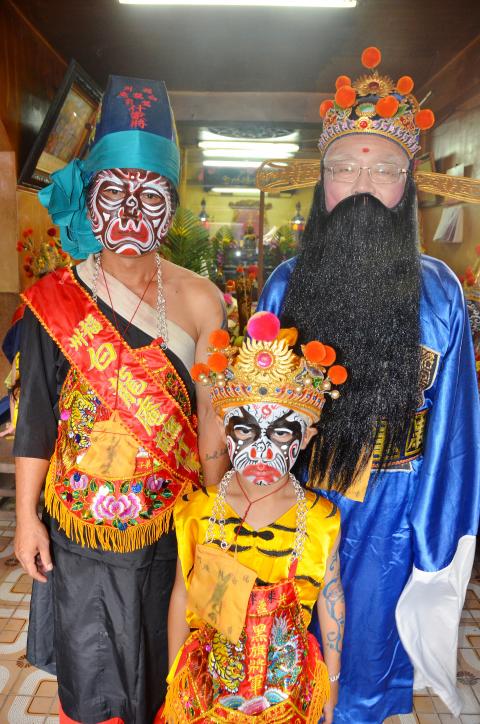
Photo: Yeh Yung-chien, Liberty Times
照片:自由時報記者葉永騫
Grandfather Tsai says that when he first started performing with the infernal generals troupe as a young lad it was because he was suffering from an ailment that doctors were unable to treat at the time, so he sought help from the gods. Eventually recovering his health, he decided to fulfill his duty of repaying the gods by serving as one of the infernal general characters. When his son was a young boy, Tsai would often take him to the temple to learn how to perform, and says that his grandson started studying because he was interested, thus you have three generations performing together in one association. Being able to perform together in this year’s ceremony for welcoming the Wang Yeh gods is a rare treat indeed.
(Liberty Times, Translated by Kyle Jeffcoat)
七十五歲蔡正雄當文判、兒子蔡明哲扮沈二爺,外孫楊家恩則擔任白劍將軍,三代同台扮演開基屏東縣東港鎮共善堂什家將,共同參與東港迎王平安祭典,蔡正雄說,他年紀大了,三代同堂扮家將的畫面以後恐怕很難再見到。
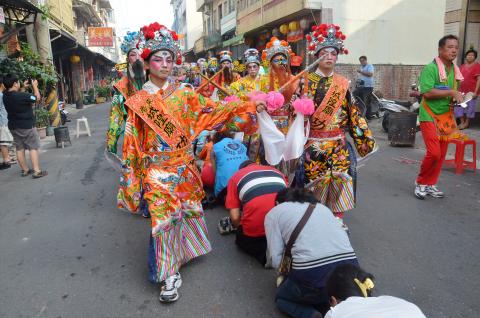
Photo: Yeh Yung-chien, Liberty Times
照片:自由時報記者葉永騫
東港共善堂的什家將成立約八十年,是東港鎮第一個家將團,成員有十二人,分成文武判、文武差爺、前四班、後四季,早期東港迎王的規模並不盛大,由什家將負責迎王祭典護衛工作,後來隨著祭典人數愈來愈多,規模愈來愈大,請王、迎王等護衛工作改由人數較多的宋江陣一百零八條好漢負責,但共善堂什家將在地方仍頗負盛名。
今年迎王更有七十五歲的蔡正雄等老班底參與扮家將,教導後進學習扮好家將,傳承這項民俗技藝,他也和兒子蔡明哲、外孫楊家恩同台扮演什家將,成了相當難得的畫面。
蔡正雄表示,參加什家將是因為年輕時曾經遇到不好的東西,看醫生也沒有效,後來祈求神明幫助,身體漸漸痊癒,才會接下家將這個任務,兒子是從小帶到廟裡學習,外孫因有興趣學習,才會形成三代同堂,並難得一起參加這次的迎王平安祭典。(自由時報記者葉永騫)

Many consumers are guilty of filling drawers or closets with old laptops, cellphones, fitness trackers and other electronic devices once they are no longer needed. It’s hard to know where to recycle such items, or it seems costly and inconvenient to do so. The world generates millions of tons of electronic waste — also called e-waste — each year. According to the UN’s most recent estimate, people worldwide produced 62 million metric tons of e-waste in 2022, and only about 22 percent of it was properly recycled. The US’ Environmental Protection Agency estimates that less than a quarter of e-waste is

You’re sitting in class when a classmate asks to borrow a pencil. It seems like a small favor, so you agree without hesitation. The following week, the same classmate asks to share your notes. Later, they request help with a group project. You agree each time — after all, you helped out the first time — but before you know it, it has become automatic. This scenario demonstrates the “foot-in-the-door technique,” a psychological concept that shows how agreeing to small, acceptable demands makes it easier to accept larger ones later on. The name for this strategy comes from door-to-door

A: The four-day Tomb Sweeping Day long weekend begins Friday and will run until Monday. Are you going to sweep your ancestors’ tombs? B: I did in advance last weekend, so I can go to Kaohsiung to see the musical “The Phantom of the Opera.” A: Wow, is “Phantom” touring Taiwan again? It debuted in 1986, so this year marks the 40th anniversary of the show. B: And it’s not just touring Kaohsiung starting March 31, but also Taipei starting April 21 and Taichung starting May 26. A: “Phantom” is one of the world’s Four Major Musicals. I’ve seen all of them, except “Les

Continued from yesterday(延續自昨日) https://www.taipeitimes.com/News/lang Gig Tripping “Gig tripping” combines concerts with travel. People fly to see their favorite artists perform — usually abroad—and spend a few days sightseeing before or after the show. While die-hard fans have done this since the 1960s, the post-pandemic travel boom changed the game. Even people who aren’t superfans are now booking international concert trips because they want to make the most of travel opportunities. This trend exploded in the US, as the math makes sense. Domestic concert tickets are so costly that flying abroad for the show plus tourism expenses often matches or even beats the price


 RSS
RSS