


An elderly woman’s catastrophic attempt to “restore” a century-old oil painting of Christ in a Spanish church has provoked popular uproar, and amusement.
The well-intentioned but ham-fisted amateur artist, in her 80s, took it upon herself to fill in the patches and paint over the original work, which depicted Christ crowned with thorns, his sorrowful gaze lifted to heaven.
Her work done, the “restored” figure looks somewhat like a monkey with fur surrounding a pale face and a child-like drawing of eyes, a cartoon-style nose and a crooked smudge for a mouth.
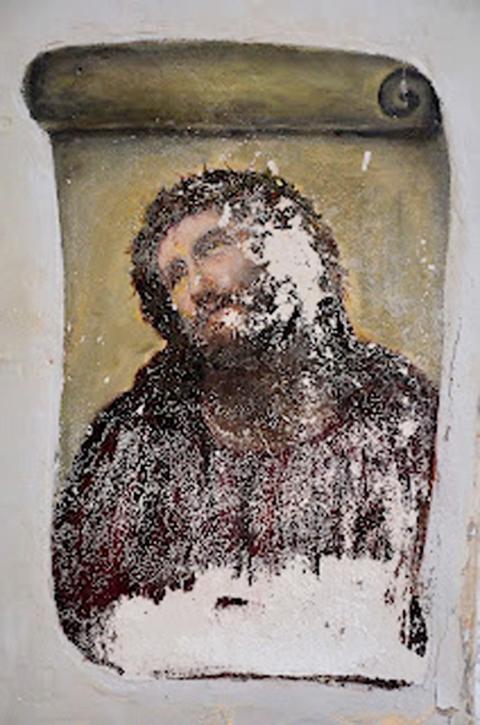
Photo: Reuters
照片:路透
Titled Ecce Homo (Behold the Man), the original was no masterpiece, painted in two hours in 1910 by a certain Elias Garcia Martinez directly on a column in the church at Borja, northeastern Spain.
The new version has become a national joke, reminiscent of fictional film character Mr. Bean’s comic attempt to restore Whistler’s Mother after he sneezes on it and mistakenly wipes off the face.
Social networks and online news sites were deluged with comments by users, many of whom created their own versions of the restored work incorporating the faces of King Juan Carlos or Prime Minister Mariano Rajoy.

Photo: Reuters
照片:路透
(AFP)
一位老婦人企圖「修復」西班牙一座教堂裡的百年耶穌畫像的災難性舉動已引發舉國騷動,但也帶來不少歡笑。
這位出於一片好意、手藝卻不太靈巧的業餘畫家高齡八十多歲,她自作主張地想要修補這幅斑駁的畫像,在原作上重新上色,這幅作品描繪的是頭戴著荊棘冠冕、眼神哀傷望向天堂的耶穌。
她的工作完成後,「修復過」的人物看起來卻有點像是一隻頭戴了一圈皮草、臉部蒼白的猴子,眼睛像是小朋友的塗鴉,鼻子帶有卡通風格,嘴巴則用一塊彎曲的污漬充數。
標題為《看這個人》的原作其實也並非曠世巨作,只是一位名為賈西亞的畫家於一九一○年在位於西班牙東北部波哈市的教堂內,只花了兩小時時間直接畫在教堂圓柱上的作品。
修復後的新版畫作已在西班牙成為全國笑柄,令人聯想到虛構電影角色「豆豆先生」對著美國畫家惠斯勒名作「母親」打了個噴嚏,不小心把畫作上的人臉抹掉後,再試圖修復畫作的喜劇橋段。
各社交媒體與網路新聞網站都湧入了大批使用者發表評論,許多人更將這幅修復畫作結合西班牙國王璜.卡洛斯或總理馬里亞諾‧拉霍伊的臉,創造出自己的新版本。
(法新社/翻譯:俞智敏)

★ Bilingual Story is a fictionalized account. 雙語故事部分內容純屬虛構。 The mango looked perfect. It sat on the fruit stand like a small sunset, red on one side and gold on the other. “I’ll take this one,” said Daniel. The fruit seller shook her head. “Not that one.” Daniel was surprised. “Why not? It looks beautiful.” “Yes,” she said, “but beautiful is not always ready.” She picked up another mango and held it near his nose. “First, smell here.” Daniel smelled the top of the mango. It was sweet and warm. “Good mangoes have a smell,” she said. “Next, feel the weight.”

In 2023, an 80-year-old woman in Taipei suffocated her paralyzed son after over five decades of caring for him. Turning herself in immediately, she confessed that worsening health and anxiety about who would care for him after her death had driven her to act. The court, acknowledging her difficult situation, sentenced her to two-and-a-half years in prison while recommending a presidential pardon. This rare judicial recommendation drew a complicated social response. Supporters argue that the mother’s half-century of caregiving renders her deserving of compassion instead of incarceration, believing that allowing her to live her final years in dignity and

Put the Cart Before the Horse 本末倒置 Iris: I think I’m in love. Carl: What? Iris: We just have so much in common. We like all of the same things. Carl: Yes, but you’ve only chatted with him online. Iris: It doesn’t matter. I know we’ll end up getting married. Carl: I’m afraid you’re putting the cart before the horse. You should at least meet him first. Iris: OK, OK. I’ll do that. 艾瑞絲: 我想我戀愛了。 卡 爾: 什麼? 艾瑞絲: 我們就是有那麼多的共通點。我們喜歡的東西都一樣。 卡 爾: 是沒錯,不過妳和他只在網路上聊過天而已。 艾瑞絲: 那不重要。我知道我們最後一定會步入禮堂。 卡 爾: 妳恐怕是本末倒置了吧。妳至少應該先跟他見個面。 艾瑞絲: 好啦,好啦。我會的啦。 A tough cookie 強悍的人∕堅強的人 Tracy: I heard you went out with Iris last night. Justin: Yeah. We

1. 他非常討厭偽君子。 ˇ He has a deep hatred for hypocrites. χ He has a deep hatred to hypocrites. 註︰表示「對某人懷著愛、恨」等, 常用 have a love for/of, have a hatred for/of。 例如: We have a love for/of science. The working people have a hatred for/of all forms of exploitation. 2. 問題的答案其實不難找。 ˇ The answer to this question is not difficult to find. χ The answer of this question is not difficult to find. 註︰中文中的「的」在英語中不一定都用 of 來表示,有時須用 to。其他的例子如下: 我把房間的鑰匙弄丟了。 I lost the key to the room. 中間矗立著烈士紀念碑。 In the center stands the monument to the martyrs. 這部電影的續集你看過沒有? Have you seen the sequel to the movie? 3. 比起那家餐廳,他更喜歡這家。 ˇ He prefers this restaurant to that one. ˇ He likes


 RSS
RSS