


Besides evoking a joyous holiday atmosphere, how else could the popular secular song “Jingle Bells” inspire people? For 23-year-old Japanese classical pianist and composer Nobuyuki Tsujii, who has been blind since birth, the song was a catalyst that helped awaken his extraordinary musical talent as a born piano prodigy. At the age of two, he was able to play the melody with harmony on a toy piano, along with the melody his mother hummed. Nobuyuki Tsujii is popularly known as “Nobu,” and his rise to stardom has been dubbed the “Nobu boom.” He will present recitals in Taipei on June 15 and Kaohsiung on June 19, with a program of piano works ranging from the Classical era to the Romantic era.
At the 2009 Van Cliburn Internatonal Piano Competition, which some would say is the world’s most challenging piano contest, Tsujii tied for the gold medal with 22-year-old Chinese pianist Zhang Haochen, who has also been invited to present concerts in Taiwan later this year. Tsujii’s triumph marked a significant milestone in his career as a piano virtuoso, and he was the first blind pianist to win the first prize in any of the world’s first-class international piano competitions. Michel Beroff, one of the jurors at the competition, told the Japanese monthly piano magazine Chopin, “The special thing about his performance is his sound. It has depth, color and contrast — the genuine music.”
Tsujii made his Taiwan debut in 2000 as part of an event organized by pianist Azusa Anna Fujita, founder of the Frederic Chopin Foundation of Taipei. Along the road to stardom, Tsujii has studied piano with Masahiro Kawakami, Yukio Yokoyama, and Kyoko Tabe. He graduated from Ueno Gakuen University last year. When learning a new piece, instead of visually reading music scores like most others, Tsujii has to work hard to overcome his visual impairment by reading Braille music scores with one hand while playing the piano with the other. He listens to many recordings and memorizes the musical articulation markings, which his family, teachers or friends read out loud or record for him. One can imagine how difficult and time-consuming Tsujii’s learning process is. Nevertheless, thanks to his musical talent, prodigious memory and dogged determination, he won the first of his numerous music prizes at the age of seven, debuted on stage with a professional orchestra at 10, and gave his first piano recital in the small hall of Tokyo’s Suntory Hall when he was 12 years old. Organizers of a press conference held in Taipei last Tuesday said that tickets to Tsujii’s concerts usually sell out quickly.
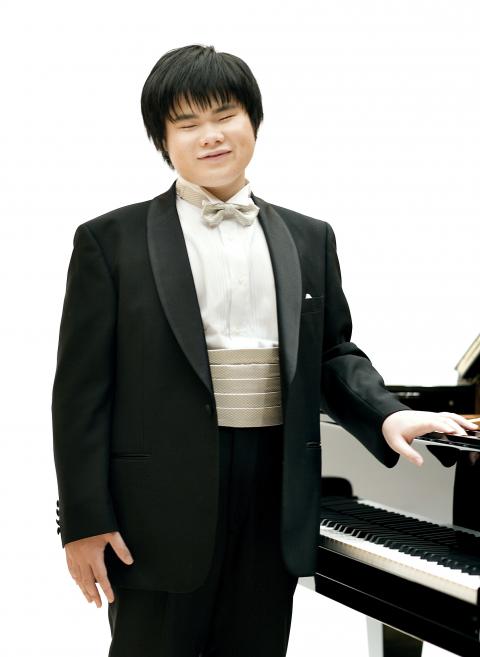
Photo by Yuji Hori, courtesy of New Aspect
照片由Yuji Hori攝影、新象提供
Since the release of his first album Debut in 2007, Tsujii has recorded numerous albums, and sales for his CDs have skyrocketed in the wake of his Van Cliburn success. In 2009, Tsujii was featured in a documentary film about the 13th Van Cliburn competition entitled A Surprise in Texas. In the film, Tsujii plays his own musical composition Whisper of the River, which he wrote when he was in high school to express his love for his father. Tsujii’s compositional style seems to be influenced by popular music, but he has expressed his wish to be regarded as a professional classical pianist. According to the tour organizers, he would like to shake off the image of a young and naive musician, despite his round-faced and boyish appearance. Tsujii’s interpretation of music is lyrical and reserved in style, which may have something to do with his personality.
Tsujii’s fingertips serve as his eyes, and he plays scores with a sensitivity that goes beyond the auditory sphere. He has given numerous charity concerts to help Japan’s earthquake and tsunami victims, and his uniquely warm expression of timbre has won him the title of “the light of Japan.” 78-year-old pianist Harvey Lavan “Van” Cliburn, Jr. told the Texan daily Fort Worth Star-Telegram, “[Tsujii] was absolutely miraculous. His performance had the power of a healing service. It was truly divine.”
Last November Tsujii played a debut recital in the main hall at Carnegie Hall in New York as part of the Keyboard Virtuosos II series, whose line-up of world-acclaimed pianists includes Maurizio Pollini, Andras Schiff, Evgeny Kissin and Mitsuko Uchida. Tsujii performed Ludwig van Beethoven’s (1770-1827) Piano Sonata No. 17 in D Minor, (“The Tempest”) and Modest Mussorgsky’s (1839-1881) Pictures at an Exhibition, taking the New York audience by storm. In his recitals in Taiwan next month, Tsujii will play these two works by Beethoven and Mussorgsky, plus Wolfgang Amadeus Mozart’s (1756-1791) Piano Sonata in A Major, K. 331.
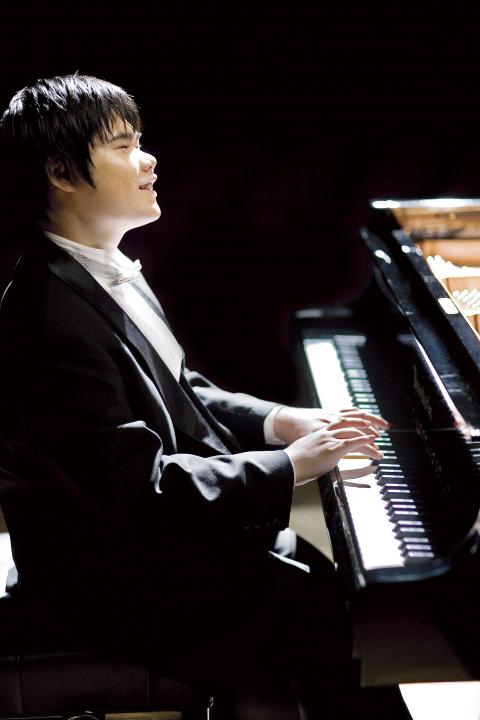
Photo by Yuji Hori, courtesy of New Aspect
照片由Yuji Hori攝影、新象提供
Some people may wonder how Tsujii visualizes the images portrayed by program music, such as Pictures at an Exhibition, as opposed to the absolute music of Mozart and Beethoven. The artworks he imagines may not be the same as what the rest of us see, but his subtle artistic interpretation mesmerizes audiences nonetheless. What color is the wind today?, a book written by Tsujii’s mother that has touched people’s hearts, tells a story of Tsujii’s battle to overcome his disability and his education. The title of the book is supposed to be a question that a young Tsujii asked his mother as a child. Tsujii’s Taiwan concerts may well be one of the most significant and special musical events held in Taiwan this year.
(Lin Ya-ti, Taipei Times)
一首膾炙人口的通俗歌曲「叮叮噹」,除了帶來歡樂的節慶氣氛外,還能帶給人們什麼樣的啟發呢?對於二十三歲日本視障古典鋼琴家兼作曲家辻井伸行來說,該曲旋律在母親的哼唱帶領下,讓當時才兩歲的他,憑著敏銳的聽覺,在玩具鋼琴上彈出具有和聲的旋律,展露過人的音樂天賦。有「辻井瘋」之稱的辻井,將於六月十五日於台北及六月十九日於高雄舉辦獨奏會,曲目包含古典與浪漫樂派時期作品。
二○○九年,辻井在號稱「全球最難」的范克萊本國際鋼琴大賽,與今年底也將來台演奏的二十二歲中國鋼琴家張昊辰,並列冠軍。此項殊榮讓辻井的演奏家生涯達到一個意義非凡的里程碑,也成為史上首位獲得世界一流鋼琴大賽首獎的盲人鋼琴家。評審之一的米謝‧貝羅夫稱讚:「他的演出富有深度、色彩與對比,是真正的音樂。」
辻井曾於二○○○年在財團法人中華蕭邦音樂基金會創辦人藤田梓的邀請下,首度訪台演出。一路走來巨星鋒芒愈趨亮眼的辻井,師承川上昌裕、橫山幸雄、田部京子等,並於去年自上野學園大學畢業。雖無法像明眼人讀譜,但他努力克服先天障礙,辛苦地靠著一手摸點字譜而另一手彈奏練習、聆聽大量錄音曲目,以及透過身旁親友師長將樂譜上的表情記號朗誦或錄音記錄下來,才得以學會一首新曲,再再顯示辻井艱辛與耗時的學習歷程。即便如此,辻井憑藉其音樂天賦、驚人的記憶力以及永不放棄的毅力,讓他在七歲獲獎第一座音樂大賽獎項、十歲首度與專業管絃樂團同台,十二歲首度在東京三得利音樂廳的小廳開獨奏會。據主辦單位上週二在台北舉行的記者會上表示,辻井的音樂會,經常是一票難求。
自二○○七年出版首張個人專輯《Debut》後,辻井已經灌錄多張暢銷唱片,並在贏得范克萊本大賽後,銷售更是創佳績。他在紀錄二○○九年第十三屆范克萊本鋼琴大賽影片《德州的驚喜》中,演出一首表達對父親的愛的高中時期創作《河流的細語》。雖然辻井作曲曲風多偏流行,但主辦單位表示,他希望被定位為一位嚴肅的古典鋼琴家,並且擺脫圓臉外表給人稚嫩的印象。其曲目詮釋上較偏向於抒情與內斂,這可能與其人格特質有關。
辻井以指尖代替眼睛,以超越聽覺世界的敏感度彈奏音符,並以特有的溫暖琴聲,在許多日本大海嘯的慈善音樂會上獻藝,甚至被當地視為日本人的希望。高齡七十八歲的美國鋼琴家哈維‧拉凡‧范克萊本接受德州《華茲堡星電報》訪問時曾說:「辻井伸行的演出十分神奇,擁有治癒人心的魔力,充滿神聖性。」
去年十一月,辻井與毛利齊奧‧波里尼、安德拉斯‧席夫、艾夫根尼‧紀新,以及內田光子等著名鋼琴家共同名列卡內基「鋼琴大師系列二音樂會」的音樂家,並首度在紐約卡內基音樂廳的主廳舉行獨奏會,演出路德維希‧凡‧貝多芬(一七七○一八二七)的《第十七號D小調鋼琴奏鳴曲「暴風雨」》與莫迪斯特‧穆索斯基(一八三九-一八八一)的《展覽會之畫》,造成轟動。辻井在下個月訪台的獨奏會上,亦將演奏這兩首貝多芬與穆索斯基的作品,並外加一首沃夫岡‧阿瑪迪斯‧莫札特(一七五六─一七九一)的《第十一號A大調鋼琴奏鳴曲》。
有些人可能會好奇,相對於莫札特與貝多芬的絕對音樂,《展覽會之畫》這首具象的標題音樂,對全盲的辻井而言,其想像出的畫作可能有別於一般人,但他對藝術的細膩詮釋,讓觀眾神往。辻井的母親將兒子的奮鬥故事與教育過程,寫成《今天的風是什麼顏色?》一書,感人無數,而書名應該是辻井小時候常問母親的話吧。相信辻井所帶來的音樂會,將會是台灣今年別具意義的音樂盛事之一。
(台北時報記者林亞蒂)

Many consumers are guilty of filling drawers or closets with old laptops, cellphones, fitness trackers and other electronic devices once they are no longer needed. It’s hard to know where to recycle such items, or it seems costly and inconvenient to do so. The world generates millions of tons of electronic waste — also called e-waste — each year. According to the UN’s most recent estimate, people worldwide produced 62 million metric tons of e-waste in 2022, and only about 22 percent of it was properly recycled. The US’ Environmental Protection Agency estimates that less than a quarter of e-waste is

You’re sitting in class when a classmate asks to borrow a pencil. It seems like a small favor, so you agree without hesitation. The following week, the same classmate asks to share your notes. Later, they request help with a group project. You agree each time — after all, you helped out the first time — but before you know it, it has become automatic. This scenario demonstrates the “foot-in-the-door technique,” a psychological concept that shows how agreeing to small, acceptable demands makes it easier to accept larger ones later on. The name for this strategy comes from door-to-door
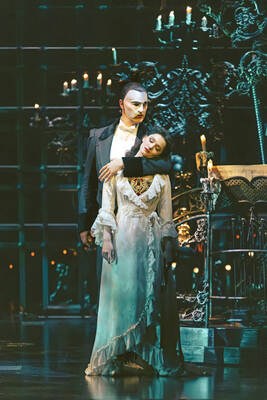
A: The four-day Tomb Sweeping Day long weekend begins Friday and will run until Monday. Are you going to sweep your ancestors’ tombs? B: I did in advance last weekend, so I can go to Kaohsiung to see the musical “The Phantom of the Opera.” A: Wow, is “Phantom” touring Taiwan again? It debuted in 1986, so this year marks the 40th anniversary of the show. B: And it’s not just touring Kaohsiung starting March 31, but also Taipei starting April 21 and Taichung starting May 26. A: “Phantom” is one of the world’s Four Major Musicals. I’ve seen all of them, except “Les

Dos & Don’ts — 想想看,這句話英語該怎麼說? 1. 我們很早到達電影院。 ˇ We arrived at the theater very early. χ We arrived the theater very early. 註︰arrive 為不及物動詞,後面如果有受詞要用 at 或 in。例如:They arrived in Taipei yesterday.。一般大地方,如國家、省、大城市等前面用 in,凡小地方城鎮、學校等則用 at。 2. 開車半小時以後,我們到達了海灘。 ˇ After half an hour’s drive, we got to the beach. χ After half an hour’s drive, we got the beach. 註︰come, go, get(來、去、到達)某地時,在表示地點的名詞前面應該用 to,如 go to school, go to Taipei, come to Shanghai 等。如果這些動詞後面所跟的是 here, there, home 等副詞,則不用 to。 3. 明天我會回辦公室。 ˇ I will be back in the office tomorrow. χ I will be back to office tomorrow. 註︰to be back 一語裡的 back 是副詞,不是介詞,所以後面要用 at (the market) 或 in (the office)。 假如假期結束,要回學校上課了則可說: ? Kids will be back


 RSS
RSS