


A museum in Italy has started burning its artworks in protest at budget cuts, which it says have left cultural institutions out of pocket.
Antonio Manfredi, of the Casoria Contemporary Art Museum, set fire to the first painting on Tuesday.” Our 1,000 artworks are headed for destruction anyway because of the government’s indifference,” he said.
The work was by French artist Severine Bourguignon, who was in favor of the protest and watched it online.
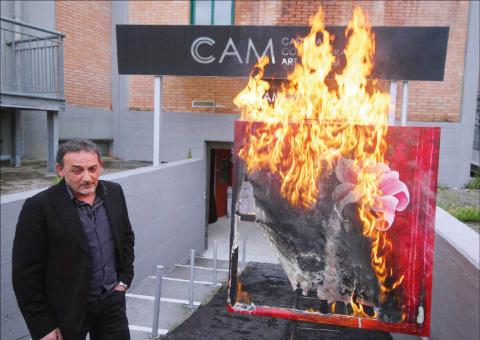
Photo: Reuters
照片:路透
Manfredi plans to burn three paintings a week from now on, in a protest he has dubbed “Art War.”
Artists from across Europe have lent their support, including Welsh sculptor John Brown, who torched one of his works, Manifesto, on Monday.
Italy’s debt crisis led to the resignation of former prime minister Silvio Berlusconi last year. Since his departure, the government has passed a tough package of austerity measures and other reforms.
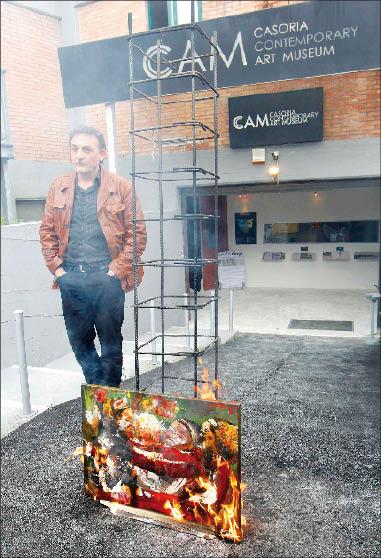
Photo: Reuters
照片:路透
Art institutions say they have been particularly affected by the country’s economic woes, with state subsidies and charitable donations drying up.
(Liberty Times)
義大利一家美術館開始燒毀館藏藝術品,抗議政府削減預算,讓文化機構賠錢經營。
卡索利亞當代美術館的安東尼歐‧曼佛萊帝,週二點火焚燒第一幅畫作。「我們的一千件館藏,無論如何都要燒毀,都是政府漠視造成的。」
這幅畫作是法國藝術家布赫吉農的作品,他支持抗議行動,並在線上觀看抗議過程。
曼佛萊帝計畫從現在開始,在他稱為「藝術之戰」的抗議活動中,一週燒三幅畫。
歐洲各地的藝術家都表達支持,包括威爾斯雕刻家約翰布朗,在週一燒掉他的作品「宣言」。
義大利債務危機導致前總理貝魯斯孔尼去年辭職,自從他下台後,政府通過嚴苛的撙節措施方案,以及其他改革辦法。
藝術機構表示他們受到經濟困境的影響特別大,國家補助削減,慈善捐款枯竭。
(自由時報/翻譯:陳維真)
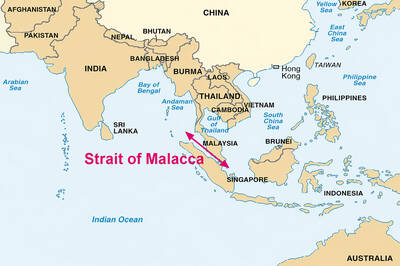
The closure of the Strait of Hormuz has forced policymakers in Asia to face questions over the security of other maritime chokepoints, including the Strait of Malacca, which is the world’s busiest waterway for international trade. WHAT IS THE MALACCA STRAIT? The 900km long Malacca Strait, bounded by Indonesia, Thailand, Malaysia and Singapore, provides the shortest sea route from East Asia to the Middle East and Europe. It carries nearly 22 percent of the world’s maritime trade, according to the Center for Strategic and International Studies (CSIS). This includes oil and gas shipments from the Middle East to the energy-hungry economies of China,
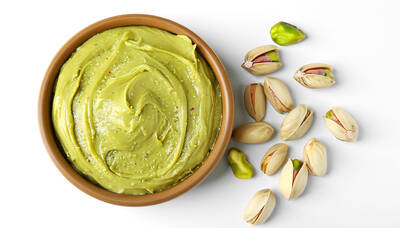
It seems like every year, new foods or drinks start trending and suddenly show up everywhere. A decade ago, avocado __1__ restaurant menus, while oat milk became the must-have addition to your coffee in cafes around five years back. The latest trend to hit this list is the pistachio. This flavorful green nut now features in everything from chocolate bars to Indian curries. While pistachios have long played a central role in certain regional cuisines, their recent global __2__ can be traced to Dubai. There, a specialty chocolate shop went __3__ on TikTok for one of its chocolate bars

One reason pistachios have taken the food world by storm compared to other nuts is their soft, green color. When ground down into a cream or butter, the green hue __6__ nicely with golden pastries or dark-brown chocolate, making it perfect for Instagram photos and TikTok videos. Their labor-intensive cultivation and __7__ also contribute to their image as a premium ingredient. Thus, buying a pistachio-based product often feels like a __8__ treat. Pistachios also stand out for their distinct flavor and health __9__. They have a subtle, sweet, earthy flavor that goes well with both sweet desserts and

Cameras are everywhere — in our pockets, on our walls and even in space. They capture emotions, preserve history and reflect culture. Through these devices, photography is now essential to modern life, influencing how we perceive ourselves and the world. To understand the root of their power, let’s explore the camera’s remarkable journey. The story begins with the camera obscura, a dark room with a tiny hole. Light passing through the opening projected an inverted image on the opposite wall. Renaissance artists used this principle to paint accurate scenes. However, these images couldn’t be preserved as photographs. That changed


 RSS
RSS