


A family in Nantou County discovered a boa coiled up hiding in a bucket that was placed upside down on their balcony. The boa’s tail was sticking out of the bucket because it could not fit inside the bucket. At the beginning of last month, the owner of the house, a woman surnamed Liu, thought it was strange that the bucket had a tail, but she was afraid to touch it. Eventually she cried out that her one-year-old grandchild often sleeps in the room next to the balcony where the boa was hiding, and that if the animal had slipped into the room, it would have posed a great danger to the child.
The boa was over 1.8m long and weighed 15kg. The thickest part of the snake was as thick as an adult leg. The boa is capable of swallowing chickens, ducks, and rabbits; thus, swallowing a one-year-old child would be a piece of cake.
It was when Liu was doing house chores and needed to use the bucket, she was shocked to see part of a boa’s tail. Without wasting any time, she alerted the fire department in Caotun Township. Firefighters spent four minutes getting the boa out of the bucket and putting it into an iron cage they brought with them.
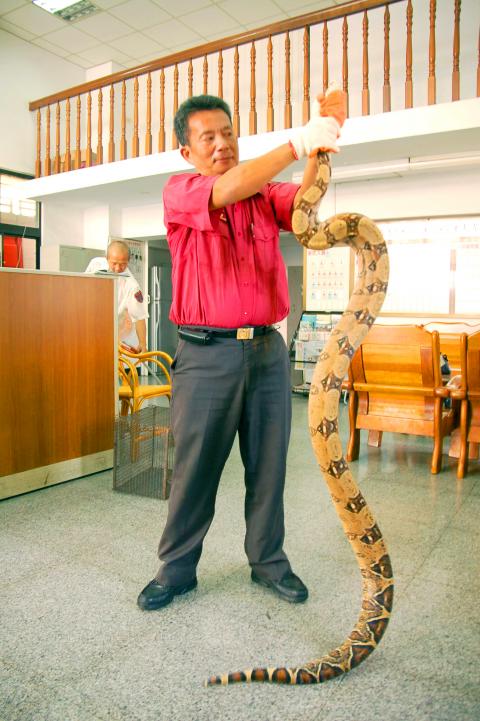
Photo: Chen Feng-li, liberty Times
照片:自由時報記者陳鳳麗
Liu said she usually sweeps the floor in the evening, but she did not have the energy to do the chores on that particular evening; thus, she delayed her house chores till the next morning. Thanks to her procrastination she was not attacked by the boa in the evening, and was able to detect the danger during the day when she could see better. She said her grandchild often comes to visit during vacations, and would sleep in the bed in the room next to the balcony. The casement window where the boa was hiding is less than a meter from the bed. Fortunately the grandchild was not there that night. She tries not to think about might have occurred had the child been there.
A veterinarian from the Council of Agriculture said red-tail boas are kept as pets in Taiwan, and are usually fed mice and chicks. When they grow bigger, however, they need significantly larger portions, which becomes a financial burden for pet owners. In this case, the boa might have been abandoned.
Red-tail boas are good at climbing. To climb to the second floor is an easy task for them. This kind of animal is still not even the strongest of their kind. If a boa attacks a person, their bones might not be crushed, and also humans are not a boa’s typical prey. But it would be devastating for a newborn child to be bitten by a boa.
(LIBERTY TIMES, TRANSLATED BY TAIJING WU)
南投縣一戶人家的小陽台,竟潛伏一條粗大的巨蟒,蜷曲躲進倒置的水桶內,但塞不進尾巴。劉姓女主人上個月初察覺怪異「水桶怎會長尾巴?」不敢驚動而幸運逃過一劫。事後她驚呼,一歲乖孫常回來睡這間房,巨蟒若無聲無息溜進來,孩子就危險了。
這條巨蟒體長超過一米八、重達十五公斤,直徑最大如成人小腿肚,能吞下雞、鴨、兔,吞下一歲嬰兒非難事。
女主人想取水桶清掃時,瞥見桶緣露出一截蛇尾,嚇得立刻關上落地窗,打電話向草屯消防分隊求救。消防員花了四分鐘才把巨蟒抓出水桶,塞入預備的鐵籠裡。
劉姓女主人說,平日她都是入夜才拖地,前晚懶得清掃,拖到隔天上午,也全賴這次延遲,才沒有在夜間遭巨蟒攻擊,得以在視線良好的白天察覺危機。她說,孫子假日都會來,就睡在這個房間的兒童床,床旁不到一公尺就是落地窗,巨蟒就躲在窗外的陽台。幸好孫子昨天沒回來,否則後果太可怕,她不敢往下想。
農委會獸醫師表示,台灣有人把紅尾蟒當寵物養,餵食老鼠或小雞等,但牠長大後,食量變大,對主人是一大負擔,這條巨蟒應是因而被棄養。
紅尾蟒是攀爬高手,二樓的高度對牠而言輕而易舉,雖然力量在蛇類中不算最大,被纏繞不太會擰斷骨頭,人類也非紅尾蟒的獵物,但若是嬰、幼兒被牠們壓到、纏繞或咬到,後果仍不堪設想。
(自由時報記者陳鳳麗)
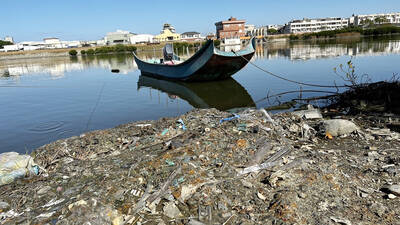
Many consumers are guilty of filling drawers or closets with old laptops, cellphones, fitness trackers and other electronic devices once they are no longer needed. It’s hard to know where to recycle such items, or it seems costly and inconvenient to do so. The world generates millions of tons of electronic waste — also called e-waste — each year. According to the UN’s most recent estimate, people worldwide produced 62 million metric tons of e-waste in 2022, and only about 22 percent of it was properly recycled. The US’ Environmental Protection Agency estimates that less than a quarter of e-waste is
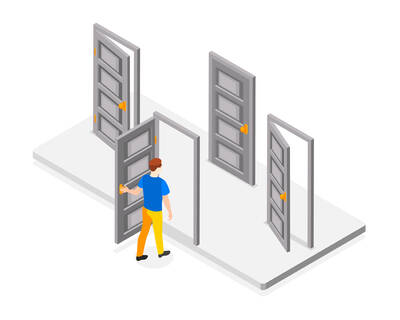
You’re sitting in class when a classmate asks to borrow a pencil. It seems like a small favor, so you agree without hesitation. The following week, the same classmate asks to share your notes. Later, they request help with a group project. You agree each time — after all, you helped out the first time — but before you know it, it has become automatic. This scenario demonstrates the “foot-in-the-door technique,” a psychological concept that shows how agreeing to small, acceptable demands makes it easier to accept larger ones later on. The name for this strategy comes from door-to-door

A: The four-day Tomb Sweeping Day long weekend begins Friday and will run until Monday. Are you going to sweep your ancestors’ tombs? B: I did in advance last weekend, so I can go to Kaohsiung to see the musical “The Phantom of the Opera.” A: Wow, is “Phantom” touring Taiwan again? It debuted in 1986, so this year marks the 40th anniversary of the show. B: And it’s not just touring Kaohsiung starting March 31, but also Taipei starting April 21 and Taichung starting May 26. A: “Phantom” is one of the world’s Four Major Musicals. I’ve seen all of them, except “Les
Dos & Don’ts — 想想看,這句話英語該怎麼說? 1. 我們很早到達電影院。 ˇ We arrived at the theater very early. χ We arrived the theater very early. 註︰arrive 為不及物動詞,後面如果有受詞要用 at 或 in。例如:They arrived in Taipei yesterday.。一般大地方,如國家、省、大城市等前面用 in,凡小地方城鎮、學校等則用 at。 2. 開車半小時以後,我們到達了海灘。 ˇ After half an hour’s drive, we got to the beach. χ After half an hour’s drive, we got the beach. 註︰come, go, get(來、去、到達)某地時,在表示地點的名詞前面應該用 to,如 go to school, go to Taipei, come to Shanghai 等。如果這些動詞後面所跟的是 here, there, home 等副詞,則不用 to。 3. 明天我會回辦公室。 ˇ I will be back in the office tomorrow. χ I will be back to office tomorrow. 註︰to be back 一語裡的 back 是副詞,不是介詞,所以後面要用 at (the market) 或 in (the office)。 假如假期結束,要回學校上課了則可說: ? Kids will be back


 RSS
RSS