


Japanese inventors have pushed the frontiers of technology with the ultimate companion for lonely singles — a wired torso-shaped device that you can hug and that hugs you back.
The “Sense-Roid” looks like a tailor’s mannequin with silicon skin and is packed with pressure sensors. It is connected to a jacket worn by the human user that replicates the embrace with the help of air compressors.
The illusion of a mutual hug with the half-humanoid is enhanced by artificial muscles and vibrating devices in the “tactile jacket,” say the inventors from the University of Electro-Communications in Tokyo.
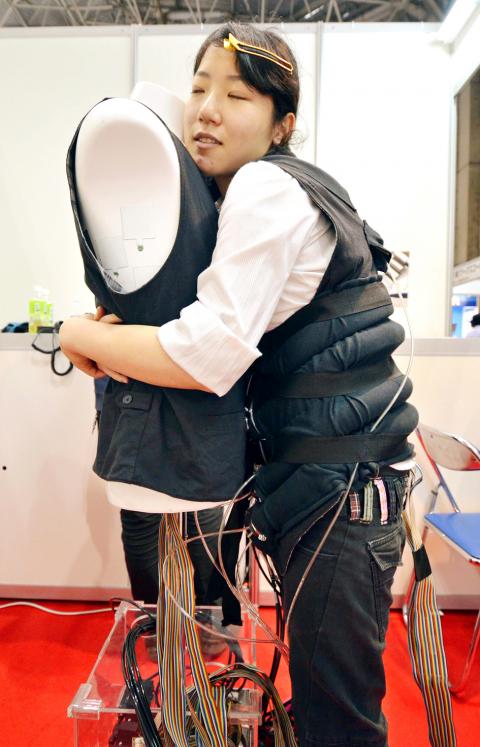
Photo: AFP
照片:法新社
“Many people initially feel surprised and uncomfortable about the unusual experience, but they gradually get accustomed to it until they feel comfortable and pleasant,” said research team member Nobuhiro Takahashi.
“Usually people feel nothing, or they even feel bad, when they hug strangers, but they experience feelings of satisfaction, love and comfort when they hug a boyfriend or girlfriend,” Takahashi said.
“We wondered how humans would feel if they could hug themselves.”
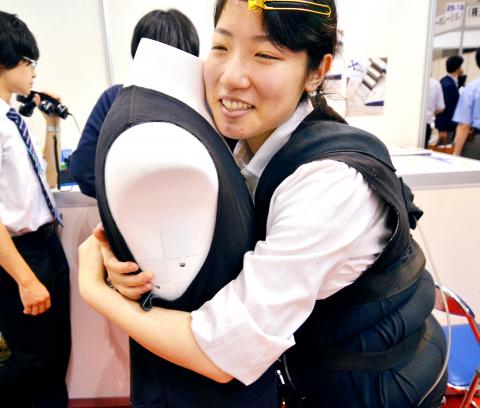
Photo: AFP
照片:法新社
He added that the device could be used in medical therapy and to give comfort to elderly people living alone. However, there were no immediate plans to put the gadget into commercial production.
The “Sense-Roid” was on display at the 3D & Virtual Reality Expo in Tokyo last week.
(AFP)
日本發明家突破科技尖端,已為獨身者推出「終極伴侶」—使用者可以擁抱這個配有線路的軀體形狀裝置,且它也會還以擁抱。
「Sense-Roid」看起來像個裁縫師的人體模型,皮膚以矽膠做成,並且夾克上佈滿壓力感測器。使用者穿上它,就能藉著空氣壓縮機的輔助,仿製擁抱的感覺。
東京電氣通信大學發明家表示,「觸覺夾克」內含人工肌肉與震動裝置,增進使用者與半人形機器人相擁的感覺。
研究團隊中的一名研究員高橋土井表示:「許多人剛開始對於這種不尋常的經驗,感到驚奇且不舒服。但他們逐漸習慣,且感到舒服與愉悅。」
高橋說,「人們擁抱陌生人時,通常沒有感覺,甚至會感到不適。但他們在與男女朋友相擁時,則感到滿足、愛意與舒適。」
他說,「我們想知道,若是擁抱自己會是怎樣的感覺。」
他補充說,這個裝置可以作醫療用途,並可給獨居老人慰藉。然而,目前並未立即打算將此裝置以商品販售。
「Sense-Roid」上週在東京3D與虛擬實境展上展示。
(法新社/翻譯:林亞蒂)

Many consumers are guilty of filling drawers or closets with old laptops, cellphones, fitness trackers and other electronic devices once they are no longer needed. It’s hard to know where to recycle such items, or it seems costly and inconvenient to do so. The world generates millions of tons of electronic waste — also called e-waste — each year. According to the UN’s most recent estimate, people worldwide produced 62 million metric tons of e-waste in 2022, and only about 22 percent of it was properly recycled. The US’ Environmental Protection Agency estimates that less than a quarter of e-waste is
You’re sitting in class when a classmate asks to borrow a pencil. It seems like a small favor, so you agree without hesitation. The following week, the same classmate asks to share your notes. Later, they request help with a group project. You agree each time — after all, you helped out the first time — but before you know it, it has become automatic. This scenario demonstrates the “foot-in-the-door technique,” a psychological concept that shows how agreeing to small, acceptable demands makes it easier to accept larger ones later on. The name for this strategy comes from door-to-door

A: The four-day Tomb Sweeping Day long weekend begins Friday and will run until Monday. Are you going to sweep your ancestors’ tombs? B: I did in advance last weekend, so I can go to Kaohsiung to see the musical “The Phantom of the Opera.” A: Wow, is “Phantom” touring Taiwan again? It debuted in 1986, so this year marks the 40th anniversary of the show. B: And it’s not just touring Kaohsiung starting March 31, but also Taipei starting April 21 and Taichung starting May 26. A: “Phantom” is one of the world’s Four Major Musicals. I’ve seen all of them, except “Les

Dos & Don’ts — 想想看,這句話英語該怎麼說? 1. 我們很早到達電影院。 ˇ We arrived at the theater very early. χ We arrived the theater very early. 註︰arrive 為不及物動詞,後面如果有受詞要用 at 或 in。例如:They arrived in Taipei yesterday.。一般大地方,如國家、省、大城市等前面用 in,凡小地方城鎮、學校等則用 at。 2. 開車半小時以後,我們到達了海灘。 ˇ After half an hour’s drive, we got to the beach. χ After half an hour’s drive, we got the beach. 註︰come, go, get(來、去、到達)某地時,在表示地點的名詞前面應該用 to,如 go to school, go to Taipei, come to Shanghai 等。如果這些動詞後面所跟的是 here, there, home 等副詞,則不用 to。 3. 明天我會回辦公室。 ˇ I will be back in the office tomorrow. χ I will be back to office tomorrow. 註︰to be back 一語裡的 back 是副詞,不是介詞,所以後面要用 at (the market) 或 in (the office)。 假如假期結束,要回學校上課了則可說: ? Kids will be back


 RSS
RSS