


New Zealand’s most famous sheep, a merino named Shrek that became a celebrity when he was found in 2004 after six years on the loose, has died at a South Island farm, his owner said last Tuesday.
Shrek went missing from his herd in 1998 and was assumed dead until he was found in a mountain cave six years later, sporting a massive fleece that made him appear three times his normal size.
The public in New Zealand, where sheep outnumber the 4.3 million human population almost 10 to 1, took the rambling ruminant to their hearts.
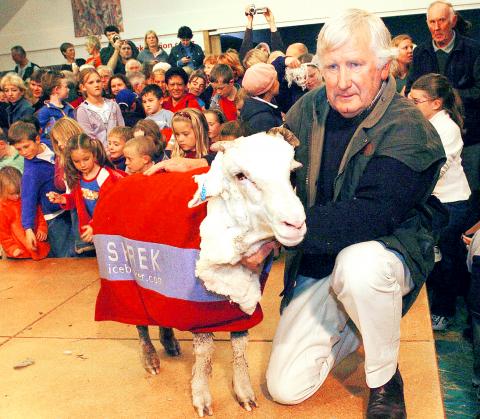
Photo: AFP
照片:法新社
Television stations carried live broadcasts when a shearer clipped his oversize fleece, which weighed in at almost 27kg, around six times the wool normally gathered from the average merino.
The sheep was flown to meet then prime minister Helen Clark at the national parliament in Wellington, became the subject of several children’s books and made regular charity appearances.
But owner John Perriam said Shrek had to be put down two weekends ago as, at 16 years old, his health was failing.

Photo: AFP
照片:法新社
“He was just an ordinary sheep, went AWOL and hid, and when he was found he became the darling of the nation,” Perriam told TVNZ.
“He had an unbelievable personality. He loved children and he was really good with the elderly in retirement homes.”
Josie Spillane from the charity Cure Kids said it was impossible to estimate how much money the sheep had raised for worthy causes.
“At the end of the day, it is the death of an iconic Kiwi. He just happens to be a sheep,” she told the Southland Times.
Reports said a memorial service would be held for Shrek last week at the Church of the Good Shepherd in Tekapo.
(AFP)
紐西蘭最負盛名的美利諾綿羊「史瑞克」,因牠「在逃」六年後,於二零零四年被發現,而成為一頭明星羊。不過,牠主人上週二說,「史瑞克」已在南島的一座農場與世長辭。
「史瑞克」一九九八年自羊群中失蹤,當時農場主人認定牠已死亡,卻在失蹤六年後於一座山的岩洞裡發現其蹤影,展露牠龐大毛茸茸的毛,讓牠外表看起來比實際還要大三倍。
紐西蘭羊群數量比該國四百三十萬人口還多,幾乎是十比一。紐西蘭人民對這些四處漫步的反芻動物疼愛有加。
電視台實況轉播一位剪羊毛的人剪下牠異常龐大綿密的羊毛,重量幾乎達二十七公斤,大約是一般美利諾綿羊能剪下毛量的六倍之多。
這頭羊專程搭機到威靈頓的國家議會晉見當時的總理海倫‧克拉克,成為許多童書的主角,並定期出現在慈善場合。
但主人約翰‧佩瑞安說,「史瑞克」在兩週前的周末就不得不被安樂死,因為十六歲的牠,健康已衰退。
佩瑞安告訴紐西蘭電視台說,「牠原來只是一頭無故離隊並躲起來的平凡綿羊,但當牠被發現時,牠即成為國內的寵兒。」
他說,「牠有種難以置信的性格。牠喜愛小孩,並與在養老院的長者相處融洽。」
紐西蘭「治癒孩童」(暫譯)慈善機構的喬西‧史碧蘭說,這頭綿羊為各種善行所募到的金額是難以估計的。
她告訴《南島日報》說,「總歸一句話,這是一位紐西蘭代表性「住民」的辭世。而這位住民,只不過湊巧是頭綿羊罷了。」
報導指出,「史瑞克」的追思儀式上週在蒂卡波的好牧羊人教堂舉行。
(法新社/翻譯:林亞蒂)

Many consumers are guilty of filling drawers or closets with old laptops, cellphones, fitness trackers and other electronic devices once they are no longer needed. It’s hard to know where to recycle such items, or it seems costly and inconvenient to do so. The world generates millions of tons of electronic waste — also called e-waste — each year. According to the UN’s most recent estimate, people worldwide produced 62 million metric tons of e-waste in 2022, and only about 22 percent of it was properly recycled. The US’ Environmental Protection Agency estimates that less than a quarter of e-waste is

You’re sitting in class when a classmate asks to borrow a pencil. It seems like a small favor, so you agree without hesitation. The following week, the same classmate asks to share your notes. Later, they request help with a group project. You agree each time — after all, you helped out the first time — but before you know it, it has become automatic. This scenario demonstrates the “foot-in-the-door technique,” a psychological concept that shows how agreeing to small, acceptable demands makes it easier to accept larger ones later on. The name for this strategy comes from door-to-door

A: The four-day Tomb Sweeping Day long weekend begins Friday and will run until Monday. Are you going to sweep your ancestors’ tombs? B: I did in advance last weekend, so I can go to Kaohsiung to see the musical “The Phantom of the Opera.” A: Wow, is “Phantom” touring Taiwan again? It debuted in 1986, so this year marks the 40th anniversary of the show. B: And it’s not just touring Kaohsiung starting March 31, but also Taipei starting April 21 and Taichung starting May 26. A: “Phantom” is one of the world’s Four Major Musicals. I’ve seen all of them, except “Les

Dos & Don’ts — 想想看,這句話英語該怎麼說? 1. 我們很早到達電影院。 ˇ We arrived at the theater very early. χ We arrived the theater very early. 註︰arrive 為不及物動詞,後面如果有受詞要用 at 或 in。例如:They arrived in Taipei yesterday.。一般大地方,如國家、省、大城市等前面用 in,凡小地方城鎮、學校等則用 at。 2. 開車半小時以後,我們到達了海灘。 ˇ After half an hour’s drive, we got to the beach. χ After half an hour’s drive, we got the beach. 註︰come, go, get(來、去、到達)某地時,在表示地點的名詞前面應該用 to,如 go to school, go to Taipei, come to Shanghai 等。如果這些動詞後面所跟的是 here, there, home 等副詞,則不用 to。 3. 明天我會回辦公室。 ˇ I will be back in the office tomorrow. χ I will be back to office tomorrow. 註︰to be back 一語裡的 back 是副詞,不是介詞,所以後面要用 at (the market) 或 in (the office)。 假如假期結束,要回學校上課了則可說: ? Kids will be back


 RSS
RSS