


Two-seater T-34 training aircraft no. 3413 of the Air Force Academy experienced an engine failure last Sunday during a routine training flight, and was forced to make an emergency landing on the riverbed in the Kaoping River. Flight instructor Colonel Lai Wen-yu and the pilot, Second Lieutenant Chen Hou-chun, landed safely. The Air Force authorities immediately sent an investigative taskforce to handle the issue, and ordered all aircraft of the same model to be grounded.
The Air Force Academy said the single-engine aircraft took off from the academy’s runway in Greater Kaohsiung’s Gangshan District at 11:01am. The engine failure occured at 11:16am. They originally decided to land on another airbase in Pingtung County, but since it was too far, Lai decided to crash-land on an open sand field in Kaoping River. They finally landed 27km east of the Air Force Academy airport at 11:26am. After landing the aircraft layed flat on its belly on the riverbed.
The Air Force Academy said that 23-year-old Chen, who sat in the front seat, has accumulated 86 hours in-flight and belongs to the class of 2010. 45-year-old Lai has 2,853 hours in-flight and belongs to the class of 1988.
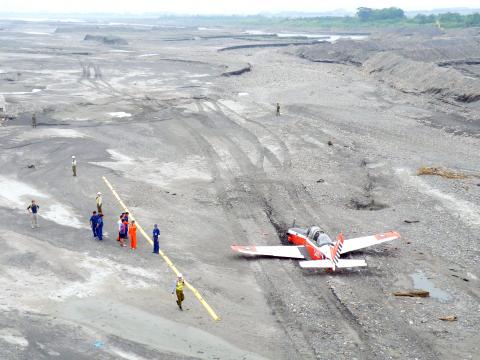
Photo: Luo Hsin-jen, Taipei Times
照片:自由時報記者羅欣貞
Last year two T-34 training aircraft crashed in the mountains of Namasia and Liukuei townships in Greater Kaohsiung, tragically causing four people to be killed in the line of duty. This most recent crash-landing of yet another T-34 training aircraft after experiencing engine failure leaves people once again questioning just how safe this model is.
(LIBERTY TIMES, TRANSLATED BY TAIJING WU)
空軍官校編號3413的T-34雙人座教練機,上週日上午在例行訓練飛行時空中熄火,被迫緊急降落高屏溪河床,機上上校教官賴紋由、少尉學官陳厚郡兩人平安。空軍立即派出調查小組處理,並要求同機型全部停飛。
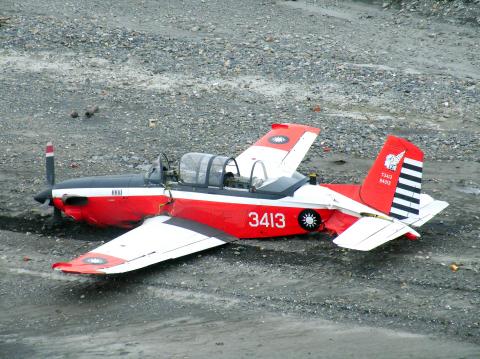
Photo: Luo Hsin-jen, Taipei Times
照片:自由時報記者羅欣貞
空軍官校表示,該單引擎教練機昨天上午十一點零一分,從高市岡山空軍官校機場起飛,十一點十六分發動機熄火,原本打算迫降屏東另一個基地,但距離太遠,賴紋由決定在空曠的高屏溪沙地迫降。於是十一點二十六分降落,約在空軍官校機場東方二十七點三三公里處。教練機迫降後平躺在河床上。
空軍官校指出,前座少尉學官陳厚郡,空軍官校九十九年班,二十三歲,累積飛行時數八十六小時。後座上校教官賴紋由,空軍官校七十七年班,四十五歲,飛行時數二八五三小時。
去年接連有兩架T-34教練機分別在高市那瑪夏、六龜山區失事墜毀,造成四人不幸殉職。又有這次T-34教練機因發動機熄火發生迫降,T-34的飛行安全問題,再度備受各界質疑。
(自由時報記者羅欣貞、蘇福男、游太郎)
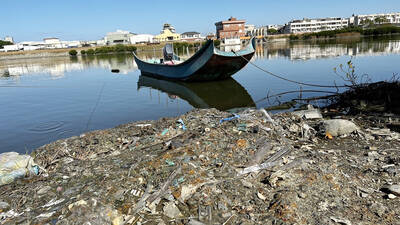
Many consumers are guilty of filling drawers or closets with old laptops, cellphones, fitness trackers and other electronic devices once they are no longer needed. It’s hard to know where to recycle such items, or it seems costly and inconvenient to do so. The world generates millions of tons of electronic waste — also called e-waste — each year. According to the UN’s most recent estimate, people worldwide produced 62 million metric tons of e-waste in 2022, and only about 22 percent of it was properly recycled. The US’ Environmental Protection Agency estimates that less than a quarter of e-waste is
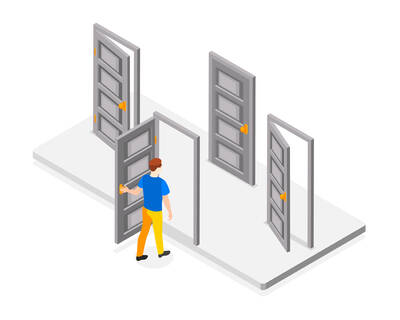
You’re sitting in class when a classmate asks to borrow a pencil. It seems like a small favor, so you agree without hesitation. The following week, the same classmate asks to share your notes. Later, they request help with a group project. You agree each time — after all, you helped out the first time — but before you know it, it has become automatic. This scenario demonstrates the “foot-in-the-door technique,” a psychological concept that shows how agreeing to small, acceptable demands makes it easier to accept larger ones later on. The name for this strategy comes from door-to-door

A: The four-day Tomb Sweeping Day long weekend begins Friday and will run until Monday. Are you going to sweep your ancestors’ tombs? B: I did in advance last weekend, so I can go to Kaohsiung to see the musical “The Phantom of the Opera.” A: Wow, is “Phantom” touring Taiwan again? It debuted in 1986, so this year marks the 40th anniversary of the show. B: And it’s not just touring Kaohsiung starting March 31, but also Taipei starting April 21 and Taichung starting May 26. A: “Phantom” is one of the world’s Four Major Musicals. I’ve seen all of them, except “Les

Dos & Don’ts — 想想看,這句話英語該怎麼說? 1. 我們很早到達電影院。 ˇ We arrived at the theater very early. χ We arrived the theater very early. 註︰arrive 為不及物動詞,後面如果有受詞要用 at 或 in。例如:They arrived in Taipei yesterday.。一般大地方,如國家、省、大城市等前面用 in,凡小地方城鎮、學校等則用 at。 2. 開車半小時以後,我們到達了海灘。 ˇ After half an hour’s drive, we got to the beach. χ After half an hour’s drive, we got the beach. 註︰come, go, get(來、去、到達)某地時,在表示地點的名詞前面應該用 to,如 go to school, go to Taipei, come to Shanghai 等。如果這些動詞後面所跟的是 here, there, home 等副詞,則不用 to。 3. 明天我會回辦公室。 ˇ I will be back in the office tomorrow. χ I will be back to office tomorrow. 註︰to be back 一語裡的 back 是副詞,不是介詞,所以後面要用 at (the market) 或 in (the office)。 假如假期結束,要回學校上課了則可說: ? Kids will be back


 RSS
RSS