


China has followed Japan’s lead in the capsule hotel market, amid an explosion of leisure travel in the world’s most populous country.
The first capsule hotel in Shanghai opened on Jan. 8, less than a month before the Spring Festival holiday, when hundreds of millions of people crisscross the country to celebrate Lunar New Year with their families.
The hotel has 68 cabinet-sized rooms imported from Japan — where capsule hotels originated — each equipped with a power point, clock, light, television and wireless Internet, the China Daily said.
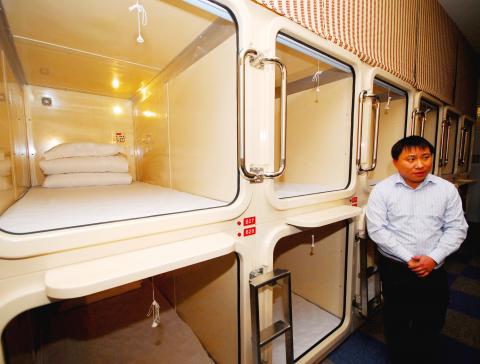
Photo: AFP 照片:法新社
The men-only hotel charges 68 yuan (US$10) for 10 hours or 88 yuan for 24 hours, the report said, citing Ta Zan, who owns the hotel and used to work for capsule hotels in Japan.
“This is a huge bargain compared with other budget hotels in Shanghai,” Ta, 33, was quoted as saying.
The report said the budget hotel near the Shanghai Railway Station was the first capsule hotel in China to be built to international standards.
No one at the hotel could immediately be contacted for comment.
China’s booming tourism industry was expected to host 2.1 billion domestic and international travelers last year, an increase of 12 percent over the previous year, according to previous industry estimates.
(AFP)
在休閒旅遊蓬勃發展之際,身為世界上人口最多的中國,也跟進日本首創的膠囊旅館市場。
為慶祝農曆新年,上億人與他們的家庭在中國境內四面八方旅行。在農曆新年的前一個月,上海第一家膠囊旅館在一月八日開幕。
《中國日報》報導,膠囊旅館源自日本,旅館有六十八間從日本進口約儲藏櫃大小的房間,每間房間都有電源插座、時鐘、燈、電視與無線上網等設備。
報導引用旅館負責人塔贊的話指出,限男賓入住的旅館十小時收費六十八元人民幣(約十美元),或二十四小時八十八元人民幣。塔贊曾經在日本的膠囊旅館工作。
報導引用三十三歲的塔贊的話指出,「相對於上海其他廉價旅館,這個價格更便宜。」
報導指出在上海火車站附近建造,並符合國際標準的膠囊旅館,是中國首見。
目前尚未有任何住客可供聯繫以了解他們的想法。
根據先前統計,中國蓬勃發展的觀光產業,去年帶來二十一億的國內外旅客,比前年成長了百分之十二。
(法新社/翻譯:林亞蒂)
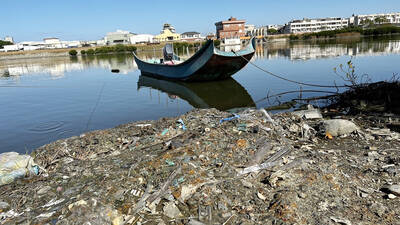
Many consumers are guilty of filling drawers or closets with old laptops, cellphones, fitness trackers and other electronic devices once they are no longer needed. It’s hard to know where to recycle such items, or it seems costly and inconvenient to do so. The world generates millions of tons of electronic waste — also called e-waste — each year. According to the UN’s most recent estimate, people worldwide produced 62 million metric tons of e-waste in 2022, and only about 22 percent of it was properly recycled. The US’ Environmental Protection Agency estimates that less than a quarter of e-waste is
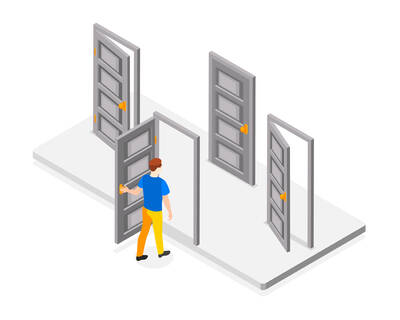
You’re sitting in class when a classmate asks to borrow a pencil. It seems like a small favor, so you agree without hesitation. The following week, the same classmate asks to share your notes. Later, they request help with a group project. You agree each time — after all, you helped out the first time — but before you know it, it has become automatic. This scenario demonstrates the “foot-in-the-door technique,” a psychological concept that shows how agreeing to small, acceptable demands makes it easier to accept larger ones later on. The name for this strategy comes from door-to-door

A: The four-day Tomb Sweeping Day long weekend begins Friday and will run until Monday. Are you going to sweep your ancestors’ tombs? B: I did in advance last weekend, so I can go to Kaohsiung to see the musical “The Phantom of the Opera.” A: Wow, is “Phantom” touring Taiwan again? It debuted in 1986, so this year marks the 40th anniversary of the show. B: And it’s not just touring Kaohsiung starting March 31, but also Taipei starting April 21 and Taichung starting May 26. A: “Phantom” is one of the world’s Four Major Musicals. I’ve seen all of them, except “Les

Dos & Don’ts — 想想看,這句話英語該怎麼說? 1. 我們很早到達電影院。 ˇ We arrived at the theater very early. χ We arrived the theater very early. 註︰arrive 為不及物動詞,後面如果有受詞要用 at 或 in。例如:They arrived in Taipei yesterday.。一般大地方,如國家、省、大城市等前面用 in,凡小地方城鎮、學校等則用 at。 2. 開車半小時以後,我們到達了海灘。 ˇ After half an hour’s drive, we got to the beach. χ After half an hour’s drive, we got the beach. 註︰come, go, get(來、去、到達)某地時,在表示地點的名詞前面應該用 to,如 go to school, go to Taipei, come to Shanghai 等。如果這些動詞後面所跟的是 here, there, home 等副詞,則不用 to。 3. 明天我會回辦公室。 ˇ I will be back in the office tomorrow. χ I will be back to office tomorrow. 註︰to be back 一語裡的 back 是副詞,不是介詞,所以後面要用 at (the market) 或 in (the office)。 假如假期結束,要回學校上課了則可說: ? Kids will be back


 RSS
RSS