


The tiny threads of the world’s oldest spider web have been found in a prehistoric piece of amber, a British scientist said last week.
Oxford University scientist Martin Brasier said the 140-million-year-old webbing proves that spiders have been catching their prey in webs since the dinosaur age. He also said the strands were linked to each other in the circular pattern familiar to gardeners the world over.
“You can match the details of the spider’s web with the spider’s web in my garden,” Brasier said.
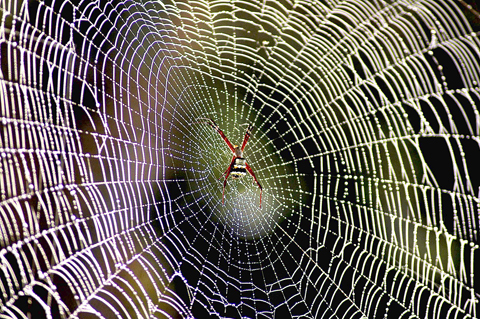
PHOTO: AP
The web was found in a small piece of amber picked up by an amateur fossil-hunter on England’s south coast about two years ago, Brasier said. A microscope showed tiny threads about 1mm long amid bits of burnt sap and fossilized vegetable matter.
Although it’s not a perfect web, it seems to confirm that spiders were building webs 145.5 to 65.5 million years ago when dinosaurs and small mammals shared the earth, said Simon Braddy, a University of Bristol scientist.
Spider experts believe that webs were developed even earlier, but the threads rarely leave any trace.
(AP)
一位英國科學家上週表示,在一塊史前琥珀中,發現了全世界最古老蜘蛛網的細微網絲。
牛津大學科學家馬丁.布雷西爾說,這個有一億四千萬年歷史的蜘蛛網證明了蜘蛛從恐龍時代就已經靠織網捕捉獵物了。他也說,這張細絲交織而成的圓形蛛網,對全世界的園丁來說並不陌生。
布雷西爾說:「這張蛛網和我家花園裡的蛛網沒什麼兩樣。」
布雷西爾說,某個化石愛好者約兩年前在英格蘭南部沿海發現一小塊琥珀,這張蛛網就保存在其中。透過顯微鏡觀察,可以在高溫灼燒過的汁液和植物化石間,看到約一公釐長的極小蛛絲。
布里斯托大學的科學家賽門.布萊迪說,雖然這蜘蛛網並不完整,但似乎可以確認在一億四千五百五十萬到六千五百五十萬年前,地球仍被恐龍和小型哺乳類動物統治的時期,蜘蛛就開始織網了。
蜘蛛專家相信,蜘蛛甚至更早以前就開始織網,只是幾乎沒有留下任何可以追溯的蛛絲馬跡。
(美聯社�翻譯:袁星塵)
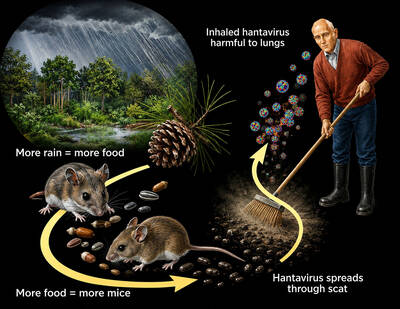
An outbreak aboard a cruise ship of a rare rodent-borne illness called hantavirus has left three passengers dead and sickened others, but global health officials say the risk to the general public remains low because the germ does not easily spread between people. “This is not the next COVID, but it is a serious infectious disease,” said Maria Van Kerkhove, director of epidemic and pandemic preparedness at the World Health Organization (WHO). “Most people will never be exposed to this.” The virus usually spreads when people inhale contaminated residue of rodent droppings. Hantaviruses have been around for centuries and are thought to

A: Apart from the Danjiang Bridge in New Taipei City, the MRT Sanying Line (Light Blue Line) will open in June. B: Is that the new line leading to Yingge District, the ceramic town? A: Yup, the line will connect the Yingge Ceramics Museum and the Old Streets in Sanxia and Yingge Districts. B: The eastward extension of the Tamsui-Xinyi Line (Red Line) that goes through Taipei’s Xinyi District will also open in June. A: Plus, Taoyuan’s Aerotropolis Line (Green Line) will partially open by the end of the year. In the future, it will connect the

1. 他病了三天。 ˇ He has been sick for three days. χ He has been sick since three days. 註︰這裡現在完成時態 have / has been 表示從過去某一時日到現在的一段時間存在的行為或狀態,與它連用的時間副詞應為 「for +若干時」,如 for a year, for three hours 等,意思是歷時多少。 2. 他自從星期三以來都很忙。 ˇ He has been busy since Wednesday. χ He has been busy from Wednesday. 註︰「自從……以來」,該用 since。說從某一天(某一時刻)到某一天(某一時刻)才用 from,如 from Monday till Friday。 3. 房間角落裡散放著一些零星物件。 ˇ There were some odds and ends lying in the corner of the room. χ There were some odds and ends lying at the corner of the room. 註︰「在房間角落裡」該用介詞 in。例如: He stood in the corner. There is a lamp in the corner of the room. at the corner 指房子外部的拐角。例如: A little boy

Have you ever wondered how people navigate the world when they can’t see a map? For individuals with visual impairments, conventional maps are nearly impossible to use. This is where tactile maps come in — essential tools that allow people to “see” the world through touch. A tactile map is specially designed with raised lines, textures, and symbols to represent geographical features such as roads, rivers, and buildings. Users explore it with their fingertips. However, these maps are not exclusively for people with visual disabilities. They serve as valuable multisensory learning tools that enhance spatial understanding for everyone, making


 RSS
RSS