

歡迎閱讀《週日科學版》!我們每週日都要為你介紹可以在家中進行的有趣科學實驗。你可以在《科學日誌》中 記錄自己做了哪些活動,這樣就可以將所學的紀錄下來,比較這些結果,也許還可以利用它們來設計新的實驗!先看一下《科學日誌》的點子再開始吧。展開實驗之前,記得要獲得大人許可喔!
Have you ever seen a lava lamp? This week we are going to have our very own funky homemade lava fun! Make sure you wear old clothes and work in the kitchen, as this experiment can get very messy!
What you will need:
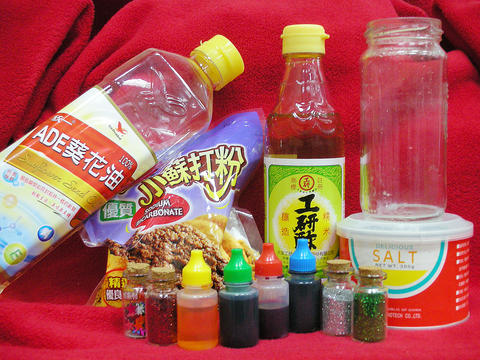
PHOTO: CATHERINE THOMAS, TAIPEI TIMES
a glass jar
salt
vinegar
water
food coloring
vegetable or baby oil
sodium bicarbonate
a bright lamp or a torch
glitter (optional)
★ Fill the jar a quarter full of water.
★ Now add two quarters of vegetable oil. You should still have a quarter of the space left at the top of the jar. Do the oil and the water mix?
★ Add several drops of food coloring. Watch what happens. Where do the drops go? Do they mix with the other fluids?
★ Drop in a tablespoon of bicarbonate of soda. Where does it go and how does it act?
★ Add a tablespoon of vinegar. Where does the vinegar go?
★ Wait for everything to settle.
★ Now add a large pinch of salt. Watch what happens.
★ Wait for the mixture to settle. Now add some more salt.
★ Try shining the lamp or torch behind the lamp.
★ If you like you can add some glitter now. Where does the glitter sit in the mix?
(CATHERINE THOMAS, STAFF WRITER)
你看過「熔岩燈」嗎?本週我們要來體驗自製時尚熔岩燈的樂趣!務必穿舊衣服在廚房進行這個實驗,因為過程會很髒亂唷!
所需材料︰
一個玻璃瓶
鹽
醋
水
食用色素
沙拉油或嬰兒油
碳酸氫鈉(小蘇打)
一盞亮燈或是一個手電筒
亮粉(非必要)
★ 在玻璃瓶內裝入四分之一滿的水。
★ 接著再加入四分之二的沙拉油,此時你的瓶子應該還剩四分之一的空間;油和水會混在一起嗎?
★ 滴入幾滴食用色素,仔細觀察有什麼變化產生,色素滴入後會跑到哪裡?會和瓶中其他液體混合嗎?
★ 加入一大湯匙小蘇打粉,小蘇打粉會在瓶中哪處?又會起什麼作用?
★ 再加入一大湯匙的醋,醋會流到何處?
★ 靜置,等所有的東西都沉澱下來。
★ 加入一大撮鹽,觀察其變化。
★ 等瓶中混合液體靜止後,再加入一些鹽。
★ 試著用燈或手電筒從後方照射玻璃瓶。
★ 如果你有準備亮粉,現在可以把它們加進去,亮粉會跑到哪裡去呢?(翻譯:袁星塵)

“OK.” You say it dozens of times a day without giving it a second thought. It slips effortlessly into text messages, office meetings and casual chats alike. Yet behind this surprisingly simple expression lies one of the most entertaining origin stories in the history of language. The story begins in 1839, when a craze for creative abbreviations had swept through New England’s educated classes. Editors at the Boston Morning Post led the trend, though nearly all their inventions faded within months. One, however, proved far more enduring. On March 23, editor Charles Gordon Greene coined “OK” as a humorous abbreviation for

A: Although we can’t fly to Paris for singer Celine Dion’s comeback shows, we can still enjoy K-pop girl group IVE’s concerts in Taipei, or the hit “Tung! Take Me Away” concert in Taitung this weekend. B: Singer Post Malone’s show in Kaohsiung, and even the widely discussed “Beheading Heartbreaker Chen Shimei Arts Festival” in Tainan are also coming next weekend. A: Don’t forget that hit South Korean “Waterbomb Music Festival” is bombing Kaohsiung. B: I heard that Waterbomb Kaohsiung not only features top artists from Taiwan and South Korea, but also activities like the Blue Team and Yellow

A: The legendary “Queen of Country” and original singer of the megahit “I Will Always Love You” Dolly Parton passed away recently. It’s truly heartbreaking. B: And US pop singer Ariana Grande recently announced that she’d withdraw from next year’s London musical and take a “step back” from the public eye temporarily, triggering fans’ concern for her health. A: Meanwhile, Canadian pop diva Celine Dion is finally making a grand comeback. B: That’s so amazing. Celine took a break after developing a rare neurological disorder, “stiff person syndrome,” in 2022. A: Now, she’s returning to

Why do people sit with their legs crossed? For many, crossing one leg over the other at the knee is comfortable and habitual. Over the years, people have wondered whether the position is bad for their health. Some believe it may __1__ high blood pressure or circulation problems. Others are concerned that it may affect posture, particularly in the spine and pelvis. Research suggests that although blood pressure may rise slightly when the legs are crossed, it returns to __2__ soon after the position is changed. Crossing the legs tightly may temporarily reduce blood flow in the raised leg, but the


 RSS
RSS