


Paleontologists from Argentina and Brazil earlier this month unveiled a new giant dinosaur species that lived 88 million years ago in the Patagonia region of Argentina, where they found its fossils.
"It is one of the three largest dinosaur fossils ever discovered in the world and the most complete because we found 70 percent of its skeleton," said Argentina's Comahue National University Paleontology Center Director Jorge Calvo.
Belonging to the Titanosaur family, the newly discovered dinosaur measured 32 - 34m in length and lived exclusively in Patagonia.
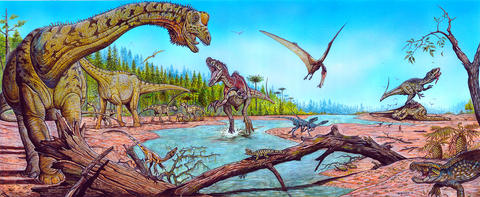
PHOTO: AP
It has been named Futalognkosaurus dukei, with the first name from the Mapuche language meaning "giant chief of dinosaurs," and the second in honor of the Duke Energy Argentina company that largely financed the digs.
The new dinosaur was found at the start of the excavation, in February 2000, alongside other animal and plant fossils in a 400m2 area.
The fossils allowed experts to "reconstruct an ecosystem of the upper Cretaceous period (from 97 to 66 million years ago) with unprecedented exactitude," Calvo said.
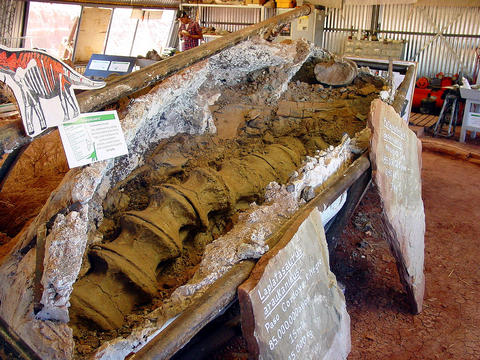
PHOTO: AP
"The fact that most of the fossils were found in a limited area under a 0.5m rock layer makes us deduce that all those animals lived in the same epoch," he added.
The paleontologists also found fossils of fish, shellfish, at least two types of crocodile-like creatures and several dinosaurs, including the flying Pterosaur and carnivores like Megaraptor, with its 40cm claws.
They also found plant fossils of leaves showing the dominance of flowering plants at the time. (AFP)
阿根廷與巴西的古生物學家在本月初公佈了一個新發現的大型恐龍物種。這種恐龍八千八百萬年前生活在阿根廷的巴塔哥尼亞地區,這也是古生物學家發現恐龍化石的地方。
「這是現今全世界發現最大的三具恐龍化石之一,也是歷來保存得最完善的一具,因為我們找到牠百分之七十的骨骸,」阿根廷科瑪烏埃大學古生物中心主任喬治.卡佛說。
和雷龍同科的這種新發現的恐龍有三十二到三十四公尺長,僅出沒在巴塔哥尼亞地區。
這種恐龍被命名為「Futalognkosaurus dukei」,這是當地馬普切語。Futalognkosaurus的意思是「恐龍的大頭目」,dukei則是為了向大量資助挖掘工作經費的阿根廷杜克能源公司表達謝意。
這個新種恐龍化石是在二OOO年二月份開挖初期出土的。在此四百平方公尺的範圍附近,也挖掘到了其他動植物的化石。
這次出土的化石讓專家們可以「空前精準的重建白堊紀後期(九千七百萬到六千六百萬年前)的生態系統」,卡佛說。
「事實上,這次出土的化石絕大多數是在一個半公尺厚的岩石層下方的特定範圍內發現的,因此我們推論這些生物都是生存在同一個時期,」卡佛接著說明。
這些古生物學家們也發現了魚類化石、貝類化石、兩種以上類似鱷魚的生物化石,和其他好幾種恐龍化石,包括會飛的翼龍和肉食性恐龍如:暴龍,還有其四十公分長的爪子。
他們也挖掘到植物葉片的化石,顯示開花植物當時已經出現。 (法新社/翻譯:袁星塵)
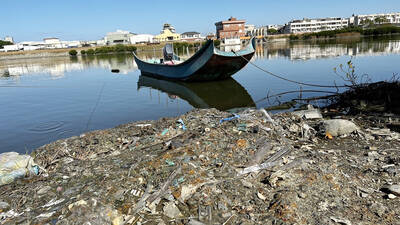
Many consumers are guilty of filling drawers or closets with old laptops, cellphones, fitness trackers and other electronic devices once they are no longer needed. It’s hard to know where to recycle such items, or it seems costly and inconvenient to do so. The world generates millions of tons of electronic waste — also called e-waste — each year. According to the UN’s most recent estimate, people worldwide produced 62 million metric tons of e-waste in 2022, and only about 22 percent of it was properly recycled. The US’ Environmental Protection Agency estimates that less than a quarter of e-waste is
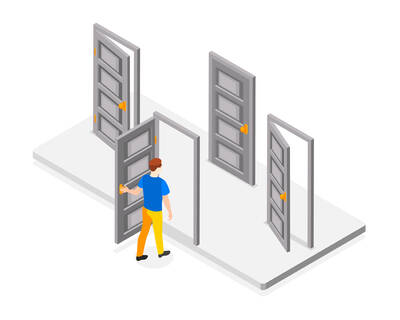
You’re sitting in class when a classmate asks to borrow a pencil. It seems like a small favor, so you agree without hesitation. The following week, the same classmate asks to share your notes. Later, they request help with a group project. You agree each time — after all, you helped out the first time — but before you know it, it has become automatic. This scenario demonstrates the “foot-in-the-door technique,” a psychological concept that shows how agreeing to small, acceptable demands makes it easier to accept larger ones later on. The name for this strategy comes from door-to-door

A: The four-day Tomb Sweeping Day long weekend begins Friday and will run until Monday. Are you going to sweep your ancestors’ tombs? B: I did in advance last weekend, so I can go to Kaohsiung to see the musical “The Phantom of the Opera.” A: Wow, is “Phantom” touring Taiwan again? It debuted in 1986, so this year marks the 40th anniversary of the show. B: And it’s not just touring Kaohsiung starting March 31, but also Taipei starting April 21 and Taichung starting May 26. A: “Phantom” is one of the world’s Four Major Musicals. I’ve seen all of them, except “Les

Dos & Don’ts — 想想看,這句話英語該怎麼說? 1. 我們很早到達電影院。 ˇ We arrived at the theater very early. χ We arrived the theater very early. 註︰arrive 為不及物動詞,後面如果有受詞要用 at 或 in。例如:They arrived in Taipei yesterday.。一般大地方,如國家、省、大城市等前面用 in,凡小地方城鎮、學校等則用 at。 2. 開車半小時以後,我們到達了海灘。 ˇ After half an hour’s drive, we got to the beach. χ After half an hour’s drive, we got the beach. 註︰come, go, get(來、去、到達)某地時,在表示地點的名詞前面應該用 to,如 go to school, go to Taipei, come to Shanghai 等。如果這些動詞後面所跟的是 here, there, home 等副詞,則不用 to。 3. 明天我會回辦公室。 ˇ I will be back in the office tomorrow. χ I will be back to office tomorrow. 註︰to be back 一語裡的 back 是副詞,不是介詞,所以後面要用 at (the market) 或 in (the office)。 假如假期結束,要回學校上課了則可說: ? Kids will be back


 RSS
RSS