


In late September, Indian Viswanathan Anand, 38, won four games and drew the rest to win the World Chess Championship held in Mexico City.
Anand, who was born in the southern Indian city of Madras, combines a calm, modest manner with lightning brilliance on the chessboard. He learned the game at age six from his mother, Susheela, whom he had an emotional chat with after his victory.
"With a choking voice, Anand said 'amma (mom), I have won. I am the world champion for the second time,'" Susheela said.
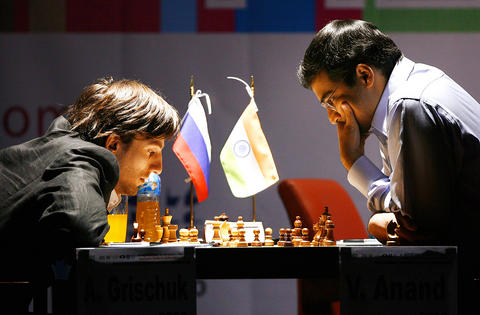
PHOTO: AFP
His wife, Aruna Anand, likens his mind to a computer. In addition to his talent, she said Anand puts in long hours every day refining his game.
Anand has collected a number of nicknames over the years. When he beat Anatoly Karpov in 2000, he was dubbed the "Indian Meteor" for the speed of his rise in the chess world.
His wife is amused by another nickname for her spouse, the "Tiger of Madras."
"In Madras, there are no tigers. There are perhaps two in the zoo," said Aruna, who accompanies her husband to all his tournaments.
But she said the nickname captures how Anand appears to be taking it easy until he "seizes the advantage and is transformed into a tiger."
The stocky, bespectacled Anand, with a round, smiling face, divides his time between Madras, the United States and Madrid -- his base for tournaments in Europe. But it's in India where he's treated as a hero.
"Given that chess is officially played in 161 countries, he is our only global icon," said the Hindustan Times newspaper. (Staff writer, with AFP)
上個月底,三十八歲的印度西洋棋手維斯瓦納坦.阿南德以贏四局、其他皆為平手的成績,拿下在墨西哥市舉行的全球西洋棋錦標賽的冠軍。
阿南德生於印度南部的馬德拉斯市。他兼具穩重與謙遜的特質,並且在西洋棋上表現亮眼。他六歲時就跟母親蘇席拉學下棋。在贏得勝利後,阿南德與母親有一段感性的對話。
蘇席拉說:「阿南德哽咽地說:『媽媽,我贏了。我二度成為世界冠軍。』」
阿南德的妻子阿汝娜.阿南德把阿南德的頭腦比喻為一台電腦。除了他的天賦,她說阿南德每天都花長時間致力精進棋藝。
阿南德這些年來得到了許多的小名。他二○○○年擊敗對手安南脫里.卡波夫時,就因為在世界西洋棋壇竄升的速度而被冠上「印度流星」的稱號。
他的太太聽到他被稱為「馬德拉斯之虎」笑得很開心。
伴隨丈夫四處比賽的阿汝娜說:「馬德拉斯沒有老虎。或許動物園裡有兩隻。」
不過,她說這個暱稱貼切描述阿南德下棋總是一派輕鬆,可是「一旦掌握優勢,就變成一頭出閘猛虎」的情況。
身材健壯還帶著付眼鏡的阿南德有一張圓圓的笑臉,他把時間都花在馬德拉斯、美國與馬德里,這些地方皆是他在歐洲錦標賽的據點。不過,他在印度被視為一位英雄。
《印度斯坦時報》指出:「因為西洋棋是一百六十一個國家公認的正式運動,他是我們唯一的全球人物。」
(法新社╱翻譯:艾利斯)
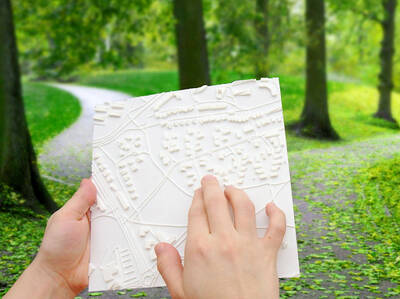
Have you ever wondered how people navigate the world when they can’t see a map? For individuals with visual impairments, conventional maps are nearly impossible to use. This is where tactile maps come in — essential tools that allow people to “see” the world through touch. A tactile map is specially designed with raised lines, textures, and symbols to represent geographical features such as roads, rivers, and buildings. Users explore it with their fingertips. However, these maps are not exclusively for people with visual disabilities. They serve as valuable multisensory learning tools that enhance spatial understanding for everyone, making

The debate surrounding Taipower’s recent corporate identity reboot has gone well beyond the design community. The controversy began after Taipower replaced the familiar “Taiwan Power Company” wording — widely regarded as the calligraphy of Yu You-ren (1879-1964), former Control Yuan president and master calligrapher — with a modern logotype by designer Aaron Nieh’s team, Aaron Nieh Workshop. Taipower said the change was not a wholesale replacement of old signage, but an “optimization of its identity system,” aimed at meeting the needs of digital media, electronic bills, apps, social media graphics and various small-format applications. Existing physical markings, such as building

Since 2005, the third Monday in January has come to be known as “Blue Monday.” In other words, that day is believed to be the most depressing day of the year. This concept seems logical at first. After all, Monday marks the start of the school or workweek after two days of rest and fun. Also, blue is a color that is often associated with sadness. Furthermore, in many parts of the world, January is a time when the weather is cold, rainy, and gloomy. But is there any scientific proof that this January day is truly sadder than any of

Continued from yesterday(延續自昨日) https://www.taipeitimes.com/News/lang For the most part, the idea of “Blue Monday” has been rejected as a myth. Some mental health experts also say there is a danger in labeling a certain day as the most depressing time of the entire year. Some argue that if people expect to feel sadder on the third Monday in January, this belief alone may increase their anxiety. One group that is worried about the negative effect of believing in Blue Monday is Samaritans. A mental health charity based in the UK, Samaritans is working to turn Blue Monday into “Brew Monday.” In this


 RSS
RSS