


The skeleton of a Siberian mammoth dating back some 15,000 years and a meteorite from Russia go on auction in Paris this month in the first such sale of curiosities from paleontology, Christie's auction house said.
The skeletons of a woolly rhinoceros and of a cave bear along with rare bird and fish fossils are also to go under the hammer during the April 16 auction in Paris.
The complete skeleton of the mammoth, with its impressive tusks, stands at 3.8m and measures over 4.8m in length. Its estimated value is between 150,000 euros (NT$6.6 million) and 180,000 euros (NT$7.9 million).
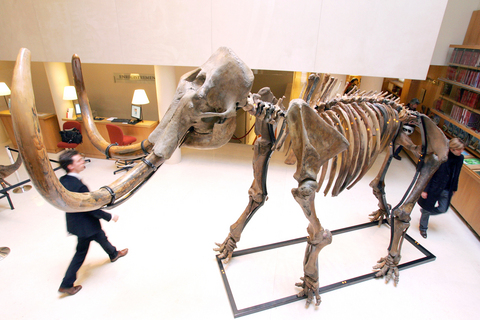
PHOTO: AFP
The skeleton of a woolly rhinoceros, some 10,000 years old, is expected to fetch up to 65,000 euros (NT$2.8 million) while that of a bear is valued at between 20,000 and 25,000 euros (NT$882,424-NT$1 million).
A 150kg meteorite from Russia containing semi-precious stones and showing rare marks of its entry into the atmosphere is up for grabs, valued at between 90,000 and 120,000 euros (NT$3.9 million-NT$5.2 million).
Also from Russia at the Christie's auction will be a private collection of trilobites, or fossils of arthropods, dating from 400 million years ago.
The fossil of an angel fish dating back 50 million years and one of only five known examples of the species in the world will be offered for sale for some 50,000 to 80,000 euros (NT$2.2 million-NT$3.5 million).
It is the last such fossil in private hands, from the collection of veterinarian Jean Bouhanna.
A rare bezoar, a pearl that forms in the stomach of certain herbivores, valued at up to 25,000 euros (NT$1.1 million) will also go under the hammer. (AFP)
佳士得拍賣公司指出,一萬五千年前西伯利亞毛象的骨骸與俄羅斯一顆隕石,本月將在巴黎首場古生物奇珍異品拍賣會中拍賣。
一頭毛犀牛與洞熊的骨骸、稀有鳥類與魚類化石,也會在巴黎這場四月十六日的拍賣會上供人競標。
包括驚人長牙在內的完整毛象骨骸長達三點八公尺,高逾四點八公尺,估價約在十五萬歐元(新台幣六百六十萬元)至十八萬歐元(新台幣七百九十萬元)之間。
一萬年前的毛犀牛骨骸預計可賣到六萬五千歐元(新台幣兩百八十萬元),而洞熊則約值兩萬至兩萬五千歐元(新台幣八十八萬兩千四百二十四元至一百萬元)。
蘊含半寶石、顯示進入大氣層珍貴痕跡的俄羅斯一百五十公斤重的隕石也待價而沽,售價約在九萬至十二萬歐元(新台幣三百九十萬元至五百二十萬元)之間。
在這場佳士得拍賣會上,也有同樣來自俄羅斯私人收藏的四億年前節肢動物化石「三葉蟲」。
五千萬年前的神仙魚化石是世上五個已知的僅有標本之一,將以五萬至八萬歐元(新台幣兩百二十萬至三百五十萬元)的標價拍賣。
這是這類化石的最後私人收藏品,來自獸醫師尚.布哈拿的收藏。
稀有的毛糞石,也就是某些草食動物胃裡形成的寶石,身價達兩萬五千歐元(新台幣一百一十萬元),也會一起拍賣。
(法新社/翻譯:賴美君)

The debate surrounding Taipower’s recent corporate identity reboot has gone well beyond the design community. The controversy began after Taipower replaced the familiar “Taiwan Power Company” wording — widely regarded as the calligraphy of Yu You-ren (1879-1964), former Control Yuan president and master calligrapher — with a modern logotype by designer Aaron Nieh’s team, Aaron Nieh Workshop. Taipower said the change was not a wholesale replacement of old signage, but an “optimization of its identity system,” aimed at meeting the needs of digital media, electronic bills, apps, social media graphics and various small-format applications. Existing physical markings, such as building

Since 2005, the third Monday in January has come to be known as “Blue Monday.” In other words, that day is believed to be the most depressing day of the year. This concept seems logical at first. After all, Monday marks the start of the school or workweek after two days of rest and fun. Also, blue is a color that is often associated with sadness. Furthermore, in many parts of the world, January is a time when the weather is cold, rainy, and gloomy. But is there any scientific proof that this January day is truly sadder than any of

Continued from yesterday(延續自昨日) https://www.taipeitimes.com/News/lang For the most part, the idea of “Blue Monday” has been rejected as a myth. Some mental health experts also say there is a danger in labeling a certain day as the most depressing time of the entire year. Some argue that if people expect to feel sadder on the third Monday in January, this belief alone may increase their anxiety. One group that is worried about the negative effect of believing in Blue Monday is Samaritans. A mental health charity based in the UK, Samaritans is working to turn Blue Monday into “Brew Monday.” In this

A: In early May, there were concerts by Icyball, Chyi Yu, Korea’s EXO and Japan’s Anisama, but I missed them all. What a shame. B: That’s OK. There are shows coming up by various artists, including Power Station, Accusefive, Japanese singer Mika Nakashima, Chinese-Icelandic jazzer Laufey, and even Singaporean diva Stefanie Sun. A: After a 12-year hiatus, Stefanie is finally returning to Taipei again. B: In late May, there will be more shows by Crowd Lu, WeiBird, Korea’s Donghae, 2AM, EXID, and Thailand’s BUS. A: The Thai boyband is so popular. It looks like “T-pop” is catching up with J-pop


 RSS
RSS