


South African moviemakers hope that skeptical private investors will finally show some confidence in the cash-strapped local industry after a South African movie won an Oscar for best foreign film, as well as five other international awards.
The Zulu-language film Tsotsi, which means "thug," tells the story of a gangster who finds a baby in a stolen car.
Yesterday, another Zulu film about an HIV-positive woman, was the first South African film to be nominated for an Oscar last year.

PHOTO: AFP
Tsotsi cost US$3 million (NT$97.6 million) to make and was mainly funded by the UK Film and TV Production Company. Part of the cost was paid by the National Video and Film Foundation of South Africa, which initially turned down director Gavin Hood's loan application because of fear the movie would be too violent.
But it broke records for ticket sales in its first weekend, earning 250 percent more than Yesterday did in its first weekend. The Oscar winner is certain to make a profit, which is unusual in the South African film industry.
People in the South African film industry say there are no companies in South Africa that provide filmmakers with money to make their movies. Most South African movies get their funding from groups dedicated to arts and film outside the country.
"In general, local movies don't make a profit," said Lindi Ndebele, a director at the arts and culture ministry. "There isn't enough money ... to make the films." "Hopefully, Tsotsi has touched a nerve with private investors," she added. (AFP)
南非電影製片商希望裹足不前的民間投資者,在南非電影榮獲奧斯卡最佳外語片和五項其他國際大獎之後,能對資金匱乏的本土電影產生些許信心。
以祖魯語拍攝的「Tsotsi」(暴徒)是描述一名搶匪在贓車裡發現一名嬰孩的故事。
另外一部有關一名愛滋女病患的祖魯語片 -- 「昨日」是首部榮獲去年奧斯卡提名的南非片。
耗資三百萬美元(新台幣九千七百六十萬元)的「Tsotsi」,主要由英國影視公司出資拍攝,部份費用由南非全國影視基金會負擔。南非全國影視基金會原本因擔心電影過於暴力而拒絕導演胡德的貸款申請。
但是「Tsotsi」首週便以高出二點五倍的票房打破「昨日」的首週票房紀錄。這部奧斯卡得獎影片肯定是棵搖錢樹,是南非電影界的異數。
南非電影界人士指出,南非沒有企業願意提供製片者拍攝資金,多數南非電影必須向海外影藝團體籌資。
藝術文化部主任琳蒂.娜貝勒說:「一般說來,本土電影是不賺錢的,也沒有足夠的資金拍片。希望『Tsotsi』能讓民間投資者多多關注本土電影。」 (法新社)
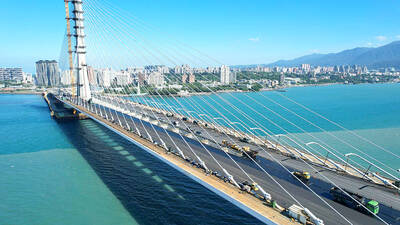
A: The Danjiang Bridge in New Taipei City is to open on May 12, and the MRT Sanying Line (Light Blue Line) will also open in June. Isn’t that great? B: Is that the bridge connecting the city’s Tamsui and Bali Districts? What’s so special about this new landmark spanning the Tamsui River? A: The Danjiang Bridge will become the world’s longest-span single-mast asymmetric cable-stayed bridge — with a total river-crossing section of 920 meters and main span of 450 meters. B: The news says there are sidewalks and bike lanes on both sides. Watching the sunset from the
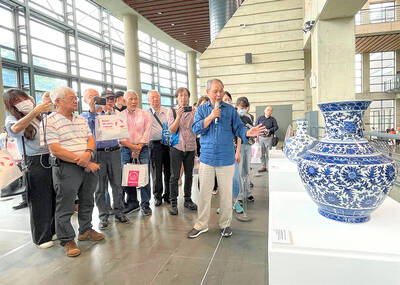
A: Apart from the Danjiang Bridge in New Taipei City, the MRT Sanying Line (Light Blue Line) will open in June. B: Is that the new line leading to Yingge District, the ceramic town? A: Yup, the line will connect the Yingge Ceramics Museum and the Old Streets in Sanxia and Yingge Districts. B: The eastward extension of the Tamsui-Xinyi Line (Red Line) that goes through Taipei’s Xinyi District will also open in June. A: Plus, Taoyuan’s Aerotropolis Line (Green Line) will partially open by the end of the year. In the future, it will connect the

In the dense forests of Tanzania, a young researcher sat quietly among the trees, her gaze fixed on a troop of chimpanzees. It was 1960, and Jane Goodall, armed with nothing but a notebook and endless curiosity, was about to change science forever. Inspired by childhood stories like the Dr. Dolittle series, she had dreamed of Africa — and now, thanks to the encouragement of anthropologist Louis Leakey, she was there, face-to-face with the wild. What Jane discovered shocked the world. Chimpanzees weren’t mere creatures of instinct; they were individuals with emotions, families, and even the capacity for tool
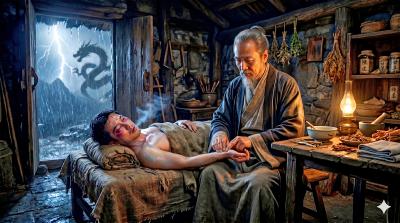
★ Bilingual Story is a fictionalized account. 雙語故事部分內容純屬虛構。 Rain hammered the roof in hard, uneven bursts. “Hold him still!” Baosheng pressed one hand against the stranger’s brow as the man twisted on the wooden bed. His left eye was swollen shut. The right one burned red like a coal. “It feels like fire,” the man gasped. “Like something is clawing inside.” Thunder rolled across the mountain. Baosheng leaned closer. The man’s skin was cold, but heat rose from his face. A strange smell hung in the air. He began the four methods of diagnosis: looking, listening/smelling,


 RSS
RSS